the rack

Whatever Wednesday: My Mom’s New Rack

On Monday, my mother was practically bursting with excitement. The following is how the conversation proceeded. Sort of. Mostly. Mmmk, I’m getting older, my mind is slipping, and I have a twisted sense of humour. If you’re drinking something, put it down. No seriously. Put.IT.DOWN. And swallow that sip still in your mouth.

“Guess what I ordered?”

“A Capuchin monkey that’ll scratch your head while you play Angry Birds on your iPad?”

“No, silly! Something with much more oomph than a Capuchin monkey. Jeez.”

“What, then? J-Lo’s ass?”

“Lauren!”

“Well… you gotta admit, J-Lo’s ass has FAR more oomph than a Capuchin monkey. Although a Capuchin monkey would fit much better into a Fiat than J-Lo’s ass – I’ve digressed. What’d ya get?”

“It’s a curvy, sleek, stylish, auto-draining stainless steel dish rack. It sits up on four rubber nubs, and has curved stainless steel prongs, and the angle is such that it doesn’t collect water but instead keeps the water running straight into the sink!”

“So…what you’re saying here is that you got a busty new rack for your dishes?”

“Yes, and it’s simply fantastic. It’ll gleam in the soft light of the kitchen lights as the dishes drip dry rested atop silver rods.”

“Sounds like you’ll have some extremely happy dishes soon, Mom.”

“Oh, I will. I will.”

“I’m gonna leave you and your new rack all alone then, mmmmk? My Capuchin monkey is signalling to me that lunch is ready. And when the Capuchin says jump, by GOD, you jump. Because it just gets ugly when they fling poo.”


Breastfeeding and Postpartum Depression – Again

A recent research article, posted by The Postpartum Stress Center on Facebook, looks into the relationship between postpartum depression and breastfeeding.

The findings? Women who breastfeed are less likely to experience postpartum depression.

Here’s what The Postpartum Stress Center had to say about the study on Facebook:

“Uh-oh. Here we go… research shows reciprocal relationship between PPD and breastfeeding. Women who breastfeed were more likely to have PPD and women with PPD were less likely to breastfeed. Now, that being said – this is NOT what I see in my clinical practice. In fact, we see more evidence of women feeling BETTER when they stop breastfeeding. For a number of reasons that vary from woman to woman. This is why it continues to be important that we read the studies, but not jump to conclusions that may not relate to each individual woman.”

Here’s my reaction:

Caveats:

  • Small study – only 137 women
  • Mentions employed mothers who were formula feeding but the abstract makes no mention of employed breastfeeding/pumping mothers.

As a blogger focused primarily on Postpartum Mood Disorders and emotional health for moms, this study raises my hackles.

I’ve blogged about the whole breastfeeding v. not-breastfeeding thing during a Postpartum Mood & Anxiety Disorder thing before – several times- and each time, I conclude the same thing.

YOU have to do what is BEST FOR YOU. It doesn’t matter what anyone else says, it doesn’t matter what the research says, it doesn’t matter what is best for baby food-wise. What matters here, the most, is that you are addressing your needs, healing, and doing so in a manner which alleviates the most stress and anxiety for you.

Your motherhood journey is just that – yours.

The only thing which matters is that you, your baby, and your family, are thriving. If your path includes breastfeeding, great. If it doesn’t, that’s great too. When you struggle with a mental illness, your emotional health absolutely comes before everything else –at least in my book it does.

If you wanted to breastfeed but find it’s too stressful because of your Postpartum Mood & Anxiety Disorder, talk it over with your care-provider. Let them help you make your decision but don’t let them pressure you into continuing simply because the research claims breastfeeding is “protective” against PPD. Guess what? You’re already struggling. So unless breastfeeding is the ONE thing to which you’re clinging and the ONE thing which helps you heal, helps you feel like you matter, it’s OKAY to stop.

It’s okay to use formula.

Frankly, it’s sad we have to give ourselves permission not to breastfeed in this day and age. Moms use formula for a variety of reasons –as long as baby is growing, healthy, happy, and loved, it shouldn’t matter what form of nutrition is used.

So go. Do what feels best for you, for your family, and for your sanity –and don’t let anyone judge you for it.

My Postpartum Voice of the Week badge

Postpartum Voice of the Week: @jenrenpody’s Horror Show in My Mind

I have a special place in my heart for women who struggle with Intrusive Thoughts. Don’t get me wrong, I have a place in my heart for all women who struggle with Postpartum Mood & Anxiety Disorders, but Intrusive Thoughts plagued me during both of my episodes. They are insidious tenacious monsters hell-bent on tearing your mind and soul apart.

When I come across a post mentioning Intrusive Thoughts, I read it with a heavy heart. I know how she felt when those thoughts attacked her. The burning fear, the anxiety, the repulsion of “Oh my GOD why am I thinking like this?!?!” which catapults itself through her brain as the monster takes hold in her mind.

This particular blogger, Jen, a proud member of #ppdchat, writes a heart-rendering (and potentially triggering) post about her journey with Intrusive Thoughts. She’s revisiting this time in her life as a result of a tragic event in her area this past weekend. It’s difficult, as women who have been through this, not to flash back when something terrible happens in a family near us – or even harder yet, a family we know personally. We internalize our thoughts, our fears, and everything comes flooding back, threatening to pull us under.

My absolute favourite part of this past is this paragraph:

I knew that these intrusive thoughts were not real and that they were not rational.  I could not stop them from replaying over and over in my head.  It took me months of therapy to realize that I had suffered from these thoughts.  In order to protect myself, I stuffed those thoughts way down deep.  I could not bear to bring them to the light of the day because they were just too horrible to contemplate.

Jen deals with these emotions in a powerful post which you absolutely should read. As stated earlier, however, it may be possibly triggering if you’re still struggling and on fragile ground. So read her post, “Horror Show in My Mind: Intrusive Thoughts,” with a mindful consciousness and an open heart. Then show her some love, will you? She needs it this week.

Rain Tears

Here Comes the Rain Again

Yesterday, as we hustled out the door to head to the gym at 5:00am (seriously – who does this?), we were surprised by the downpour just outside our door. It was a soft, quiet downpour in our neck of the woods but by the time we arrived at the gym, the rain fell harder and drifted sideways somewhat, thanks to the growing winds associated with the storms heading our way.

We went inside, I changed, and hopped in the pool. I swam for 40 minutes, engaged with focusing on my stroke instead of the rain just outside the massive windows next to the pool. Once in the hot tub though, I could see the rain, illuminated by the parking lot lights. It still fell quite heavily, according to a fellow soaker.

The rain didn’t stop until last night.

Throughout the day, it wavered between insanely driven to soft and quiet. People in the apartment complex ran to and fro, many covering their heads as they dared to venture into the uncovered spaces. I heard a few giggles from children and witnessed just a couple of adults use their regular strides as they headed to their cars.

Then it hit me.

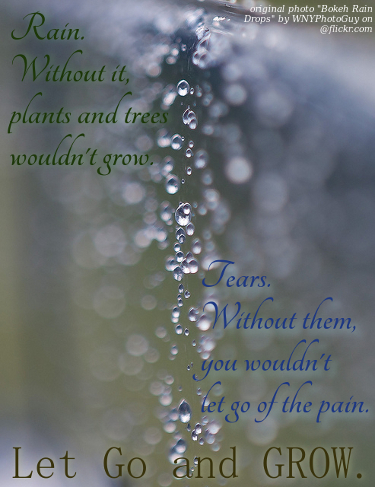
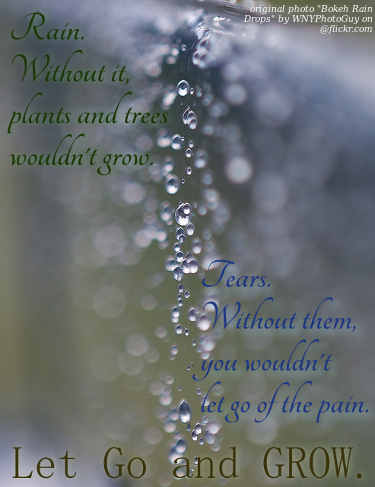
Rain feeds the vegetation around us. Without it, we wouldn’t have ancient oak trees, green grass, gorgeous flowers, delicious vegetables or fruit. We wouldn’t have the oceans, lakes, ponds, creeks, fish, and all the other flora and fauna which depends upon the very vitality the rain provides as it falls.

Even though many of us don’t like the rain, it provides the means for our planet to thrive.

Boom.

Each of us is different. Each of us reacts to crying in our own way, just as each of us protects ourselves differently when it rains. Some of us run. Some of us use umbrellas. Some of us cover our heads with our hands or a magazine or newspaper. Some of us meander through the rain, not caring if we get soaked and enjoying the feel of every drop on our skin.

Bottom line – we all cope with the rain differently.

Tears are a part of processing emotion. Some of us cry at the drop of a hat or an overtly emotional commercial. Then there are those of us who hold our tears in until they burst through all our carefully constructed barriers, causing a flood as our emotions tied to those tears release. Then there are those of us who just don’t cry at all.

There is no right way to process emotion. There are unhealthy ways to process emotion, yes, but there are so many variants on the healthy ways to process emotions. Just like a walk in the rain – we all do what feels right for US.

Rain allows our planet to grow and thrive.

Tears allow us to grow and thrive.

It’s okay to let go and cry, it’s okay to breathe deeply and open the floodgates.

It’s not okay to pretend everything is okay when it’s not, to keep things to yourself if you’re hurting. What’s important is to remember you’re not alone – no matter where you live – (in a flood plain, a rainforest, a desert…) just because how you process things looks different than how someone else processes them doesn’t mean you’re wrong.

It just means you are human and an individual.