Monthly Archives: October 2013

Thoughts on Miriam in DC

On October 3, 2013, Miriam Carey tragically lost her life Washington, DC. She was supposed to be in Connecticut, taking her daughter to a doctor’s appointment according to the myriad of articles I have read this morning.

They all seem to have the similar tone to them, these articles. That a woman tragically lost her life because she had Postpartum Depression.

Yet, medication recovered at her Stamford, CT, apartment would indicate that what was going on with Miriam went much deeper than Postpartum Depression.

A woman with Postpartum Depression does not simply break with reality and drive hundreds of miles out of her way to drive into barriers, lead police on a chase, and somehow end up dead, all with her infant daughter in the back seat.

The behaviour of Miriam Carey lends itself to the behaviour of a mother struggling with Postpartum Psychosis, the facts of which can be found at this page on Postpartum Support International’s site. According to this page, symptoms of Postpartum Psychosis can include:

  • Delusions or strange beliefs
  • Hallucinations (seeing or hearing things that aren’t there)
  • Feeling very irritated
  • Hyperactivity
  • Decreased need for or inability to sleep
  • Paranoia and suspiciousness
  • Rapid mood swings
  • Difficulty communicating at times

There are a number of symptoms on that list I have seen discussed this morning. Some of them match up with PPP.

The other things I have seen discussed this morning are heartbreaking. Folks judging Miriam for her actions. Saying she’s a monster. Wondering how she could possibly have driven her vehicle into the barriers and toward a hail of police bullets with her daughter in the back seat.

I have also seen some honest discussion about what it means to struggle with a mood disorder after the birth of a child and how it hurts whenever something like this happens. I feel as if I have been punched in the gut, to be honest. I want to fall to my knees and weep for what happened to Miriam. But instead, I am writing and I am reaching out to those in the community I founded to support women and families struggling with mood disorders after the birth of a child.

Why?

Because this kind of support, on a human level, helps quell the storm. It lets others know they are not alone and there is hope. We help each other find the way in the dark, particularly when a storm like this tragedy looms on our shores. You see, at one time or another, we have all been Miriam. We have had those thoughts, the scary ones about driving our cars into solid objects, about letting go, about just giving up and moving on toward that great white light. Some of us have almost touched that white light. WE KNOW the darkness which drove Miriam to Washington, D.C. intimately. We have sat with it on our shoulders, in our hearts, and felt it try to gain control of our heads. We, however, are the lucky ones because we are still here, fighting.

When the women of the Postpartum Support Community band together, it is a beautiful thing. We are some of the strongest women in the world and we refuse to stand down. In the spirit of standing strong, I will be participating in a Blog Carnival “For Miriam” on World Mental Health Day on October 10th. If you would like to join us, you can find more information here on the FB page.

For now, know that you are not alone, it is absolutely okay to reach out for help, and you are loved.

If you or a loved one are currently struggling with a Perinatal Mood & Anxiety Disorder, reach out to Postpartum Support International at their website or find me on Twitter @unxpctdblessing. There is also 24/7 support available via the hashtag #PPDChat and we have a closed FB group as well. You are never alone.
Why Stigma is Not Like a Band-Aid

Stigma sucks.

So does Stigmata but that’s a whole ‘nother topic.

Thing is, band-aids would do a better job of healing stigmata, as horrific as it is, than it they would to heal the misconceptions about mental illness.

For centuries, people have developed their own fears and prejudices in regards to those of us who struggle with mental illness.

We’re scary.

We’re violent.

We’re stupid.

We can’t function.

We should be locked away.

We are to be feared.

We are to be hidden.

We are to be whispered about.

We are not to be talked about at all.

We are to hide our illness the best we can.

We are an embarrassment to our families.

We can’t have friends.

We can’t have children.

We can make our illness go away.

We choose to be crazy, nuts, insane, loco.

We use mental illness as an excuse to not contribute to society.

We are lazy.

Meet stigma.

Stigma is a heavy blanket which covers all of us who struggle with mental illness. Not only do we fight against whatever illness it is we are diagnosed with, but we fight the blanket too. It’s a thick and heavy blanket society has flung over us to hide us as we try to function within their world. It’s hiding us. Just as a band-aid hides a wound.

Band-aids don’t always heal wounds. Sometimes a wound needs to breathe, to gulp in fresh air, scab over, and continue to grow new skin in order to heal. Fresh air is the equivalent of open conversation of mental illness not laced with stigma. Until we, as a society, are able to sit down at a table together to discuss mental illness without resorting to judging or stigmatizing those who struggle with it, we will never heal.

Stigma is not something which can be pulled off quickly like a band-aid either.

It requires a slow removal because stigma is a wound which has been festering for eons. Lots of tender care is required in order to aid in the wound reaching fresh air. Several layers need to be removed, slowly and carefully. Bold conversations, intense honesty, patience, compassion, and a dedicated desire to convey the truth about mental health are requirements.

It is possible to peel back the layers and allow the wounds to heal. Start with one person and you might be surprised where your ripple of truth ends up. But if you never start that conversation? Stigma will continue to thrive. Don’t hesitate to do something because you believe just one voice doesn’t make a difference. Because your voice, no matter how small, matters.

What Is Recovery?

In glancing through search terms which people have searched to find my blog, questions about Postpartum OCD are the most common.

The biggest question, and the one I dread the most asks, “Do intrusive thoughts go away?”

My heart breaks when I am asked if the thoughts go away because I know where they are – how they’re feeling. How FRUSTRATING it is to want to be with your child and not have any intrusive thoughts flit through your head as they snuggle close to you and  drink in that sweet angelic baby smell in the dusk of the evening.

I know it goes away.

I know it fades.

What stays, and what is difficult for those of us who have OCD to differentiate, are typical parental fears – the nagging fear that something might happen to your child when you’re not watching. THAT stays forever. It’s not intrusive, it’s a normal heightened awareness which comes with parenting. When you have survived OCD, however, it is extremely difficult to keep these normal heightened awareness type thoughts from spiraling into intrusive thoughts. We constantly battle to keep them from growing into giant monsters.

Recovery, at least for me, is not a cut-off date. It’s a constant involvement in awareness of my feelings, reactions, and coping methods in regard to the ever changing world around me. It’s ensuring that in addition to my daily requirements, I’m taking care of myself as well. Recovery is not a discharge notice from a hospital, nor is it the last pill swallowed at the end of a prescription. It’s not the final therapist visit nor is it uttering the words, “I’m okay.”

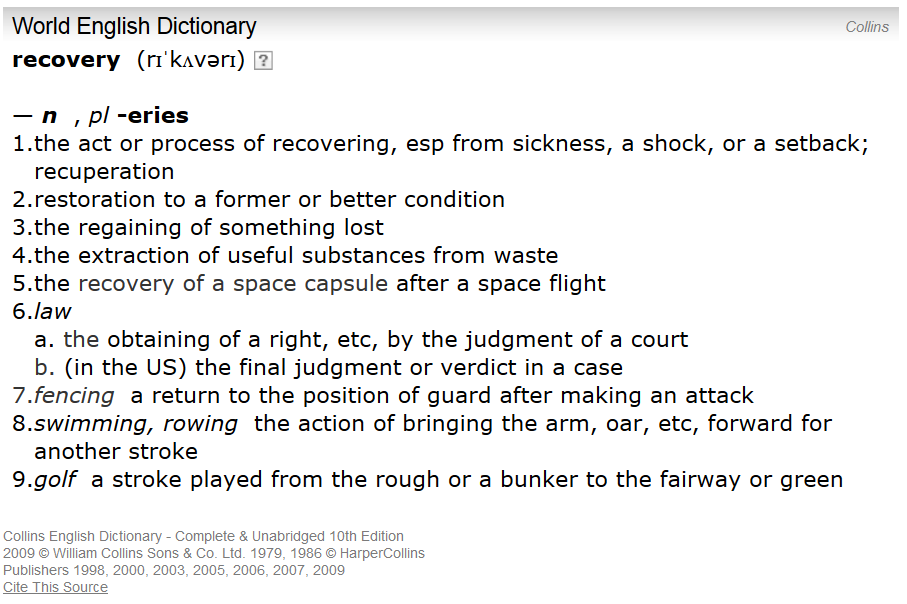
This is how the dictionary defines recovery:

Recovery Definition

What is recovery in the living world?

Recovery is life.

It’s living and moving forward with a tenacity learned in the depths of hell, a grip on enjoying all the little things and a determination to not go back. It’s knowing that even if I do go back, I have a road map to lead me back out again.

Recovery is self-care, self-compassion, and self-respect.

It is knowing that it is okay to not be okay sometimes. Recovery is celebrating both the ups and the downs. It’s getting to know yourself SO well that you recognize the difference between yourself and depression/mental illness. Recovery is knowing exactly what to do when the ugly beast stirs to keep it from waking completely. It is about arming yourself with a cadre of weapons guaranteed to slay the succubus.

Recovery is acceptance.

It’s being okay with the tough days and providing a soft place to land when they happen. It’s having a support system in place for the bleak days, one that will also be there for the good days. It’s understanding that sometimes, you’re gonna feel angry about your mental health and that’s okay. It’s learning the range of healthy and unhealthy emotions and knowing when to reach out for help.

Recovery is being imperfectly perfectly you.

According to Alexander Pope, “To err is human.” Perfection is a fallacy (so is control). It is an impossibility we set up in our minds, a standard most of us will not reach. Do the best you can with what you have. There’s a special kind of joy (and peace) to be found when you let go of any expectations you, life, or anyone else may have forced upon you. When you are truly yourself, you shine.

Recovery is personal.

We cannot compare our journey to that of others. There are similarities, sure, but we each carry our own luggage and travel our own road. Our stories are as different as we are from each other. Knowing someone else has traveled a similar road helps. But it is absolutely important to remember that just because someone was at point X by a certain point on their Y timeline does not mean you will also be at point X at the same time. There are SO many variables to every story. It is impossible to compare so stop doing just that.

Recovery is…..

Your turn. What is recovery to you? Share below.

Whatever Wednesday: Censored Funny

One of George Carlin’s funnies routines for me is when he goes through a list of “bad words.”

Words which aren’t welcome in “polite” conversation.

I love him for it.

Why?

Because we shouldn’t have to censor what we say or write.

To censor what we write, what we say, what we think is the very essence of giving up ourselves. Sure, there’s a moral argument against bringing up certain topics in certain circles. But are we pressured more by others around us or by ourselves? Where’s the line? Should we cross the line? Where’s the grey area?

What if we offend someone? *gasp*

What if we cause a parent to have to explain something to their child they aren’t prepared to explain?

What if…

I mean, really?

(I’m listening to George Carlin read the list right now, for the record.)

When does Politically Correct cross the line into limiting freedom of speech?

Shouldn’t there be a certain expectation in certain situations of crude/crass speech?

It’s why we now have ratings. Why music is labeled as “Explicit” and why movies are rated anywhere from “G” to “NC-17” or “X.”

The problem with ratings is that it creates a society in which we don’t think about examining things closely for ourselves because someone has already done it for us.

Ratings are a suggestion, people. A guide. Not a decisive statement that it’s okay for your kid to watch, listen, or play simply because some panel somewhere decided it deserved whatever rating your kid is allowed to view, hear, or play. What if they don’t hold your values? What if they think it’s okay for your kid to hear crass languague or see something crude?

Point here is that funny is funny in YOUR context, not in someone else’s context. I’m tired of censoring myself for fear of what someone else may think or say as a result of what I’ve said. It’s me. If you don’t like it, the rest of the Interwebz is at your fingertips. All it takes is a click to veer away from my words or from whatever else it is that you have found offensive.

At the same time, we have the same right as the person saying these things to speak up and say we don’t like what they’re saying. But by no means should we expect them to take back what they’ve said just because we *gasp* don’t like it. Guess what? The world is full of things we don’t like.

FULL.OF.THEM.

Wanna know how to deal with that?

Ignore it. Don’t let it into your life.

Fill your life with the beautiful, with the true, with the honest, with the FUNNY, with the hope, the compassion, the love YOU want there.

If you find yourself always focusing on the negative, take a good hard look at yourself and how YOU are living your life and what YOU are letting into it.

We live in an age during which we are very much in control of what comes into our lives.

Don’t hesitate to use that control to create a bubble. Yeah, sometimes? That bubble’s gonna pop. Sometimes? It’s okay to get angry.

But really… most of the time, anger is a wasted emotion and life is so much better when you’re happy and lost in bliss, even if that means ignorance in some areas.

On Loving Motherhood

One of the phrases I hear a lot from parents who struggle with mental health issues after the birth of a child is that they didn’t feel an instant bond with their child. Or that they did but it was to the nth degree and they obsessed over every little thing that happened to their child, to the point of it interfering with day to day living. Instead of being the parent society leads us to believe every parent should be, they were either detached or over-attached. It’s the Goldilocks syndrome with none of us feeling that “just-right” level of attachment.

One of the most difficult aspects of experiencing a mental health issue after the birth of a child is that in addition to healing ourselves, we must develop a bond with a new person we hardly know and cannot communicate with in the normal manner because they are not yet capable of deep thought and expressive language.

Imagine that you’ve just met an amazing person. You want to get to know them, to give them all you have inside you, but you can’t. You don’t have the energy. So you worry about the effect this will have on the relationship -if they’ll end up hating you because you can’t quite reach out the way they need you too. You wonder how much emphasis they’ll put on the lack of affection from your end. Somehow, though, you manage to muddle through and they miraculously stay. They love you simply because you’re you, something you struggle to comprehend. Then you feel guilty because you haven’t put as much into it as they have (or perceive that you haven’t) and so you overcompensate, which fills you with intense guilt as the days go by. So you read books about what you should be doing. After awhile, it becomes habit but somewhere, deep inside, you always wonder if you’ve done enough. Or if they’ll bring it back up some day when you falter the least bit.

Or you remain detached, thinking that it’s just not worth the work, the stress, the anxiety. Things are the way they are for a reason, right? Why bother? They’ll either stay or go. The choice is theirs in the end.

Parenting can be hell.

It’s the toughest job on the planet, and no matter how much preparation we put into it while expecting a new little one, we’re all thrust into it, suddenly. It’s on-the-job training. When you add a mental health issue, it’s like on-the-job training at the Hoover Dam on a day when it’s sprung a leak. SO much is flung at you.

Every little thing means more than it should.

Bed seems really lovely.

Giving up seems like a fantastic idea.

Walking away – sheer brilliance.

In the past, I envied parents who seem to know exactly what they’re doing or really enjoy their kids. As a survivor of multiple PMAD episodes and issues and a relative introvert, it’s extremely difficult for me to relate to others who want to spend every waking minute with their children. It’s not that I don’t love my kids, I absolutely do. But for me, parenting is traumatic. My start was more of a train wreck with a hurricane thrown in for good measure. I fight for every second of what appears to be “normal” parenting.

What I forget in my battle to be “normal” is that no one is normal. We are all fighting our own battles, they are just a bit different from the battles of those around us. As I have moved toward healing, parenting has become more like breathing for me. Sometimes I still have to fight for breath but most of the time due to the necessity of mindfulness in my own survival, parenting has become easier as the years have gone by. The wounds have healed enough to not feel as if they are torn off with every single negative instance.

To those who are still in the trenches and still fighting for breath as they fight to parent their children and remain sane, (with or without a PMAD), my hat tips to you. To those fighting through a PMAD specifically as you parent your new one (and possibly even older children), I know how it feels to be where you are and I want to tell you that it won’t always be this way.

One day, things will just work. There will always be potholes and bumps as you navigate the road, but if you take the time to just breathe, ask yourself if what you’re about to explode over is really worth it, and then address the issue at hand (or not, depending on the answer to the second step), things will improve. Take time for yourself. See your child as just that – a child – take the time to see the world through their eyes, marvel at the little things right along with them, and let the world hold you close instead of crawling away into a cave. Baby steps.

You may remember all your faults but your baby will not. All your baby needs is you. They are not mini-adults, judging you for not knowing what to do. They aren’t the ones behind the myriad of research which blames parents for all that is wrong with adults. Let it go. We are our own worst critics. If we take the time to just be as humans instead of critiquing every single choice life flows so much better.

Stop judging.

Stop worrying.

Just be. Drink in life, drink in your child. Drink in the sunshine and the joy when you can. Store it up for the days short on both.

You can do this. Even Goldilocks found the right one eventually, didn’t she?

Your just right is out there, I promise. It’s just a bitch to find in the fog.

You are not alone, you will be okay, and your baby will be okay too.

In the interest of all honesty, recovery is not as easy as sitting out in the sunshine and drinking in life. For many, it takes a multitude of visits to a therapist, maybe a few medication changes, and a hell of an effort to reach the point where you CAN sit in the sun and drink in life. It certainly took all of that for me, and more. But the fight is worth it in the end and that fight will make the sunshine even brighter once you’ve evicted the fog.

If you find yourself struggling with a Perinatal Mood & Anxiety Disorder, you can find hope and help through Postpartum Support International or over at Postpartum Progress. If you are feeling down and struggling with suicidal thoughts, reach out to Lifeline, the National Suicide Hotline here in the United States.