Monthly Archives: October 2013

Green Shoes, The NFL, and Mental Health Stigma

The NFL is making a “Crucial Catch” this month but it has nothing to do with Mental Health. Instead, they have been partnered with various breast cancer organizations to raise awareness and funds for battling breast cancer.

Participation started back in 2008 with a myriad of events as evidenced in this article, “NFL Supports Breast Cancer Awareness Month”. This year, the awareness campaign continues. Not only do players wear pink gear, but it is also auctioned off to raise funds for research. Which, in theory, is a great idea, and as someone who has lost a family member to breast cancer, I understand the desire to increase awareness and provide funds for research.

As a football fan, however, I hate the month of October. I cannot stand pink. I have hated the colour ever since I brilliantly decided at age 7 that Pepto Bismol Pink was a terrific colour for my walls and I lived in that Pepto “Abismol” Pink room for nearly 5 years before escaping it into a soothing forest green room with merlot trim.

My point here is not about the colour. It’s about the NFL ignoring an awareness week which occurs during the month of October.

In case you do not follow mental health news OR the NFL, there has been a lot of discussion regarding Brandon Marshall’s desire to wear green cleats during tonight’s Bears v. Giants (don’t get me started on the Giants’ 0-5 giddyup to the season because that’s a whole ‘nother post) game. The NFL flat out told Marshall he couldn’t do it. Then they said he could but that he would be fined. Marshall plans to pay the fine and match it with a charity donation. A donation most articles make clear will go to a cancer-care organization with the mention that he is also trying to work out details of donating to an organization making a difference in the Mental Health World.

Here’s the thing, though, from my perspective – with the big brouhaha the NFL has made regarding Marshall’s desire to wear green cleats, it seems to the casual observer as if they do not want to raise any awareness regarding Mental Health issues. On the other hand, however, their very refusal and the back and forth with Marshall does have people talking about his condition and desire to raise awareness. The NFL’s aversion to Marshall’s desire to raise awareness on the field also makes it seem, to me, that the NFL cares more about the state of a woman’s breasts vs. the state of her mind.

Marshall struggles with Borderline Personality Disorder, something an article in SI from May 2012 describes as evidence of the strides the NFL has made in making the mental health of players matter:

The hope is to create a stigma-free environment in which players feel more comfortable working through their mental health issues. Bears receiver Brandon Marshall reached a breakthrough of sorts last July, when he announced that he had been diagnosed with borderline personality disorder; the moment hints at the strides engagement programs are making behind the scenes.


The NFL also runs a Life Line specifically for players, former players, and their families, accessible on the web and via phone. The Life Line was launched in 2012. I wasn’t aware of it until today as I was Googling for this piece.

“There is no higher priority for the National Football League than the health and wellness of our players,” NFL Commissioner Roger Goodell wrote in a letter to personnel and fans at the time. (quoted from CNN) 

In addition, the NFL has been adding more and more psychologists to behind the scenes team rosters, something the previously mentioned SI article details.

With this internal attention to the mental health of their players and families, isn’t it time the NFL brought some of their powerful presence in the psyche of the American male to the table and made mental health awareness an issue? With the loss of Junior Seau, last year’s incident with Kansas City’s Jovan Belcher, Paul Oliver’s recent suicide and the loss of several other players in the same manner, the NFL needs to do more than just support mental health behind the scenes because without public action, it is all too easy to assume that nothing is being done. It is also extremely easy to assume there is no support when you have the NFL threatening a player wanting to do something as simple as wear a different colour cleat to raise awareness for Mental Health issues, something said player struggles with himself.

I get that October is taken for Breast Cancer Awareness.

All I’m asking for is one weekend where the players wear Green, as Brandon Marshall wants to do tonight, to raise awareness for Mental Health Issues. If they can do it for Breast Cancer and raise millions of dollars for research and awareness campaigns, imagine what they could do if they dedicated the same amount of energy to Mental Health research and awareness, particularly in a sport with a hard-core dedicated male audience taught by society NOT to talk about their emotions.

For now, though, I guess we will suffer through the month o’pink and hope everyone has healthy boobs instead of healthy minds.

WAY TO GO, NFL.
We Are Advocates – Hear Our Cry

I recently received an email in which it was stated that we, the advocates for women with Perinatal Mood & Anxiety Disorders, often only raise the battle cry when a woman or child dies. That we are hypocrites because we don’t help or raise the cry for women who cry out for help before a tragedy – or after a tragedy they have survived. This is simply not true.

We may raise the cry even louder when a woman or child dies but this is simply because we are angry that our previous cries have clearly not been heard and yet another mother/child dyad has been failed by multiple levels of the system designed to help them survive and thrive.

As I explore in the post “Is the Postpartum Depression Defense a Cop-Out“, the defense in the legal sense, is not at all a guaranteed path to freedom. When used, this defense often leads to a mental health incarceration of some form for a very lengthy period of time dependent upon the severity of the incident.

Often, when mother has harmed herself and/or her young child(ren), before it splashes headlong into the mainstream media, there’s mention of postpartum depression. Once the story hits, the term is bandied about as carelessly as a bubble blown by a toddler on a sunny summer day by pundits, analysts, reporters, bloggers and the like.

What is this phenomenon and why is there such a horrific misunderstanding of the classification of postpartum depression vs. postpartum psychosis? And even more chilling, has postpartum depression become the new go-to for women who commit crimes against their children or families?

First, let’s get rolling with a little definition education here.

Postpartum Depression, a commonly used umbrella term for the mood disorders on the Postpartum Mood Disorder spectrum, is also the term for one of the disorders on the spectrum. Postpartum Depression may consist of but is not limited to: sadness, crying for no reason, lethargy, lack of interest in previous activities/hobbies, distance from baby and family or social activities, anger, irritability.

Postpartum Psychosis, the most serious of the Postpartum Mood Disorders, often involves (but again, is not limited to): auditory or visual hallucinations, the inability to care for oneself and make decisions. Considered a medical emergency requiring immediate hospitalization, this particular disorder also carries the deadliest rate of both infanticide and suicide.

Second, mothers with Postpartum Depression are less likely than mothers with Postpartum Psychosis to harm themselves, their children, or their families. With Postpartum Psychosis there is a disconnect from reality during which the mother is truly unaware of her actions. It is a very scary place in which to find yourself.

So why is it then that when a mother harms her children it must be because of Postpartum Depression? Why the confusion of terms? This happens time and time again. Everyone immediately jumps on the Postpartum Depression bandwagon.

There may be issues related to a Perinatal Mood & Anxiety Disorder for many, as with the recent case of Miriam Carey, who was reported to be delusional to police by her boyfriend not too long after the birth of her now 1 year old daughter, but there are also cases in which the leap is made to a Perinatal Mood Disorder as the root cause where it is not at all the issue.

There are those who feel Miriam’s case, is a difficult one to address. And it is – for a number of reasons. So much is involved. She is far removed from the immediate postpartum period. Then you have the family stating she was hospitalized but other family members minimizing Miriam’s mental health battle despite some strong meds being found in her apartment. Miriam also experienced a head injury which her employer, according to certain accounts, says changed her mannerisms. Miriam also lost her job and had been sued by her townhouse organization. Then there’s race, politics, and the argument regarding the alleged excessive force used by Capitol Police which ultimately ended Miriam’s life.

Bottom line?

We won’t ever know what made Miriam drive to DC with her 1 year old daughter in her car unless someone finds an explicit note somewhere. Even then, there are so many factors that people can extrapolate whatever they want to from it.

Is it right to seize the tragedy to educate the public regarding Perinatal Mood & Anxiety Disorders? Is it okay to talk about Miriam’s life as if we knew her or understood her battle?

There will be people who will say no.

There will be people who will say yes.

There will be people who will say there are no such things as Perinatal Mood & Anxiety Disorders.

There will be people who will claim excessive force was used because of her skin colour.

There will be people who… you get the point by now, right?

We cannot make every one happy with this regardless of how we discuss it.

It happened in the public venue, however, and in a city central to a political firestorm and still reeling from another tragedy just a few miles away from where Miriam died. So it is being discussed. Postpartum has been dragged into the discussion.

So I will discuss it, even if the primary focus cause of Miriam’s action on Thursday is not directly related to a PMAD. Because the media has jumped on the PPD sensationalism bandwagon, I will fight back and educate, I will correct, and I will make sure that I do all I can to keep women from falling through the cracks even when, like Miriam, things continue to stack up against them.

When you’re fighting against a Perinatal Mood & Anxiety Disorder, your best chance at recovery is to focus on recovery. But when you have a snowball effect of things following it, eventually you want to jump out of your life just to get everything to stop – it’s like wiping off a cluttered table, if you will. You either take the time to put things away neatly or you just shove everything to the floor and let it fall where it may because you don’t have the energy to focus on being neat and organized about it.

My goal, the goal of every advocate and survivor I know, is to re-organize their lives into some semblance of normal. For advocates, we are dedicated to providing women who reach out to us with the tools they need to reach their semblance of normal. We know we can only save those who reach out to us and we try to expand that access by any means necessary because when someone like Miriam is failed, we take it personally.

This loss has raised many voices and not all of us agree on how to proceed. That’s okay, though, because we are all going to react the way we need to react. It’s okay to process this how YOU need to process it – if that means you need to write about it, great. If you need to stay quiet, fine. You have every right to do so. We still love you and respect you. You are not alone.

I hope, that through the discussion of this loss, we are able to stay strong, stay connected, and stay passionate, despite our differing viewpoints on how to handle this tragedy. Because our strength, our compassion, our knowledge – it is all we have to fight back against misinformation. If we manage to educate just one person, seizing the tragedy will have been more than worth it.

#PPDChat Topic – Town Hall/Open Forum

PPDChat topic 022111

Given the events which unfolded last Thursday with the tragic loss of Miriam Carey and the media reaction to said events on Friday, I wanted to take today’s chat and give us some time, as a community, to come together and share how we have been feeling as a result. I know there is quite a range of emotions out there.

I want to remind the community to focus on our feelings in relation to Thursday’s event in Washington DC and to keep politics out of the discussion this evening.

I look forward to checking in with everyone and providing a safe space for us to discuss our feelings.

Saturday Sundries: When Suicide becomes reality

Saturday Sundries Banner

Morning y’all.

I hope you have imbibed at least one cup of coffee because today I am going to get serious. Life and death serious.

Over the course of my time as a peer advocate/support person for women and families struggling with Postpartum Mood Disorders, I have faced suicidal mothers more than once. Each time it is draining. The first time I faced this issue I’ll be honest – I didn’t know what to do. The first time I faced it on Twitter, I recruited people to support me via DM, reached out to emergency contacts, and the mom connected with someone via phone. It wasn’t me but that did not matter. What mattered was that she reached out and held on to hope. She got help and is still here.

Over time I have grown more comfortable at dealing with someone in a suicidal crisis. Each time it still drains me though. But it’s part of what I do. I am very careful to ensure care for myself during and after an intense time of support. I watch a lot of comedy, exercise, and talk with others honestly and openly. I love that my support asks how I am doing if I’ve clearly gone through supporting someone.

I have had to learn how to help others. I have also learned how to help others deal with very real tragedies resulting from the often invisible illness that is a Perinatal Mood & Anxiety Disorder. Right now, our community, those who suffer from, have survived, and fight for those who are struggling, is coming to grips with the events which led to the death of Miriam Carey. There’s a wonderful article over at USA Today dealing with the situation. The article covers PMAD’s respectfully and take the time to differentiate the various types of disorders. If you read any article about what happened, make it this one.

Do you know facts and statistics about suicide? Would you know what to do if someone you loved or knew admitted to active suicidal feelings? Would you be able to recognize the signs of potential suicide? It’s important to be able to do so… think of it as basic first aid for the mind. Just as our bodies can hurt, our minds hurt too. And sometimes? Sometimes we’re not capable of recognizing the extent of the injury until it’s too late.

You are not at all helpless when it comes to suicide. You CAN do something. Start with this list over at the National Suicide Prevention Lifeline. Know how to report suicidal behaviour on Facebook. Program the National Suicide Prevention Lifeline number -1-800-273-8255- in your phone.

Start a discussion about suicide with friends. If someone jokes about it, correct them by saying that it is a serious matter and deserves serious attention, following that statement up with facts and statistics. It is absolutely not something one should ever joke about. Ever.

Despite all this, sometimes we lose people. Even if we know all the signs and know exactly what to do. We can’t put our plans into motion if we do not know the plans and thoughts of those around us. It hurts like hell to lose someone to suicide. It is a pain I know well. It is a pain others I know also know well. We can do everything right and still have suicide implode our lives. How do we cope then?

When we have lost someone to suicide, we are then termed as “survivors of suicide.” People who have survived someone who completed suicide. You are not alone in this, not at all. There are others out there who are going through the anger, the frustration, the sadness, the regret, the what if’s… the entire gamut of emotions one goes through after losing a loved one to suicide. There are a few online resources. The first one is at Suicidology on their Suicide Survivors page. Then there is Alliance of Hope for Suicide Survivors.

There are also friends and family. Some of them may not understand your grief. They may not understand the length of it or the manner in which you choose to grieve. But grief is different for all of us, just as life is different for all of us. Grieve in the manner which feels best to you and don’t worry about what anyone else thinks. Let it out, let it flow through you, and process your emotions in the best possible way for YOU.

Bottom line – suicide is not something we need to remain silent about. It’s not something we should continue shoving in a corner and pretending it doesn’t happen. It happens, to everyone in all walks of life. We ALL are affected by suicide.

Let’s get together and talk about it – open up, let people know they are loved, they matter, and we do care. Today, take the time to smile at a stranger. Say hello and ask how they are and mean it – stick around for the answer, don’t drift off into the crowd. Offer to help someone with something. Do a good deed. You may just be the one thing they’ve been needing to brighten their ever so darkened life.

After that good deed? Start a conversation somewhere about how important it is to discuss suicide and the issues that can cause it but also what to do when the mere thought of it is looming on the horizon. You may just save a life doing both. And that, my friends, is why we all matter.

Open Letter to Savannah Guthrie

Dear Savannah Guthrie:

Sit down.

I would like to talk with you for a few seconds.

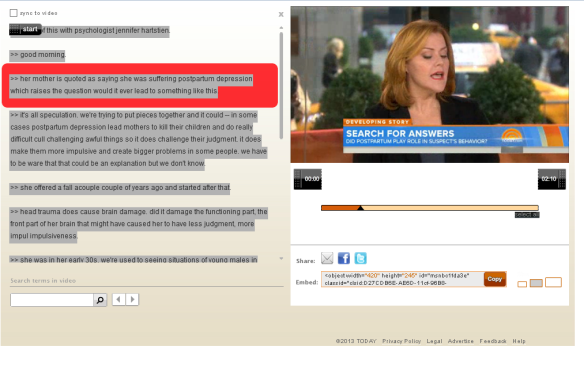
Savannah Guthrie Transcript“Would postpartum depression, if it existed, ever lead to something like this?” you asked psychologist Jennifer Hartstein this morning on the Today Show as you kicked off a discussion about mental health and the tragic situation which concluded in Miriam’s death yesterday. (You’ll note that the “if it existed” part is strangely omitted from the screenshot)

“…if it existed…”

*sucks teeth*

So, Savannah, darling, about that “…if it existed…” comment… I am guessing you would like to tell me that when I was in the hell that was immediately after giving birth to both of my daughters, I imagined it. Didn’t happen.

I did not have compulsions, I did not delve into the darkness and fight to get through every day even though I was triggered by even the tiniest cry. Never existed. My hospitalization – unnecessary because it was for something that never existed.

My blog? A bunch of hot air because I waste my time discussing some inane make believe condition that doesn’t exist.

Women fight and struggle with Perinatal Mood & Anxiety Disorders every damn day. Reporting about it as you did this morning helps no one. I get that it is easier to say Postpartum Depression because it’s a term the general public understands. BUT it’s a term they understand because people like YOU refuse to educate the public at large about the other conditions along with Postpartum Depression such as Postpartum Anxiety, Postpartum Post Traumatic Syndrome, Postpartum OCD, and Postpartum Psychosis.

There was no discussion of these other conditions on your show this morning. NONE.

You sat there and grinned through the entire segment, nodding and smiling but educating no one.

What about the mom in Iowa who is three months postpartum and watches you faithfully and is struggling but heard you associate postpartum depression with a desire to harm oneself? Oh, now she can’t seek help because people will think she wants to kill herself and her child. YOU did that to hundreds of mothers across the country today, Savannah. You added to the stigma instead of taking a few extra minutes to educate yourself about the entire situation.

But “It’s a developing story…” so? Gather the facts on what you have and educate yourself along the way. Don’t be ignorant along the way, be educated. You, more so than any of the rest of us, are in a position to remove stigma in a powerful way because you have the audience and the platform on which to do so.

You failed us this morning.

You broke our hearts and made us wonder when or even if, stories like these will EVER be reported properly. Your colleague over at ABC, Dr. Richard Besser, got close when he made a point to mention Postpartum Psychosis.

Instead, you discussed Postpartum Depression and a potential brain injury as a result of a fall.

Sighs.

Way to fail, Savannah. Way.to.fail.