Tag Archives: peer support

The Elephant in the #PPDChat Community

Inferior without your consent

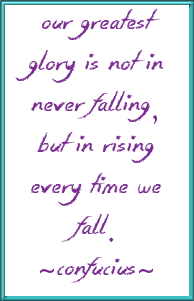
This past week, Katherine Stone over at Postpartum Progress announced the the Warrior Mom Leadership Team, an editorial team comprised of a diverse group of writers and advocates, who will help run her blog throughout the year. I am a member of this team along with several other fellow dedicated and amazing survivors who have battled through so much. Along our journeys, we all have been incredibly honest, dedicated, vocal, and driven to share our stories. Some of us started with the most basic of intentions but somewhere along the way, we became recognized advocates through hard work and repeatedly putting ourselves out there sometimes meeting with Fall Get Uprejection along the way. We brushed ourselves off and put ourselves back out there all over again.
Often, we did not even mean to put ourselves out there but had our stories noticed for whatever reason, forced into a higher level of publicity with our very personal battles than perhaps we were ready to deal with. So we rolled with it because we had to not because we wanted to.

One of my primary goals with my growth as an advocate was to develop an online network women and families could access 24/7. My goal with #PPDChat was not to develop a network to lift bloggers and advocates to higher popularity or to create popularity cliques within the community. My goal was to increase peer support for women and families to access whenever they need it, wherever they were. The worst aspect, for me, about a PMAD, is the overwhelming feeling of being all alone. That isolation, the fear that YOU are the only one stuck in this dark hell, is absolutely terrifying and what needs to be remedied first.

#PPDChat exists to create a sisterhood and community, yes, but it is not meant to cause divisiveness or jealousy of any friendships which may seem to net more opportunities or be more intimate than others. I realize these things will happen because this is the nature of humans in a group setting. We gravitate toward others like us. It’s hard-wired deep within us to do so.

The primary goal with #PPDChat was to create a safety-net. To move those who are hurting and isolated toward a place of healing, warmth, and eventually, a return of joy. One of the side-effects of this community has been the development of advocates as they have felt supported and buoyed by the community at large. Certain members have grown stronger in their advocacy voices as they have discovered they truly are not alone and witnessed the power of conjoined voices will do for a woman still fighting. Other members have continued along their own personal path of healing, not joining in the advocacy movement for their own personal reasons. But we have come this far together, as a community.

One of the definitions of community is: “a feeling of fellowship with others, as a result of sharing common attitudes, interests, and goals.” #PPDChat is definitely all of those and what keeps it fascinating is that even though PMAD has brought us together, our interests are broad and undefined – allowing for individual friendships to organically develop. Not once have I ever seen it as something which has intentionally excluded certain members. If anything, there have been multiple opportunities to include yourself with other members through guest posts, guest hosting within #PPDChat, and various other outreach situations. We all operate within our “circle of comfort” because of our various issues, something which may limit our exposure to the Social Media world at large, something which often moves faster than the speed of light. It can be exhausting to keep up and we are all moving at a different pace.

Regarding reaching out to involve everyone on an equal footing, Katherine has multiple opportunities for being involved at Postpartum Progress:

I, too, have offered to post guest stories and often highlight Postpartum Voices of the Week. I realize I have been slack over the past year but now that I am actively blogging, I plan to resuscitate this part of My Postpartum Voice. It is important to remember, however, that neither Katherine nor I nor every advocate can possibly read every single thing on the internet about PMAD’s. So we all highlight what we can when we can, which leads to some people feeling left out while others get a few minutes in the spotlight which may lead to other “opportunities”.

That said, those who have become more public and vocal are not any better than those who have not.

Repeat that.

Those who have become more public and vocal are not any better than those who have not.

This is where we return to the quote with which I started:

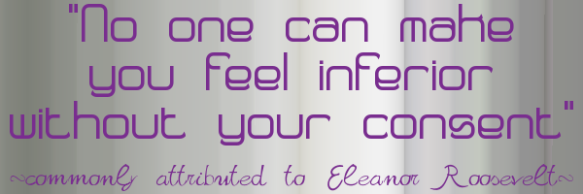
“No one can make you feel inferior without your consent” ~Eleanor Roosevelt~

When you allow a decision which seems exclusive to hurt you so deeply you lash out toward those who have been included, you are giving that decision power over you and thereby creating your own storm of emotions.

For those of us who ARE more public and vocal, opportunities are not viewed as something we covet or even necessarily seek out. For many of us, the “opportunities” may even be anxiety-inducing but we see them as an opportunity to educate, inform, and raise awareness so we charge forward. We do not see the opportunities as making us better than those who are not “chosen” for these opportunities – they are not a platform on which we place ourselves so others may look up at us and feel left out. Our words, our fight, our journey, for whatever reason, has included these turns and curves. As I emphasize ALL THE TIME:

EVERY JOURNEY IS DIFFERENT AND MUST BE RESPECTED AS SUCH.

I will not apologize for being a member of Katherine Stones’ Warrior Mom Leadership Team. No one should have to apologize for being a member of this team nor should Katherine be made to second guess the folks she has placed on the WMLT. Katherine is entrusting her blog, a blog she has worked tirelessly to develop a strong, ethical, and respected reputation for, to the members of this team. I get that she needed to choose people SHE felt she could trust to continue the tradition of the brand she has developed. I know I would be unable to trust my blog to just anyone. I respect her decision as just that – HER decision.

I feel I would be remiss if I did not also point out that this is not an award, this was not a contest, and we are not being paid to be on the WMLT. It is volunteer – and something we agreed to do because it promotes the community and it is going to help further reduce the stigma and misconception of PMAD’s.

Would I be saying all of this even if I were not on the WMLT?

Hell yes.

Because I GET that it’s her choice because it’s Katherine’s blog.

We cannot (and should not) internalize everything. We cannot expect every single door to open for us – the doors which open for us are the doors MEANT to open for us. Some may take more work, more drive, and some may seem as if they open easier for other people.

While it’s perfectly normal and acceptable to feel left out, the manner in which this has been expressed over the past 48 hours in reaction to Katherine’s announcement has greatly saddened me. The sub-tweets, the sub-textual expressions, and the chit-chat behind the backs of those chosen (and yes, I saw a good deal of this on Twitter) has broken my heart because for me, this defeats the very idea of a unified community.

We are all advocates. We are all responsible for dismissing stigma and fighting back against myths with our voices and our journeys. When we fail to support those who, for whatever reason, end up surging forward in the public realm, we fail the community as a whole.

Am I saying it is wrong to be upset?

Absolutely not.

What I AM saying is there needs to be honesty and respect in how we express these emotions. There needs to be the realization that your words WILL be read by those who have managed to not be “looked over” or become “it” girls. Words DO hurt. I get that you are disappointed and you are hurt, I do. I have felt that myself when yet again, my blog fails to gain any recognition or when #ppdchat fails to gain any recognition in an awards process. It’s frustrating as hell. But do I publicly denounce those who have won recognition? Hell no. I congratulate them with grace and deal with my disappointment privately.

BECAUSE THAT’S WHAT YOU DO. You support the community, you empower it, and you rejoice that the subject matter is receiving attention. It does not matter WHO is doing it, but WHAT is receiving the recognition. It is about furthering the cause, not about garnering individual attention. (Again, however, human nature celebrates when individual attention is received and deflates when it is not – hard-wired, not a faulty reaction at all).

The moment you make it about “ME” is the moment you are not advocating for “US” and that, in my opinion, is failing to kick stigma’s ass.

In that scenario, no one is a winner.

We all have different reasons for writing and when we summarily dismiss the achievements of those around us based on a personal negative reaction, we damage any progress we may make as a whole.

I write because I love to write and I will be damned if I let someone journey along this road alone. I do not write for glory or to be an “it” person, whatever the hell that is. I have never, ever considered myself to be an “it” person, in fact, I have always thought of myself as the complete opposite.

It’s okay for people to be sad and I’m not trying to fix it but at the same time, in expressing their feelings, they are dragging those who HAVE been chosen down and not expressing their disappointment in a healthy manner, which leads to divisiveness and guilt. “United we stand, divided we fall” and all that.

For me, accepting a place on the WMLT means Katherine can focus on doing more with Postpartum Progress, the non-profit which means she can make even MORE strides against PMAD’s. She’s been kicking ass for years with her blog and is already making waves with her non-profit. So if she asks for help, I will say yes as long as it doesn’t interfere with what I already have going on (because it is healthy to make sure you don’t overload your plate).

I’m speaking up because I do not want this recent decision to divide the community. I want us to remain supportive of each other. I want us to be able to express disappointment without attacking other members and without making other members feel guilt and/or shame for achieving something for which others feel they have been “overlooked.” When we drag one person down for achieving something, we impede EVERYONE’S progress toward a better tomorrow. Is that what we want?

We, all of us, are better than this.

We, all of us, know battling alone sucks.

We, all of us, want to win the fight.

We, all of us, are winning this fight, in our own little ways.

Let’s just make sure we do it together – as a team.
To Empower without Condescension

There is a habit I have witnessed within a multitude of places in the perinatal support realm. It is the habit of treating women who are struggling as if they were instead their infants. The habit of “Oh, she’s not well enough to do this yet, tell her to do x,y, or z instead” or “What is she THINKING” when a mother attempts to regain her foothold in the world at large as a normal human being.

It disgusts me.

Mothers with mental health issues are still adults.

They have a sense of self, intelligence, a sense of the way life is meant to be lived, and they know how to do what needs to be done. Right now, however, they may need a little bit of support. That does not mean, however, that we lay them down, swaddle them, stick a pacifier in their mouths, and treat them as if they are infants who need every thing done for them.

Why on earth is it that we do this to those who are suffering and struggling?

Their very fight is one dedicated to returning to the person they once were and want to be again. When you treat them as an infant, you decry their struggle. You strip the person they once were completely out of the equation, turning it into a pointless battle. In fact, when you treat them this way, you are doing more harm than good.

I would not want to be demeaned when I reached out for support – would you?

When a mother reaches out for help, she has managed to gather enough courage to say “I can’t do this on my own.” Respect her strength and audacity.

When a mother reaches out for help, she expects to be heard. Hear her voice, her adult voice, and respond in kind.

When a mother reaches out for help, she expects to be met with compassion and respect. Do that. Do not belittle her behaviour or her requests. Guide her, refer her, but dear God, do NOT tear her down any more than she has already been torn down.

One of my primary goals when women reach out to me for support is to respect them as adults, as humans, as independent women who are temporarily scared shitless by the dark hole surrounding them. They do not need me to baby them any more than a soldier needs to be babied after being injured during war. They don’t need me yelling at them either, but you get what I mean.

Strike a balance. Be compassionate, respectful, firm, and guiding, but do NOT demean, belittle, or treat a woman as incapable of participating in her own recovery. The second you deem a woman as incapable of participating in her own recovery, you have opened the door to defeat.

If we expect to help others recover, we must empower them without condescension. If we cannot do this, we absolutely should not be in the field of helping others because we are only harming.

Hear, respect, respond, guide, empower, let go.

These are the basic rules by which I operate. Simple. Straightforward. Rooted in compassion.

The next time someone reaches out to you with a mental health issue -postpartum or not- keep these words in mind. You might be surprised at how far it will get you – and how many lives it will save.

Celebrating by Giving Back: Pregnancy & Postpartum Support MN

I’m excited to share with you about Pregnancy & Postpartum Support MN. I’m even more excited to tell you that their Associate Director, Crystal Clancy, will be our guest on Monday evening. We will be discussing how a Postpartum Helpline functions and what goes into getting it up and running.

According to Crystal, here’s a bit about the organization:

How we started:

We started in 2006 as a small group of mental health practitioners with a desire to support new /expectant parents who are struggling with mental health difficulties. Our goal was to provide resources and education to professionals and new/expectant parents.

What we do: What PPSM offers that is unique are two things:

1) The resource list for practitioners and parents. This is a list of vetted mental health practitioners and psychiatrists who specialize in perinatal mental health. We also list support groups, classes, and are working on adding alternative options.

2) The HelpLine, which is a call in line for parents and providers who are looking for resources and ongoing support. They can be paired with a trained peer volunteer, most of whom have survived their own experience with a PMAD, or know someone very close to them who has. The peer volunteer offers phone support, and we make it clear that it is NOT a substitute for therapy, but more of a “am I going to get through this?” helping hand.

Planned events:

The annual Beyond the Baby Blues Conference in June, sponsored by NAMI; we are also hoping to pull together a 5K for next fall! In addition, we try to have “Meet and Greets” 3-4 times per year for people who would like to know more about PPSM and how they can get involved.

How people can donate/volunteer:

On our website (which should be back up and running soon), or they can contact us through our Facebook page and we can find a workaround that they can donate to Paypal for PPSM or find out how they can volunteer.

Here’s the link to PPSM’s FB page. Click there to find out more about them and nose around their social media presence. As Crystal shared, the website is under construction at this time and they hope to have it up and running soon.

I hope y’all have a great weekend! Crystal and I are looking forward to chatting with you on Twitter on Monday night at 8:30pm ET, 7:30pm CT, and 5:30pm PT. Just follow the hashtag #PPDChat. See you there!

We Are Advocates – Hear Our Cry

I recently received an email in which it was stated that we, the advocates for women with Perinatal Mood & Anxiety Disorders, often only raise the battle cry when a woman or child dies. That we are hypocrites because we don’t help or raise the cry for women who cry out for help before a tragedy – or after a tragedy they have survived. This is simply not true.

We may raise the cry even louder when a woman or child dies but this is simply because we are angry that our previous cries have clearly not been heard and yet another mother/child dyad has been failed by multiple levels of the system designed to help them survive and thrive.

As I explore in the post “Is the Postpartum Depression Defense a Cop-Out“, the defense in the legal sense, is not at all a guaranteed path to freedom. When used, this defense often leads to a mental health incarceration of some form for a very lengthy period of time dependent upon the severity of the incident.

Often, when mother has harmed herself and/or her young child(ren), before it splashes headlong into the mainstream media, there’s mention of postpartum depression. Once the story hits, the term is bandied about as carelessly as a bubble blown by a toddler on a sunny summer day by pundits, analysts, reporters, bloggers and the like.

What is this phenomenon and why is there such a horrific misunderstanding of the classification of postpartum depression vs. postpartum psychosis? And even more chilling, has postpartum depression become the new go-to for women who commit crimes against their children or families?

First, let’s get rolling with a little definition education here.

Postpartum Depression, a commonly used umbrella term for the mood disorders on the Postpartum Mood Disorder spectrum, is also the term for one of the disorders on the spectrum. Postpartum Depression may consist of but is not limited to: sadness, crying for no reason, lethargy, lack of interest in previous activities/hobbies, distance from baby and family or social activities, anger, irritability.

Postpartum Psychosis, the most serious of the Postpartum Mood Disorders, often involves (but again, is not limited to): auditory or visual hallucinations, the inability to care for oneself and make decisions. Considered a medical emergency requiring immediate hospitalization, this particular disorder also carries the deadliest rate of both infanticide and suicide.

Second, mothers with Postpartum Depression are less likely than mothers with Postpartum Psychosis to harm themselves, their children, or their families. With Postpartum Psychosis there is a disconnect from reality during which the mother is truly unaware of her actions. It is a very scary place in which to find yourself.

So why is it then that when a mother harms her children it must be because of Postpartum Depression? Why the confusion of terms? This happens time and time again. Everyone immediately jumps on the Postpartum Depression bandwagon.

There may be issues related to a Perinatal Mood & Anxiety Disorder for many, as with the recent case of Miriam Carey, who was reported to be delusional to police by her boyfriend not too long after the birth of her now 1 year old daughter, but there are also cases in which the leap is made to a Perinatal Mood Disorder as the root cause where it is not at all the issue.

There are those who feel Miriam’s case, is a difficult one to address. And it is – for a number of reasons. So much is involved. She is far removed from the immediate postpartum period. Then you have the family stating she was hospitalized but other family members minimizing Miriam’s mental health battle despite some strong meds being found in her apartment. Miriam also experienced a head injury which her employer, according to certain accounts, says changed her mannerisms. Miriam also lost her job and had been sued by her townhouse organization. Then there’s race, politics, and the argument regarding the alleged excessive force used by Capitol Police which ultimately ended Miriam’s life.

Bottom line?

We won’t ever know what made Miriam drive to DC with her 1 year old daughter in her car unless someone finds an explicit note somewhere. Even then, there are so many factors that people can extrapolate whatever they want to from it.

Is it right to seize the tragedy to educate the public regarding Perinatal Mood & Anxiety Disorders? Is it okay to talk about Miriam’s life as if we knew her or understood her battle?

There will be people who will say no.

There will be people who will say yes.

There will be people who will say there are no such things as Perinatal Mood & Anxiety Disorders.

There will be people who will claim excessive force was used because of her skin colour.

There will be people who… you get the point by now, right?

We cannot make every one happy with this regardless of how we discuss it.

It happened in the public venue, however, and in a city central to a political firestorm and still reeling from another tragedy just a few miles away from where Miriam died. So it is being discussed. Postpartum has been dragged into the discussion.

So I will discuss it, even if the primary focus cause of Miriam’s action on Thursday is not directly related to a PMAD. Because the media has jumped on the PPD sensationalism bandwagon, I will fight back and educate, I will correct, and I will make sure that I do all I can to keep women from falling through the cracks even when, like Miriam, things continue to stack up against them.

When you’re fighting against a Perinatal Mood & Anxiety Disorder, your best chance at recovery is to focus on recovery. But when you have a snowball effect of things following it, eventually you want to jump out of your life just to get everything to stop – it’s like wiping off a cluttered table, if you will. You either take the time to put things away neatly or you just shove everything to the floor and let it fall where it may because you don’t have the energy to focus on being neat and organized about it.

My goal, the goal of every advocate and survivor I know, is to re-organize their lives into some semblance of normal. For advocates, we are dedicated to providing women who reach out to us with the tools they need to reach their semblance of normal. We know we can only save those who reach out to us and we try to expand that access by any means necessary because when someone like Miriam is failed, we take it personally.

This loss has raised many voices and not all of us agree on how to proceed. That’s okay, though, because we are all going to react the way we need to react. It’s okay to process this how YOU need to process it – if that means you need to write about it, great. If you need to stay quiet, fine. You have every right to do so. We still love you and respect you. You are not alone.

I hope, that through the discussion of this loss, we are able to stay strong, stay connected, and stay passionate, despite our differing viewpoints on how to handle this tragedy. Because our strength, our compassion, our knowledge – it is all we have to fight back against misinformation. If we manage to educate just one person, seizing the tragedy will have been more than worth it.

What Is Recovery?

In glancing through search terms which people have searched to find my blog, questions about Postpartum OCD are the most common.

The biggest question, and the one I dread the most asks, “Do intrusive thoughts go away?”

My heart breaks when I am asked if the thoughts go away because I know where they are – how they’re feeling. How FRUSTRATING it is to want to be with your child and not have any intrusive thoughts flit through your head as they snuggle close to you and  drink in that sweet angelic baby smell in the dusk of the evening.

I know it goes away.

I know it fades.

What stays, and what is difficult for those of us who have OCD to differentiate, are typical parental fears – the nagging fear that something might happen to your child when you’re not watching. THAT stays forever. It’s not intrusive, it’s a normal heightened awareness which comes with parenting. When you have survived OCD, however, it is extremely difficult to keep these normal heightened awareness type thoughts from spiraling into intrusive thoughts. We constantly battle to keep them from growing into giant monsters.

Recovery, at least for me, is not a cut-off date. It’s a constant involvement in awareness of my feelings, reactions, and coping methods in regard to the ever changing world around me. It’s ensuring that in addition to my daily requirements, I’m taking care of myself as well. Recovery is not a discharge notice from a hospital, nor is it the last pill swallowed at the end of a prescription. It’s not the final therapist visit nor is it uttering the words, “I’m okay.”

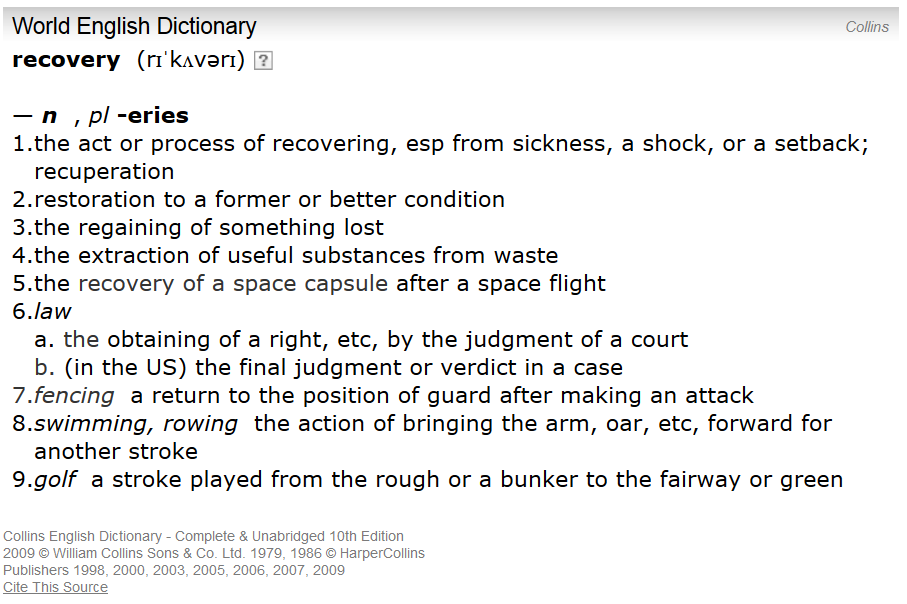
This is how the dictionary defines recovery:

Recovery Definition

What is recovery in the living world?

Recovery is life.

It’s living and moving forward with a tenacity learned in the depths of hell, a grip on enjoying all the little things and a determination to not go back. It’s knowing that even if I do go back, I have a road map to lead me back out again.

Recovery is self-care, self-compassion, and self-respect.

It is knowing that it is okay to not be okay sometimes. Recovery is celebrating both the ups and the downs. It’s getting to know yourself SO well that you recognize the difference between yourself and depression/mental illness. Recovery is knowing exactly what to do when the ugly beast stirs to keep it from waking completely. It is about arming yourself with a cadre of weapons guaranteed to slay the succubus.

Recovery is acceptance.

It’s being okay with the tough days and providing a soft place to land when they happen. It’s having a support system in place for the bleak days, one that will also be there for the good days. It’s understanding that sometimes, you’re gonna feel angry about your mental health and that’s okay. It’s learning the range of healthy and unhealthy emotions and knowing when to reach out for help.

Recovery is being imperfectly perfectly you.

According to Alexander Pope, “To err is human.” Perfection is a fallacy (so is control). It is an impossibility we set up in our minds, a standard most of us will not reach. Do the best you can with what you have. There’s a special kind of joy (and peace) to be found when you let go of any expectations you, life, or anyone else may have forced upon you. When you are truly yourself, you shine.

Recovery is personal.

We cannot compare our journey to that of others. There are similarities, sure, but we each carry our own luggage and travel our own road. Our stories are as different as we are from each other. Knowing someone else has traveled a similar road helps. But it is absolutely important to remember that just because someone was at point X by a certain point on their Y timeline does not mean you will also be at point X at the same time. There are SO many variables to every story. It is impossible to compare so stop doing just that.

Recovery is…..

Your turn. What is recovery to you? Share below.