Tag Archives: mental health

#PPDChat Topic – Creating a Menu for Mental Well-Being & Motherhood

ppdchat-11-18-13

We all know that once Motherhood crashes into our lives our nutrition takes a dive for awhile. Sure, some of us may manage to get great food after we’ve given birth and/or while we are running around after the little ones but some of us are grabbing whatever we can to keep ourselves alive as we rush around in the vortex of our children.

For those of us who struggle with mental health issues, including PMAD’s, nutrition is extremely important. What we fuel our bodies with does affect our brains. We need to be mindful of how we feed our minds – and not just with thoughts or events, but with nutrients.

Join me tonight for a very casual (read: not technical/medical at all) discussion about what we can do to improve our moods through the foods we choose to fuel our minds. Looking forward to chatting with you about what’s worked for you, what hasn’t worked, and what foods are better choices as well as how to easily incorporate these foods into a hectic lifestyle.

See you at 830pm ET, y’all!

veteran-infographic

When You Thank A Vet

Today marks Veteran’s Day here in the United States. It’s a day we set aside to honor those who have fought so valiantly for our country.

With the advent of technology, reaching out to Veterans to declare your support is easier than ever before. Businesses, organizations, individuals – everyone is sending a shout out to Vets today. It is amazing to see the support flowing forth.

But.

I think there is an aspect we often forget about as we reach out to give our thanks to the vets who have fought for us through service in various branches of our military.

It is important to remember they are human too. They have emotions, reactions, and they too, are remembering their journey in their own way as we lavish them with praise and appreciation.

Some may struggle with PTSD. Others are lost in thoughts of brothers in arms lost to battle. Others contend with the idea that those who thank them for all they have taught them are themselves the teachers and worthy of praise.

We forget, all too often, I think, the intense emotional aspect of war. The toll it takes on all of us. Perhaps this is because best summed up by this quote:

“Humankind cannot bear very much reality.”

T.S. Eliot, Four Quartets

Is war something we are unable to closely associate with human emotion because of the very nature of it? Is battle too fierce? The fighting too gruesome? Do our psyches not allow us to carry the traumatic alongside the sensitivity? Is this our brain’s way of protecting us from an emotional overload? Or is it because the majority of soldiers for so long have been men and therefore not allowed to operate as anything less than robotic, keeping them from processing the emotions battle swells within them?

We do not broadcast our losses on the evening news as often as we should, a point made in this deeply moving post about a citizen sharing a last flight home by a soldier. Instead, we relegate ourselves to separation from the tremendous loss and focus instead on the reunions of soldiers with loved ones. We are not acknowledging, in my humble opinion, the steep and tragic cost associated with prolonged battle. The loss, the heartache, the raw emotions steeped in battle and drenched in blood shed against tyrants who dare to threaten our freedoms, are far too great for humanity to bear.

We, for whatever reason, do not often equate humanity with soldiering. Empathy and compassion fails to mesh well with the ferocity of battle. So when soldiering and emotion intersects, as it often does on Veteran’s Day for so many, it can be triggering. It may leave some feeling overwhelmed and not knowing quite how to deal with the gratitude flowing their way.

It is not like Christmas or Thanksgiving. We are not celebrating, we are honoring. There are no gifts or celebratory meals. Instead, there is quiet recognition and thoughtful consideration of all that our veterans have sacrificed. Like anything else, we all choose to do this differently for it is intensely personal for those of us who have a veteran in our lives. Whether they be friends, brothers, sisters, fathers, mothers, grandfathers, or grandmothers, how we choose to honor their service and their memories is as unique as a snowflake which falls with the first snow.

We may choose to honor them quietly or we may make a public statement. For me, today, I am wearing my grandfather’s tag and will probably at some point watch Mister Roberts, a movie I used to watch with my grandfather quite often. Both of my grandfathers served in the Navy in WWII and although they never spoke of it with me, I knew they carried their experiences with them, as all veterans do. Military service is a part of their souls and the very fiber of their beings. Once you have served, there is rarely a time when you can untangle soldier from human. Therein, in my opinion, lies the challenge in coming to grips with the flow of gratitude on Veteran’s Day.

I only saw my grandfather cry once – when we were at a play meant to raise funds for the WWII D-Day Monument. As the telegraph notifications came in reporting the deaths of the soldiers in Bedford, Virginia, the hall went completely silent. Deeper than an audible silence; the kind of silence which envelops a room when there is great respect for what is occurring. I glanced over at my grandfather at this point to see his cheeks soaked in tears. I quickly looked away and struggled to hide my own flooded cheeks shortly thereafter. We never spoke of these tears but I never forgot them for they symbolized the emotional depths of war for me and always will.

For many, in particular those who have seen war since 2001, today is different. The memories are recent, the pain is ongoing, and they have joined the Greatest Generation in knowing the pain of war. Yes, the pain. War is not some glorified wonderful thing. It is not the Hollywood version where there is a rise to action, action, and then a conclusion. It’s messy, it rips families apart, it pushes soldiers to their limits and back again, and if they’re lucky, they get to come home, alive and still intact both physically and mentally. For all too many, this is not the case, and their wounds may not be visible to the eye.
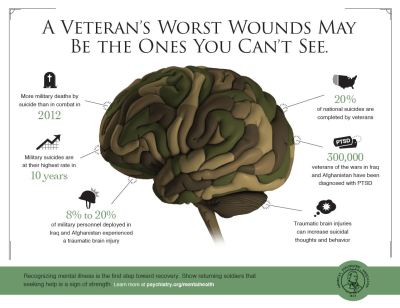
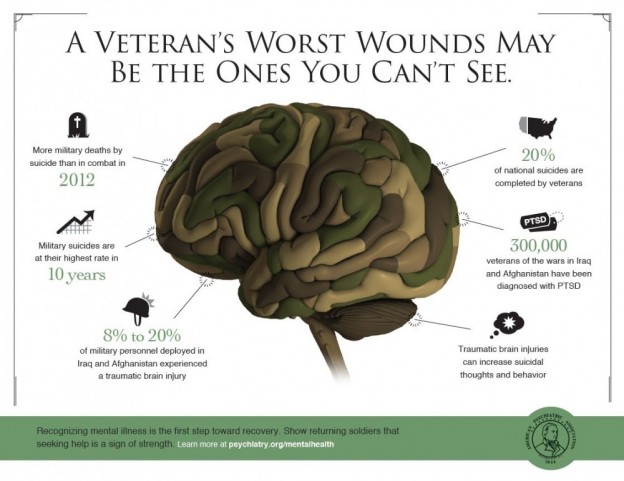
veteran-infographicSuicide rates among soldiers, for the first time ever, outnumbers the deaths occurring in active combat. There is PTSD, and number of additional other issues which, again, because of technology and advancements in mental health awareness & medicine, are now at the forefront of the adverse affects of war. Women who are deployed face a higher risk of Postpartum Depression which in turn, affects an entire generation. War truly leaves a mark on every one of us, both on and off the battlefield.

So today, when you thank a veteran, particularly a younger veteran, take the time to embrace that they may be filled with emotions they may not be ready for today as a result of the onslaught of gratitude. Take the time to realize that these brave men and women have lost loved ones, brothers in arms, and they are replaying this in their heads as you thank them for their service. Respect their journey but also take the time to check in with them and ask them how they are doing.

For they are soldiers, they are brave men and women, but beneath it all, they have a heart, a soul, and they have bled for us, some more than others. They deserve nothing less than our greatest compassion and understanding for the hell they witnessed on the battlefield as they fought for freedom from tyranny in our great country’s name.

ppdchat-11-4-13

#PPDChat Topic 11.4.13: Developing Self-Care Strategies

ppdchat-11-4-13

With the holidays rapidly approaching, it is time to revisit the topic of self-care. As women, we so very often forget to mother the most important person in our lives – ourselves. If we do not take the time to refill our souls and our bodies, we are useless to those around us. Self-care is not selfish, it is selfless for it allows us to give others more when we are giving from full capacity. Just as it is impossible to pour a glass of water from an empty pitcher it is difficult to pour ourselves into others if we are empty.

Go check out this worksheet and rate your level of self-care. What areas are lacking? Where are you thriving? Then I want to challenge you to doing what the worksheet says at the top – commit to improving at least ONE thing from each section every week. Baby steps matter and with the busy holiday season right around the corner, it is important we all remember to give the gift of ourselves to ourselves. While the small things are not at all a FIX for your issues, they matter and they add up over time.

It is also important to remember to care for ourselves during the winter months, particularly if we struggle with Seasonal Affective Disorder. Having moved back north where there is less sunshine during the winter, I am finding this a challenge. Feel free to jump in and share any strategies you may have to combat this common issue as well as discuss the challenge struggling with SAD in addition to PPD may bring.

Looking forward to chatting about the importance of self-care during the fall & winter months at 1pm ET & 830pm ET. See you on Twitter!

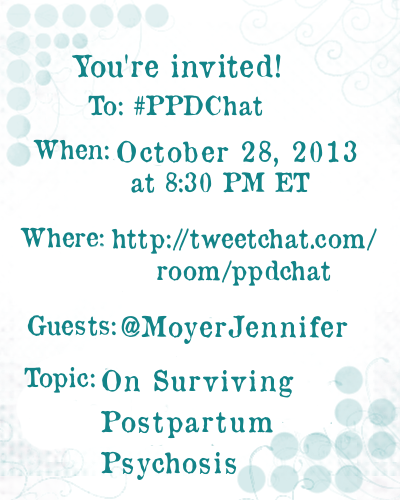
Upcoming #PPDChat Guest: Jennifer Moyer – On Overcoming Postpartum Psychosis

Jennifer Moyer Guest Announcement

On Monday, October 28, 2013, I’m thrilled to announce that the #PPDChat community will have the opportunity to chat with Jennifer Moyer, an amazing advocate located in Florida. According to Jennifer’s bio at her website, she “has experience as a postpartum support and education consultant, a certified postpartum doula and a speaker on mental health issues.”

The stigma surrounding a Perinatal Mood & Anxiety Disorder is rough enough – particularly because of the damage done when mainstream media confuses Postpartum Depression with Postpartum Psychosis which is a medical emergency. Even then, the damage also affects those who struggle with Postpartum Psychosis. While the risk is higher for both suicide and infanticide with a case of Postpartum Psychosis, not all mothers who experience Postpartum Psychosis commit the heinous crimes which pop up in the news all too often these days.

I know this can be a touchy subject for some but I hope you will join us as Jennifer shares her story and her journey toward recovery and advocacy with us at #PPDChat on Monday evening at 830pm ET. We will chat at 1pm ET about the myths and facts about Postpartum Psychosis as we lead in to Jennifer’s chat Monday evening.

No mother should ever be ashamed of or afraid to share her story. Let’s break down those walls together!

Jennifer MoyerJennifer’s mission is to bring hope and inspiration to individuals and families facing mental health challenges.  She is a mental health advocate.  She overcame postpartum psychosis.  She is a writer and speaker on mental health issues striving to increase the awareness, education, prevention and treatment of postpartum psychosis and other mental health issues related to childbearing as well as mental health, in general. Visit her website here.

How the @BostonGlobe got Postpartum Depression Wrong

With more news stories mentioning Postpartum Depression these days, it is becoming painfully obvious that reporters are scrambling to get their facts straight. Bless them for trying but sometimes, even with the best of intentions, they fall short. Like Karen Weintraub’s article “When the ‘baby blues’ are something more” at the Boston Globe on October 21, 2013.

Karen defends herself in the comments (all two of them at time of writing) about the term “baby blues” by saying that in her researching for this piece, she discovered there is such a thing as baby blues:

Boston Globe Comments

Kudos to Ms. Weintraub for doing enough research to realize that baby blues ARE distinct from depression.

BUT.

There are a multitude of omissions and errors within the article as it stands right now. Let’s go through them:

Ms. Weintraub breaks the Perinatal Mood & Anxiety Disorder experience into only three groups:

  • Baby Blues
  • Postpartum Depression
  • Postpartum Psychosis

Immediately, sirens sound. Particularly because the case study, a Nicole Caligiuri, a first time mother, states she felt “angry and anxious” all the time. While anger/irritability is a sign of depression, anxiety combined with anger is typically (in my non-professional opinion) more closely related to an anxiety disorder. Ms. Caligiuri, however, was diagnosed with Postpartum Depression.

By ignoring the additional facets of the PMAD spectrum, Ms. Weintraub does a severe disservice to those mothers who may be suffering from Postpartum Anxiety, Postpartum Post-traumatic Stress Disorder, or Postpartum OCD.

Weintraub states that 50-85% of new mothers experience baby blues, 14% experience postpartum depression, and a “fraction of 1 percent of new moms” experience Postpartum Psychosis. If you go by those numbers (at the higher levels), nearly 100% of all new mothers experience one of these three phenomena and none experience Postpartum Anxiety, Postpartum Post-traumatic Stress Disorder, or Postpartum OCD.

According to Postpartum Support International’s Get the Facts page:

  • Approximately 6% of pregnant women and 10% of postpartum women develop anxiety. Sometimes they experience anxiety alone, and sometimes they experience it in addition to depression. 
  • Postpartum Obsessive-Compulsive Disorder (OCD) is the most misunderstood and misdiagnosed of the perinatal disorders. It is estimated that as many as 3-5% of new mothers will experience these symptoms.
  • Approximately 1-6% of women experience postpartum post-traumatic stress disorder (PTSD) following childbirth.

But in Weintraub’s scenario, there isn’t room for the nearly 20-27% of women who develop these particular Perinatal Mood & Anxiety Disorders. As a survivor of Postpartum OCD, I find this troubling. Particularly because OCD can scare a new mother into thinking she is experiencing a form of Psychosis due to the horrific intrusive thoughts.

As I have mentioned multiple times, it is beyond important to differentiate the varying aspects of a Perinatal Mood & Anxiety Disorder. Why? Because when you lump Postpartum Psychosis sensationalism in with Postpartum Depression, things get murky. You scare new mothers who may be a bit depressed into thinking if they go get help, they will be thought of as potential criminals and have their babes ripped from their arms the instant they admit to feeling anything less than happy.

An additional issue with this article is the strong focus on early motherhood. The logic of this focus is evidenced by the study on which it is centered but a quick mention that PMAD can persist beyond early motherhood would have been a quick fix for this bias.

Why is it important to emphasize that PMAD onset can extend beyond early motherhood?

Often, many mothers do not realize they have issues until they are well into the 6th month or more. I have had mothers contact me at almost a year postpartum to share that they think something has been deeply wrong since the birth of their child but they did not recognize it until now. Many Perinatal Mood & Anxiety Disorders crop up within the first 2-3 months, often immediately after the period of baby blues, but some mothers do not recognize them or even get hit with them until much later. PMAD’s can crop up  within the first 12 months after birth and even then, may not be recognized until much later. But this information is not mentioned anywhere in the article nor are we ever told at what point Ms. Caligiuri sought help.

I deeply appreciate Ms. Weintraub’s effort to reach out to Dr. Katherine Wisner and Dr. Michael O’Hara, respected experts in the research field of Perinatal Mood & Anxiety Disorders, however, I wish she (or her editor) had taken the time to allow this article to be a bit more clear regarding the wide scope of Perinatal Mood & Anxiety Disorders. I also wish a side bar had been included to resources for women and families who are struggling with these issues, particularly given that Ms. Weintraub included this quote from Dr. O’Hara:

Social support is probably the most important thing to provide a new mother, who is at a particularly fragile point in life, said Michael O’Hara, a professor of psychology at the University of Iowa, who has been researching and treating postpartum depression for three decades.


Postpartum Support International will connect new mothers with social support. Also, specifically in Hadley, Massachusetts, there is Mother Woman, a fabulous organization who is making fantastic strides toward improving access to support and care for struggling women & families. Advocates in the trenches, such as the volunteers with PSI and Mother Woman, recognize how important it is to have peers support each other so they do not feel all alone in the dark. It is an oversight that neither of these organizations are mentioned anywhere in Ms. Weintraub’s piece.

Overall, Ms. Weintraub, despite making a few blunders, seems to handle the issue at hand with a respectable grace. The study at the heart of the article focuses on the development of depression in children born to mothers who struggled with depression but Ms. Weintraub is fabulous in her handling of this issue, particularly with this paragraph:

But parents shouldn’t feel like they’ve ruined their child’s life if they go through a period of depression, Pearson said. The increased risk of depression in their children is small. Overall, 7 percent of teens are depressed, compared with 11 percent of teens whose mothers were depressed early in their children’s lives.

She side-steps the potential onslaught of guilt and gracefully allows parents to breathe a sigh of relief by including this information from the study’s co-author.

As I stated in the opening, coverage of Perinatal Mood & Anxiety Disorders is greatly improving. But we still have a long way to go to get to fully informed reporting. For the most part, Ms. Weintraub’s article is generally free of sensationalism, includes quotes from respected experts, and manages to allay any potential guilt a new mother with a PMAD may feel in reading it. However, it is still just a few small adjustments away from being truly spectacular and informative.