#PPDChat Topic: More than Tears: Coping when PPD gets angry, anxious, and more
Leave a reply


It’s a lazy Sunday around here. We stayed home from church this morning (I know, I know). I would have stayed home regardless due to strep throat. The family didn’t go because well, it’s been pretty stormy here and they did not want to be out and about in a downpour. I can’t say that I blame them. Sometimes, it’s best to stay home and enjoy a quiet day at home.
When I was a little girl, I listened to a lot of Christian music. Among the Christian artists I really loved was one in particular – Sheila Walsh. Imagine my surprise when my daughter received a Little Princess devotional written by none other than Sheila Walsh. I had no idea she had begun writing devotionals.
Then, I discovered she was on Twitter.
Oh my heart.
She’s quirky, inspirational, compassionate, and all around awesome. I love this woman to pieces.
Lately, she’s been promoting her most recent book, The Shelter of God’s Promises. I checked it out on Amazon and really liked what I saw. The reviews were excellent too. I rushed out to a local store to purchase it and started reading. It got set aside due to sick kids, life, etc. But I want to dive back into it. And I want you to dive in with me.
So here’s the deal:
Pick up a copy of The Shelter of God’s Promises by Sheila Walsh either through Amazon or your local bookstore. For me, it was cheaper to get it locally plus I didn’t have to pay shipping. Start reading. In two weeks, on April 10, I’ll start with the introduction. I won’t be going too in depth as far as content of the book but will instead be focusing on my reaction to the book and the lessons it offers. I hope you’ll read along with me and start a discussion in the comments.
I can’t wait to begin exploring The Shelter of God’s Promises with you. I have a feeling it will be a very powerful study. Life-changing for some, even.
Happy Saturday, y’all!
It’s been grey here all day. Within the past hour, we have had torrential downpour, thunder, no lightning, and the sky is now a bright white instead of a dark lingering grey. I have been down for the count since Thursday night with Strep. I’m on the mend though, and managed to go for a drive this morning to escape the house. I ended up in a little town named Good Hope. Lately it seems to be where my car likes to take me when I need to get out and breathe. You can read more about my journey there at The 3six5 Project tonight at 8:00p.m.
There has also been an air of tension over my hometown for the past few days. The situation has resolved as of early this morning and we are all breathing much easier today. I’m not disclosing the reason because I would hate to trigger anyone inadvertently. All that matters is that it resolved without any further tragedy and all is well once again.
Today I am grateful for local law enforcement, tylenol, ibuprofen, and antibiotics. And I cannot wait until I can hug my children close again!
As always – the answer below is not meant to be complete or professional in any sense. Always seek a professional’s opinion in regard to your own situation. Everyone does not always have the same experience.

Today’s Question: Is Postpartum Depression only Tears?
No. It’s not.
Sure, tears may be involved somewhere. But they may not be involved at all. I have had so many mothers share with me that they didn’t think they had PPD because they were not crying lumps. Thing is, there are many different Mood Disorders on the Postpartum Spectrum. These include but are not limited to:
You’ll notice that I did not include the Baby Blues in the above list. It’s not there because it’s not considered a psychiatric disorder. The Baby Blues happen to many mothers – up to 80%. When the blues last longer than a few weeks and/or go beyond simply weepiness or moodiness, it is time to get checked out by your doctor.
Postpartum Psychosis is a medical emergency. Postpartum Psychosis has a fast onset. It may involve hallucinations (both auditory and visual), an incapability of making decisions for oneself, and delusional thinking. A mother with Postpartum Psychosis should NOT be left alone either by herself or with an infant. This means not even in the next room – someone needs to be with her at all times. She should also be admitted to the ER as soon as possible.
Postpartum Obsessive Compulsive Disorder, the disorder with which I struggled, involves what are called intrusive thoughts. These thoughts often include visualizations of harming our children or ourselves, but unlike Postpartum Psychosis, we are immediately repulsed by these thoughts as soon as they flit through our heads. We struggle to control them and often will create a blizzard of IT’s with no end in sight as we get lost in the ever expanding tunnel of negative “what-if” thoughts. I recently wrote a post about whether or not these thoughts go away. They fade and get easier to control but they never really go away, a difficult reality for many to face. I am a little over 5 years past my last PPOCD episode. I still have the occasional thought but I am able to stop them quicker and they do not happen nearly as often.
Postpartum Post Traumatic Stress Syndrome can be triggered by a negative birth experience or anything within the birth/newborn process which is perceived to be traumatic by the mother. The worst thing you can ever say to a mother with PP PTSD is that she’s silly for being so upset over such a small thing. Clearly, if it is causing her issues to the extent that it interferes with her daily living, it is not a small issue for her. Mothers with PP PTSD will avoid the place at which the triggering event took place – such as the hospital, doctor’s office, midwife’s office, etc. She may also struggle with graphic triggering dreams, intense anxiety, panic attacks, hyper-vigilance, and flashbacks. It is important to note that PP PTSD can occur in conjunction with any of the other mood disorders, and may even be the triggering point for the development of other disorders such as Anxiety and Obsessive Compulsive Disorder. This is my own opinion because I believe I had PP PTSD with my first and second daughters which then led to my OCD. My first birth was very traumatic and my second birth led to a month long NICU stay for our daughter.
Postpartum Anxiety is marked by constant worry about things which don’t need to be worried about, hyper-vigilance, overwhelming sense of doom, inability to sit still, racing thoughts, and possible physical symptoms such as dizziness, hot flashes, and nausea. There is help available for Postpartum Anxiety and you are not alone in struggling with this.
Postpartum Depression, while involving symptoms of crying and sadness, also involves feelings of anger and irritability. Not many people think of depression being angry, but for many, this is how it manifests. You may also become overwhelmed with feelings of shame, sadness, and guilt. Motherhood is supposed to be a happy time for us mothers. For those of us who develop a Postpartum Mood Disorder, we become ashamed for not feeling how society expects us to feel. We struggle to ignore these feelings, leading only to a more serious and urgent situation down the road.
Bottom line, Postpartum Depression is not just tears. It might be anger, irritability, anxiety, intrusive thoughts, hallucinations, flashbacks, panic attacks, shame, guilt, and hyper-vigilance. Just because your wife isn’t weeping her way through her postpartum period does not mean she does not have a Postpartum Mood Disorder. There are so many varied ways in which this can manifest.
Please also remember that Postpartum Thyroiditis may masquerade as a Postpartum Mood Disorder. It is important to get your thyroid levels checked to rule this out as if it is Postpartum Thyroiditis, an entirely different type of medication will need to be used to treat the condition. In fact, anti-depressants may make things worse if a thyroid issue is the root cause.
Don’t tell her to snap out of it. Tell her these things. Tell her you love her no matter what. Be there for her. Let her cry on your shoulder if she needs to do so. Encourage her to see a doctor but know you can’t force her to do this UNLESS she is a clear threat to herself or to others (ie, threatened suicide or harm to others). Recruit help for housework. For childcare so she can rest. Having a baby is hard work. Raising one while struggling with a Postpartum Mood Disorder is hell. We need all the help we can get. She may not say thank you immediately but one day, in the future, she will be ever grateful for all you did for her when she needed you most. She will say thank you. One day.

":-)" by victor_nuno @flickr.com
I’ve always thought that a big laugh is a really loud noise from the soul saying, “Ain’t that the truth.”
~Quincy Jones~

Meet Selena. She blogs over at Because Motherhood Sucks. Selena submitted this story a few weeks ago and I have been dying to share it with you. I’ve been busy with sick kids among other things. I’m thrilled to finally share her words with you here as the Postpartum Voice of the Week. I hope you’ll find her words and story as powerful as I do.
I was no stranger to depression. I had my first experience with being hospitalized when I was 13 and was treated and released only to succumb again and again and again throughout my teens and into adulthood.
I was on Prozac when I found out I was pregnant and for some reason this didn’t interest my obstetrician in the least. She basically told me to taper down if I wanted, but that she was completely comfortable with Prozac during pregnancy. I stayed on a low dosage and had a relatively uneventful pregnancy. I say “relatively” because although my health and the development of the baby were totally fine, I was exhausted, nauseous and miserable throughout. So much so that I remember having other mothers ask me if people were always touching my belly and I realized that NO ONE had EVER approached me to touch my belly. Of course, I suppose I wasn’t completely approachable.
I just ASSUMED I would experience Post-Partum Depression. I read up on it. I knew the symptoms. I decided that I didn’t care about the type of birth I had or whether or not I breastfed. The goal was always a natural birth and breastfeeding, but if it didn’t work out that way, I was not going to be disappointed or hard on myself because I didn’t want any added stressors to get depressed over. My mother would be there to help me for 5 weeks and could stay longer if I needed the help.
As far as I was concerned, I was perfectly okay with depression. It was an old friend who overstayed her welcome. It was annoying, but familiar. I would deal with it and move on. No problem.
Until it happened.
I woke up to the sound of the baby crying and was overwhelmed with a sense of utter terror and panic. I was alone in the house with her. Her father had gone back to work and my mother had left the day before. In the 5 weeks that my mother had been there, I had experienced a mild case of “baby blues” and gotten over it. I had no idea how I was going to handle this gigantic task that was ahead of me. I had to get her up and feed her and change her and dress her and find time to eat something myself and keep her calm and happy and get her to nap and on and on and on. And I would have to do this every day for the rest of my life.
My kid had severe colic. She screamed non-stop for about 12 hours a day. And the doctors just told me she’d grow out of it. I knew I couldn’t do it. I had made a terrible mistake. This was all my fault. What was I thinking when I assumed that I knew the first thing about being a mother? And what kind of a failure was I? My ONLY job in the whole world is to keep her comfortable and alive and she hates me. She never stops crying and she hardly sleeps. How could I do this?
I called her father. “Please come home.”
He told me he couldn’t come immediately but he would be home when he could. And when he came home he found a sleeping baby and a complete mess of a mommy. I couldn’t stop crying. I wanted to leave. I had made a terrible mistake. I hated this baby. She didn’t even like me.
He took over and I tried to sleep.
He stayed home for the next few days. I tried to sleep when I could but I heard her crying all the time. I got earplugs and ran a fan and I heard her screaming all day long. I got mad and wondered if he hadn’t left her alone, and I stomped out into the living room only to find a sleeping baby and daddy on the couch. I was hearing things.
I was terrified. I didn’t want to touch her. I decided that I was going crazy and would have to leave her for her own good so she should get used to her father taking care of her. I didn’t want to hold her. And yet, I wanted nothing more than to nuzzle her and love her and have her little head on my shoulder and hear her breathing in my ear. In the middle of the night, I would go get her to hold her and I would cry because I didn’t understand why I wanted to leave her so badly. But I did. I wanted to run.
I had an older friend come over to let me shower one day and the baby didn’t cry for her at all. For her, it was fun to hold the baby. It was easy and enjoyable. I marveled at the way she handled the baby and how she seemed to entertain her by doing nothing. I cried because it was so hard for me. I didn’t know what to do with a baby. I didn’t want to hold her and I didn’t know where to put her down and when I did, she just screamed anyway so I got a sling and she hated that. She hated her bassinet and she hated the floor and she hated the couch. I hated this kid.
Again, I called her father at work. “I think you can take a baby to the fire department and leave them, no questions asked. I am going to take her there, okay?” He told me that was crazy talk. He said the words, Post Partum Depression.
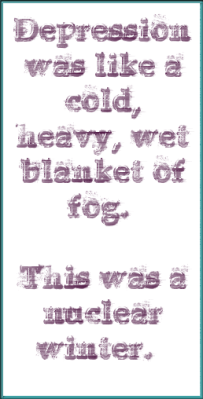 THIS was not depression. This was something else. I knew depression. I could handle depression. This was horror. This was terror. This was pure guilt and anger and infinite regret. This was like depression’s more evil, less apathetic twin. Depression was like a cold, heavy, wet blanket of fog. This was a nuclear winter.
My mother came back out to help. She took charge. She sent Ben back to work and got me an appointment with a doctor. She kept the baby busy and let me take a shower. She forced me to eat. My mother, not for the first time I am sure, saved my life.
After a few weeks of medication and 4 or 5 sessions of therapy, I was feeling a bit more steady. One morning, I was finished feeding the baby and talking to her on the bed and she looked up at me and smiled. I loved her right then. I knew without a doubt that I loved her and I never wanted to leave her. I told my mom it was safe for her to go home. I made some plans to go to a Post Partum group and began to reach out to my friends.
I would be lying if I said that I was okay right away. Being a stay at home mom requires a lot of planning your days and staying busy and it took me a really long time to find places to go to break up the day. I decided to work part time so that I had a life outside of the baby and that helped. I joined a Mommy Meet-Up group and that helped too. Mostly, I went easy on myself and realized that babies can cry and it is not an indication of my skills as a parent.
Three years later, the colic has stopped and the depression is under control but if I said I was completely thrilled with motherhood I would be lying. It has been a really difficult road for me and as a bit of a control freak, motherhood is a HUGE adjustment.
The thing that has helped me the most though, is being okay with the idea that I am simply NOT one of those women who believes motherhood is the most wonderful and thrilling experience that anyone can have. I started to blog about it and learned (mostly by anonymous comments) that there are many mothers out there who feel the same way. Motherhood is work. It is a job!
But I continue to work on it and try to find the happy moments among all the day to day drudgery. And when my three year old turns into a total monster and I have that moment of thinking how I wish I could run away, I remember how it was when I REALLY wanted to run away and that helps me to know that it’s going to be okay.
It will be okay.
……………………..
BIO:
Selena is a reader, a book person, and a self-affirmed pessimist. She lives in Upstate NY, has her hands full with her diva-esque preschooler and hopes to one day be able to write full time.
Find out more about her love of motherhood at Becausemotherhoodsucks.blogspot.com.