Tag Archives: Postpartum Mood Disorder

Baby after Postpartum Depression: Tips?

Postpartum Mood Disorders not only cloud your bonding time with your infant but they also cloud future decisions regarding childbirth.

If they choose to have another child or find themselves unexpectedly pregnant (I’ve done both), Survivor Mamas ready themselves not only for the new baby but for the very real possibility of another brush with a  Postpartum Mood Disorder.

This is one of the biggest questions I get as the Community Leader at iVillage’s Postpartum Depression Message Board.

It’s such a big question that Karen Kleiman has devoted an entire book to it entitled “Having a Baby after Postpartum Depression: What am I thinking?”

One of the wonderful women I’ve come in contact on this journey of mine has recently embarked on trying to conceive another baby. Understandably, she is concerned about experiencing postpartum depression again. She’s blogged about it here. Have any advice for her? Have you had a baby after a Postpartum Mood Disorder and not relapsed? Go show her some love. Don’t forget to leave some tips here too!

Just Talkin’ Tuesday: Defining Postpartum Mood Disorders

Welcome to my blog if you’ve traveled here from 5 Minutes for Mom’s Ultimate Blog Party for 2010.

This is my second year of participating.

The following post is meant to spark discussion as well as explain why I blog.

Won’t you come on in, sit down, and have a cup of tea?

I’m so very glad you’re here.

And if you stick around, there’s a meaningful giveaway at the end.


Since my first brush with a Postpartum Mood Disorder, I have come to learn so very much about this world I consider myself fortunate enough to have stumbled into.

Fortunate? To have stumbled into a Postpartum Mood Disorder? What the hell is wrong with you?

Isn’t that a bit like being thrilled to pieces about stumbling into a briar patch?

While I certainly wouldn’t wish a Postpartum Mood Disorder on my worst enemy, I am eternally grateful for the growth it has brought to my life. For the changed relationships, the maturity, the amazingly strong women it has brought into my life. I am eternally grateful that because of my Postpartum Mood Disorders, I have rediscovered my passion for writing. For supporting new mamas as they navigate the very dark and frightening valley of Postpartumville.

For me, as a recovered two time fighter, I define Postpartum Mood Disorders as the source of my strength. As the fertilizer from which the bloom I am constantly reinventing each and every day relies upon. My Postpartum Mood Disorders do not define me anymore. They used to – they used to fill me with a deep sadness, shame, anxiety, fear, hopelessness. I feared sharing my story. The very thought of having to tell one more person what happened to me made me want to crawl into bed, pull up the covers, and never come up for air again. Until I realized I could turn and fight. Turn and kick my PMD’s ass. So I did. And I kicked it hard.

So many women out there deserve to know they are capable of the same strength. They need to know that deep within them lies a spring so full of strength they can’t even see it or sense it until they desperately need it. Then, and only then, will the waters filled with strength begin to flow. Once that flow is turned on, there’s no turning back. Some of us need help turning it on and will need to take medication or talk with a therapist. Some of us will find help and hope in exercise and natural approaches. But just as there is no one size fits all for women, there is no one size fits all for Postpartum Mood Disorder recovery. You have to do what is absolutely right for you, your situation, and your family. And you should NOT be made to feel guilty about that at all by anyone.

This is why I blog, why I wake with the goal of connecting at least one mom with the feeling that she is not alone as she decides to turn and fight her Postpartum Mood Disorder. I have not failed in my daily mission in over three years. That’s over 1000 women and counting! There are no plans to stop this train anytime in the near future either. In fact, there are blueprints on the way to expand this bad boy.

Postpartum Mood Disorders have made me incapable of taking any moment with my family for granted. Incapable of not grasping the deeper meaning of my life and the lives of those around me. My PMD experience has brought a silent clarity to my life. And for me, it’s been absolutely instrumental in bringing my relationship with God back to where it needs to be. And for that, I am certainly eternally grateful.

When you are faced with any illness, you have a choice. You can turn and fight or you can succumb. There are those who have succumbed to their Postpartum Mood Disorders. And for them, for their families, their loved ones, I mourn. But I understand. I know how they reached that point. Because I got dangerously close to it myself. And if you ever wondered what someone who has considered suicide or held suicidal ideations is like, that person is like me, like you, like the barista at Starbucks, the Judge at the courthouse, the Principal at your kid’s school, like the cashier who just smiled at you at the grocery store – the bottom line is that mental illness, just like cancer, can hit any of us at anytime. It’s unpredictable and extremely difficult to prevent even if we do everything right.In order to help prevent suicide, it is important for us to understand the warning signs. It’s important for us to be a friend to those who are struggling. To not judge them when they open up to us. It’s especially important to continue support as they are in the early stages of healing.

I bring up suicide because it ties in with my giveaway. Steve Krupnik over at NoBlu has graciously agreed to give away one of their gorgeous Sunstone Pendants. The design was settled on

“After countless hours of research, collaboration and design we created our organizations symbol, the noblu eclipse. The design is our interpretation of a solar eclipse created to inspire people to support others faced with the challenges of all form of depression and suicide prevention. If you think of the sun as the light within each one of us and the moon as the “visitor” that may block the light of inspiration you can see why we selected this glowing option. The eclipse is a reminder to look for help when we need it, to help others when they need it and inspire everyone to make a difference.”

Those of you who are regular readers know that I’ve never done a giveaway before. But I feel very strongly about the mission of NoBlu and want to share it with you. In order to be entered, leave a comment here. A winner will be chosen on April 19th at 8:00pm EST via Random.org.

So let’s get to just talking – how do YOU define Postpartum Mood Disorders? What has your experience meant to you? How have you grown?

Not had a Postpartum Mood Disorder? Have any questions about them? Want to know how to help a loved one? I’ll answer those too.

Prefer not to comment with either of those topics but want to be entered in the giveaway? Just visit NoBlu and post the first line of their mission statement as your comment.

Therapy Choices for the Postpartum Woman

Once diagnosed with a Postpartum Mood Disorder, you are then faced with a literal bevy of choices regarding your path to wellness.

Some doctors may toss pills at you. If that happens, run. Run very fast and very far away from any physician who shoves anti-depressants your way before you’ve even finished describing what’s wrong. A good prescribing doctor will sit down with you and hear you out before grabbing for his pen and pad (or these days, keyboard and internet connection). A good physician should also run a couple of simple blood tests first to rule out thyroid disorders or anemia which need completely different types of medication to show improvement.

Some doctors may suggest psychotherapy. And that is where things start to get a little sticky. What kind of talk therapy? Will there be a couch? Will it be comfy? Will I have to talk about how my Great Aunt Edna used to kiss me on the cheeks and leave funny lipstick stains? Will I have to talk about things not related at all to my current state of mind? Will I be hypnotized? Or any other strange mumbo jumbo I’ve seen happen on TV or in the movies or from my best friend who found this website and…

Hold the phone there.

Cognitive Behavioral Therapy proved to be the best option out there for me. There was a couch but I didn’t lay down on it. I sat cross-legged on it as I drank coffee and chatted with my therapist. She sat in a really cool rocking chair with a foot stool. I got along fabulously with my therapist. That’s not to say we were bestest of buds but she knew what she was doing, just let me talk and work a lot of my issues out. I did occasionally talk about things in my past but it wasn’t at all like “So, you were born… let’s start there.” She met me where I was and let things fall where they fell. Or at least she seemed to. She did ask questions to get me to think about issues and how I was reacting to them. I had not planned on staying in therapy for long but once I became pregnant again, I made the decision to stay in through my pregnancy. Therapy gradually stopped at about 6 months postpartum of that pregnancy as we scaled our sessions back.

While I will not be covering every single last type of therapy out there, my goal is to provide some basic information for the most common therapies  used with Postpartum women.

At the top of the list is Cognitive Behavioral Therapy which is actually a blanket term for several types of therapies with similar traits. Primarily Cognitive Behavior Therapy (CBT) promotes that WE have power over our moods through our thoughts. You can read more about it by clicking here. A great resource now available for women and clinicians alike when it comes to treating Postpartum Depression is Karen Kleiman’s Therapy and the Postpartum Woman. You can read more about it by clicking here. (In the interest of full disclosure now required by the FTC, I have not been compensated at all for including this link. I sincerely believe it’s a good resource.)

EMDR or Eye movement desensitization and reprocessing is gaining popularity as an option. EMDR is most effective with Post Traumatic Stress Syndrome. You can read more about this approach by clicking here.

Peer Support/Group therapy is also an option. The primary benefit of this option is the realization it provides to women of not being alone. They really aren’t the only ones having a panic attack when they get in a car or experiencing frightening thoughts prancing through their mind at the most inopportune moments. Many times this option is a cost-effective option as well because many groups do not charge. A group led by a therapist may only charge a small fee such as $10-15 for attending. While peer support should absolutely not replace professional medical care for Postpartum Mood Disorders, it is an important aspect to add to recovery. If your area does not have a local peer group, you can find help online. The Online PPD Support Page has a very active forum for postpartum women. You can also visit the iVillage Postpartum or the Pregnant & Depressed/Mental Illness Boards. (Shameless plug on the iVillage boards, I am the Community Leader for both.) Another bonus of peer support? It reduces the recovery time.

Pharmaceutical therapy is also an available option. Some women are against taking medication and that’s perfectly okay. No one should ever be forced to take medication. Typically, pharmaceutical therapy is paired with another type of therapy. In fact, combining pharmaceutical therapy with a type of Cognitive Behavioral Therapy has proven to be one of the most successful approaches for the Postpartum Woman. Sinead O’Connor really put it best during an appearance on Oprah in regards to the function of psychiatric medications. They are the scaffolding holding you up as you revamp yourself. There are risks involved with taking medications and you should absolutely educate yourself, talk with your doctor, and if you end up deciding to take medication, be sure to inform your child’s pediatrician if you are nursing so they can be involved in monitoring for any potential issues.You should also familiarize yourself with the symptoms of Serotonin Syndrome, a fast-acting reaction which occurs for some people when they do not metabolize medication quickly enough. The build up results in a severe toxic situation. You should also avoid stopping any pharmaceutical therapy without consulting with a physician. Stopping suddenly can cause very negative symptoms similar to Serotonin Syndrome. If you have any signs or symptoms of Serotonin Syndrome, get medical help immediately.

For more serious cases of Postpartum Depression that do not respond to medication, Electroconvulsive Therapy may be suggested. ECT has come a long way since the 50’s and is a viable choice for many women who do not respond to medication. Now, I am not saying that if you choose not to take medication, you’ll be given ECT. This is for women with severe depression who cannot metabolize or do not respond at all to medication. Choosing not to take medication does not buy you an ECT ticket at all.

For women who want to use a more natural approach, there are a lot of choices. Again though, I have to urge you to make sure you are seeing a professional during your recovery. Don’t take something because it worked well for Aunt Martha. Check with your doctor and make sure it’s applicable to your situation and okay for you to take in combination with any other medication you may already be taking. Be sure your naturalist or herbalist is licensed and trained. You’ll also want to make sure that any herbs/natural supplements you are taking are compatible with breastfeeding if you are doing so. You can visit the blog over at Rebuild from Depression for a food/diet based approach.

Note: I had a reader, Steve, from Noblu.org leave a comment regarding IPT or Interpersonal Therapy. You can click here to read his comment. Thanks, Steve, for stopping by and sharing your knowledge with us!

As you can see, there are a lot of options available if you are diagnosed with a Postpartum Mood Disorder. More and more practitioners are becoming familiar with these disorders. More help is available today than even 6 years ago when I was first diagnosed. Remember to ask questions when choosing a therapist, advocate for yourself and what best fits your personal lifestyle philosophy. Don’t settle just because you want to heal. You have the power to say no. It’s your body, your mind, your say.

Tomorrow we’ll be discussing some things you can do on your own to help your recovery along. Stay tuned!

Speaking up across the blogosphere 10.30.09

I know, I know, I’m a day late. I have had a sick kid and now I’ve got a sick husband. Last night I crashed well before 11p which is a record for me as most nights I don’t go to bed until midnight or so. Life. It happens.

I’ve got a really great stories for you to read today. Enjoy, show some support, and thanks for sharing the journey!

Brittani at Holding Little Hands shares the contrast between her first and second postpartum experience. (Having a great postpartum experience the second time around really does make you realize you were robbed the first time around. Coping with the ensuing anger/guilt can be difficult!)


Just Talkin’ Tuesday 06.30.09

With last week’s debut so full of seriousness, I thought it’d be best to balance things out a bit with a lighter topic.

Sleep!

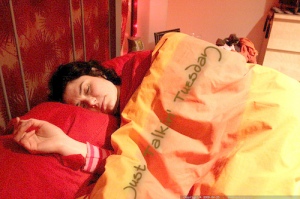
sleeping mamaAs parents, we all know how meaningful sleep can be – it’s precious lifeblood which lets us function – and when we don’t get it, World watch out! Unfortunately, those of us who struggle with a Postpartum Mood Disorder on top of the common parental experience of dazed consciousness are really in trouble. You see, it’s been proven over and over in research that sleep has something to do with our psyche. And guess what – lack of sleep can exacerbate symptoms of Postpartum Mood or Anxiety Disorders! Great, you say? Yeah, well, that was my reaction too when I first read the research. I mean, really, why did they even bother researching this topic? Isn’t it common knowledge? BUT… they did research it… and now we have something concrete to point to when our beloved partners are befuddled at our new-found obsession with sleep.

So here’s today’s topic:

Share with us what effect (if any) sleepless nights had on your Postpartum Experience. Did you sleep? Did you not sleep? When you woke up, were you rested or did you wish you could go back to sleep? What strategies did you use to help regulate your sleep? Did you read? Watch TV? Play on the Internet?

Here are some basic suggestions for those who are STILL struggling with sleep.

Get into a routine. At a certain point in the evening (if you can – we all know how unpredictable babies can be!), start a certain chain of events that will lead to you crawling er, collapsing into bed.

Once in bed, if you lay there awake, GET back up and go somewhere else. Watch TV or read for 30 minutes. Bathe, shower, drink some hot milk. Then get back in bed. Don’t stay in bed if you’re awake. This will cause you not to associate bed with just sleep. (which completely defeats the purpose!)

Have your partner take a night feeding and let you sleep for at least 5-6 hours at night. (Even if you’re nursing DO this – and have your partner get baby ready for nursing by changing diaper, etc, so you can get a few extra minutes!)

Remember – if you are not sleeping and/or have difficulty sleeping for more than a week, call your doctor. This is not the time to hold off on getting relief!

You can read more at this website about sleep disorders and difficulties.