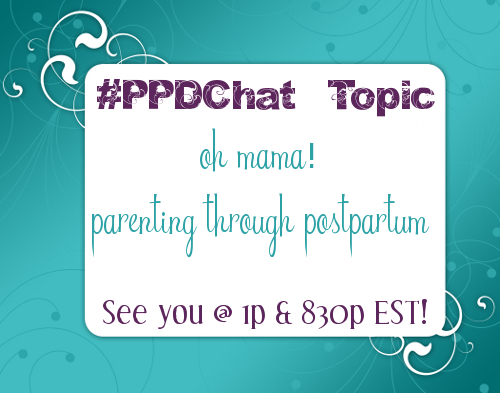
#PPDChat Topic: Oh Mama! Parenting through Postpartum Depression
Leave a reply

The following piece is an original story which was submitted for consideration. The author takes you from one of the darkest places she has ever been in to a place in which she offers hope to others. She’s still struggling in the midst of it all but thankfully has hope on her team these days. Without further ado, I give you this week’s Postpartum Voice of the Week:
 I didn’t have a “mom” growing up. I had no one to teach me right from wrong, no one to talk to, no one to look up to. My mom was physically there, just enough to scrape by with the title of “mom.” When I needed her to get through some of the darkest times of my life, she wasn’t around. I was so miserable having someone who was supposed to be there, but who wasn’t. I had promised myself that I would be the mother to my kids that I never had.
The time came for me to be mom when my first child was born in 2008. I was overjoyed, ecstatic, blessed to have such a title and to give everything I had to this little baby. We welcomed his younger sister into our family in early 2010, and with that, our family was complete. I was ready to raise these children in a family full of love and be the best mom I could possibly be. I was meant to be a mom, it was the only aspiration I ever had.
Having had a difficult childhood myself, I knew the face of depression. I understood feelings of being worthless, hopeless, and simply not good enough. What I didn’t know was that these feelings could accompany the birth of a child. After my daughter was born, things gradually started getting worse. I would become irritable with every cry, angry every time a bottle wouldn’t soothe my crying little one, and just hostile when things weren’t going the way I had planned. Six months had gone by; I had brushed the feelings off my shoulder as if they were “normal.” I had 2 kids under 2, things were supposed to be hectic, right? Running on very little sleep, being needed by two kids simultaneously with only 2 hands was enough to make any mom a little discouraged when things were rough and there was no help in sight.
Six months postpartum, I had noticed I wasn’t getting better. The irritability was at its worst, I had those same feelings of worthlessness that I had once experienced, I had no desire to take care of my kids, I had no desire to even take care of myself at this point. I let all the housework go, I cried at the drop of a hat even when I had no logical reason for crying, I started spending more time in bed, and nothing seemed worth it anymore. I had awful thoughts of leaving my children, my family, and never looking back. I just didn’t want anything. I felt like a failure; I wasn’t even good at what I wanted to be for so long…a mom. My children didn’t deserve me anymore. I kept thinking of my mom, and how there were times I wished she weren’t around-that she weren’t my mom. I didn’t want my kids to grow up wishing I wasn’t their mom or that I wasn’t around because I was a spitting image of my own mother. I thought taking myself out of the equation was the best decision for my family. I whole-heartedly believed someone could do my job better.
No matter how much I wanted to in that moment, I couldn’t ever leave my children. Ever. I knew something was wrong, and I needed help immediately before such irrational thoughts became my reality. I asked my husband to drive me to the hospital, that it was an emergency. He really had no idea what was going on, my feelings were kept to myself because I didn’t want anyone to think bad of me or that I was a bad mom for having such thoughts. After being evaluated for an hour, I wanted to walk right back out the doors I walked in. I was scared; there was no way I belonged there. Seeing other patients walk the halls with their head down, the screams that came from rooms down the hall that warranted a handful of doctors to hurry off, I knew this was a mistake. My anxiety was too much for me to handle at this point. The evaluating nurse asked me many questions that left me with feelings of shame. How could I have such deep, dark feelings when I have two beautiful children at home needing me? Needless to say, I was admitted. There was no turning back, I was there and there was no way out. Although I knew this wasn’t the right place for me, I made the decision to get everything I possibly could out of this hospital stay. I told the numerous psychiatrists and therapists I saw on a daily basis exactly how I felt, why I was there, and let them in on my life (which is something I don’t do until I have full trust in a person). Against medication from the beginning, I openly tried whatever meds they wanted to put me on because I was desperate to get better. I was diagnosed with PPD/PPA/PPOCD. What was that? I had no clue there was such a diagnosis. I was never talked to about this. After nearly a week of being there, I was released…sent on my way. I had the number to a psychiatrist and a therapist whom I was instructed to follow up with. I did just that. The psychiatrist changed my meds completely, and it was only weeks before I started to really see an improvement in my behavior. I’m still working on finding the right combination of meds to keep me stable, and we’ll go from there.
What I can tell you is that I now have hope that things will get better. If someone would have told me something, anything, about PPD ten months ago, I wouldn’t have hit rock bottom before reaching out for help. I wouldn’t have gone through four months of absolute misery thinking of how bad a parent I was and how guilty I felt that I couldn’t take care of my own children. I saw multiple healthcare professionals during my months postpartum- the OBGYN, my family doctor, my children’s doctor, nurses at hospitals when my kids were sick, yet no one ever asked me how I felt emotionally. I was too afraid to bring up my feelings, fearing they would tell me it was all normal and I was worrying too much. I almost took my life because I thought I had ruined not only myself, but my children. I almost walked out on the two most important people in my life because I thought I was crazy. The fear of admitting the awful thoughts I had was bizarre. I believed people would immediately think I was “crazy” or “undeserving” of my children. But I reached out. I took control of my own behavior. I waited too long hoping that someone would help me. I waited too long thinking I would eventually get better on my own. I waited too long to take this illness by the horns and control my own destiny. I wanted to get better so bad for my children, for my family. However, it took me wanting to get better for MYSELF before I had the courage to do so, to reach out and put myself and my feelings out there into the hands of people who have the control and the knowledge to help me. My biggest motivation was the thought of having to live the next day as miserable as the day before. Things needed to change.
These postpartum mood disorders have me in check. Every time a thought passes through my head that I have conquered this beast, I am made aware that I am still on my journey to recovery. I am, by no means, fully recovered from PPD/PPA/PPOCD, but it no longer controls me. I control it.
As awful as this journey has been, I have become a better person because of it. I have learned to cherish every moment with my children, from the sleepless nights to the temper tantrums. I have learned to appreciate things for what they are, rather than what I want them to be. Most importantly, I have learned that even in the late hours of the night, or on my darkest days, I am stronger than I think I am. I can get through the bad things, and things will get better. There is hope, and that’s what keeps me going…


Good mornin, y’all. How’s it going?
I love Saturdays. LOVE. There’s something so cozy about Saturday mornings. Round here, we take things slow and easy, enjoy a delicious brunch, and just hang out. This morning we’re having Turkey Sausage, cheesy scrambled eggs, whole grain toast, mango juice, and coffee. NOM.
That’s what we’re doing here. We’re just sitting down for coffee, brunch, and chatting about some serious stuff, girlfriend to girlfriend. Or friend to friend.
So get cozy, grab your coffee, OJ, or tea, oatmeal, danish, waffle, Cocoa Puffs or Honey Smacks, and prop up your feet (yes, that’s allowed here), and enjoy. This is for you.
As always, I am not a doctor. I am a Mom who has lived through the same hell you (or someone you love) is currently or has lived through. I’ve been there. I know what it’s like to be alone and not know where to turn. Please check with your doctor before you do ANYTHING mentioned below. What works for one person may not work for another. This disclaimer is brought to you by Common Sense and Covering my, well, you know.
If you have a question, I’d love to hear it. Email it to me at mypostpartumvoice(@)gmail(dot)com. If you want to stay anonymous, that’s fine. Just tell me in your email. You can also catch me on Twitter via @unxpctdblessing or on Facebook at the My Postpartum Voice Fan Page. With any of these, be sure to mention your question is for the Saturday Sundries feature! I’ll answer just about anything including questions about my personal experience with Postpartum Mood & Anxiety Disorders. What I will NOT do is recommend medications or one form of treatment vs. another form of treatment. That’s for you to discuss with your doctor. I’ll be happy to provide resources and information regarding therapies, etc, but I do not get specific in regards to pharmaceuticals here. It’s an ethical thing.
Now, before your coffee gets cold, let’s get onto the questions!
@walkerKarraa asked: How do moms manage their meds during time in hospital when babies come?
This is really specific from situation to situation. If you are on psychiatric meds during pregnancy and will be on them through delivery and postpartum, this is something you will want to discuss with your provider. Many providers have Mom bring her meds from home. When I delivered my son, I was on medication. I brought it with me and gave the prescription to the nursing staff. They wrote down the information and then gave it back to me. Every morning, they checked with me to make sure I had taken my dose.
I would strongly recommend only bringing as many pills with you as will be needed for your stay in the hospital, if that is where you will be birthing. This way, if there is a misplacement of your prescription, you’re not out an entire month’s supply. This is also a question you can ask at pre-registration. Inquire about hospital policies regarding existing patient prescriptions and how the hospital handles them. Do not assume your hospital will know you need to take Med A at x o’clock and Med B at x o’clock. I cannot emphasize enough how important it is to have this discussion with your caregiver AND the hospital staff where you will be giving birth.
This question came in via email. While the reader did not specify to remain anonymous, I’m going to go ahead and respect her privacy anyway. Given the nature of the question, I immediately emailed an expert on this topic, Karen Kleiman. It was Karen’s book which led me to start this blog, actually. I did not know if I wanted to have another baby after our first one. In fact, we started trying for another one, I totally freaked out, we stopped, and then a few months later, we started up again and bam. Pregnant very quickly. I was on that train. After our second, we were once again on the fence. We had begun to lean toward not when we became pregnant with our son in a very unplanned manner. He’s 3 years old now and the happiest little boy you will ever meet. His happiness is infectious. But I am done. Done done done. I did not have PPD/PPA after his birth. I spent a good bulk of the time during my pregnancy focusing on resources and support for me, not for him. It sounds selfish, I know, but it really paid off. In the end, it WAS for him because the happier I was, the better mother I was able to be for him. Without any further ado, here is the question and the answer from the fabulous Karen Kleiman:
I got PPD/PPA 5 months after my daughter was born and that was 3 years ago. How does a mom like me even consider having another biologically? I read about moms who do it and don’t understand how they get there with the fear, and all. Where are the moms who have had PPD and choose not to have another? Where can I get encouraged from other moms who are like me, and not to feel guilty about not “doing” it again? The guilt is horrible for me.
Karen Kleiman’s answer: The decision to have another baby after experiencing postpartum depression and/or anxiety is complicated by a number of factors:
1) your personal experience
2) your medical history
3) your available support network
4) your course of treatment/recovery and
5) your (and your partner’s) desires, expectations and preferences, just to name a few.
So you can see how complex this decision can be. There are women who decide that having another baby is not worth the anguish of a subsequent pregnancy and unknown postpartum experience. There are women who decide that having another baby after PPD/PPA is worth the risk. It is, to say the least, an extremely personal decision. And one, I might dare say, that is no one’s business, but yours and your partner.
I know there is significant pressure, from society, from friends, from family, etc., but it is perfectly okay for you to determine what course of action is best for you and your family. And the guilt? It can feel overwhelming, to be sure, but guilt can only thrive if you provide the opportunity. You can, with proper support, learn to embrace your decision and more forward with confidence. Find a good therapist, read good books J, find support online, (ppdsupportpage.com, Lauren and her awesome PPD twitterdom, for example). Trust me, there are many many women who struggle with this and there is never one right answer. You will feel better if you can find a therapist who specializes in this area, so you can discuss the pros, the cons, the fear, the guilt, and ultimately make an informed decision that fits your needs the best. Then, take a deep breath, and give yourself permission to stop torturing yourself. All will feel right again soon.
Oh look, a leprachaun – over there! Seriously. Look!
What? You don’t believe m… OOOH! Unicorns! There!
Okay, here’s the deal.
This is a touchy question. This question is really the crux of the current DSM-V debate. It’s very hard to answer. VERY hard.
When I attended the PSI/Marce Conference in Pittsburgh this past October, there was a presenter, Ellen Frank, Ph.D, a volunteer working with the Mood Disorders group. Dr. Frank postulated that due to the lack of research indicating a clear off-set for Postpartum Depression, the current onset of Postpartum Depression and other Postpartum Mood Disorders would continue to show a cut-off date of four weeks. What this means is that according to the new DSM, a woman cannot “officially” have Postpartum Mood Disorder if she presents with symptoms any later than four weeks after birth, something I think is a total crock of BS but hey, what do I know? I’m just someone who did not present with symptoms until 3 months in with my first and was actually told by my physician I didn’t have PPD because I was more than four weeks Postpartum. The DSM’s staff’s argument is that the DSM is merely a reference book and is flexible for interpretation from case to case – well, someone should have told my doc this. He actually pulled out the DSM-IV and read to me.
In the bigger picture, this also means that there is a lack of research in the area of a clear “off-set” of symptoms. This means that it’s really hard to “officially” say that a PMAD has moved from being a PMAD into something else.
Many of us in the field will tell moms that onset for a PMAD is anytime within the first 12 months after birth. We also state that it can take up to 18 months to recover properly. But that doesn’t mean that once your little one turns 18 months you should be running through fields of poppies and floating on clouds.
Recovery time line depends on oh so much. It depends on when you were first PROPERLY diagnosed, when you first received an effective course of treatment/therapy, what kind of support you have, what extenuating circumstances may be present in your life, how cooperative and honest you are in the recovery phase, etc.
How this question is answered from woman to woman varies depending on all of these variables. For some physicians, it’s quite cut and dry. At a certain time, your doctor may consider you no longer Postpartum and into full blown depression, anxiety disorder, etc.
The important thing to remember here is that even if your diagnosis changes, you are still making forward progress even if it doesn’t feel like it. I know it’s overwhelming to go back into that dark place, I do. I went back twice. Each time, it was worse than before. But you know what? I had been there before. I KNEW what I need to do in order to get out. Think of it as playing a video game level. Once you’ve played, even if your character fails and you find yourself at the beginning of the game, you know precisely what to do in order to get through what previously were potholes. So you see, you’re already ahead of the game. You can sides step these really dark holes which trapped you before. Fall into one? Okay. Climb out – you KNOW how to do it. You’ve done it before. You can still do it.
And just because you no longer have the official label of “postpartum depression/anxiety/OCD, etc, doesn’t mean that those of us who have PPD labels, etc, are going to shun you. If anything, we’ll just love you that much more.
Also important to note here is that if you develop a full-blown mental illness, expect your family to struggle with this new diagnosis as well. Many times it is just as hard for them to coped as it is for you. Your loved ones may have previously been accepting, understanding, and supportive. But they may now feel that you are out of the woods and this “relapse” is all in your head. If that happens, send them to me. I’ll set ’em straight.
Those are all the questions we have for today. Don’t forget to submit your questions for next week’s Saturday Sundries. I KNOW you have them!
Welcome to Saturday Sundries, A Postpartum Q&A Series. This series will be dedicated to answering questions asked by you, the readers of My Postpartum Voice and Twitter friends of @unxpctdblessing. Ask away. I will answer, to the best of my ability, any question. Sometimes the best answer I will be able to provide will involve discussing the issue with your physician. I am not a doctor, I am not a therapist, I’m just a Mom turned advocate after experiencing Postpartum Mood Disorder twice. I provide peer support and nothing more.
In the interest of furthering discussion about Postpartum Depression and tearing down the walls of Stigma, I hope you will ask questions. Don’t make them easy. Ask the hard questions. If you want to ask a question and stay anonymous, that’s cool too. You can email me at mypostpartumvoice(@)gmail(dot)com with your questions. Just specify you would like it answered anonymously. There’s no shame in not wanting to reveal yourself or your struggles. I get that. But you still deserve to have your questions answered. Someone else out there may need to have that exact question answered but they may not be able to ask it at all.
This week’s questions come straight from Twitter. There are only four this week (the most I’ll take each week is five) but they are excellent questions.
Let’s get to answering them!
First up: @MamaRobinJ asks: How would you recommend making a decision about another pregnancy when still dealing with #PPD & on meds?
Awesome question. The simplest answer I could give to this one can be summed up in one word: Carefully. But you didn’t ask me this question to get an ambiguous one word answer, did you?
There are a two books I highly recommend to any mother considering this very issue. The first book is Karen Kleiman’s What Am I Thinking? Having a Baby After Postpartum Depression. It proved to be very helpful for me. (That book is why I started this blog!) The second must-have book for any mother considering this issue would be Pregnant on Prozac by Shoshana Bennett.
One of the most important things Karen addresses is the level of fear a mother should have when faced with another pregnancy after PPD. Karen states that a healthy fear of relapse, etc, worries her less than a mother who is convinced she can breeze right through a pregnancy and postpartum after a Postpartum Mood Disorder experience. She’s right. She also talks about reframing the experience in a positive manner. (Hence, my blog.)
If you are already on meds, hopefully you are already in therapy as well. I would strongly recommend discussing this choice with your caregivers, your therapist, etc. Assemble your team, focus on your care, and prepare for the possibility of a relapse after giving birth if you decide to go ahead with getting pregnant. You’ve done the baby care thing before. You’ve done the PPD thing before. Think like a Boy Scout here and Always be Prepared!
It’s important to note here that no one should ever EVER EVER EVER EVER go cold turkey off their meds. Again, I am not a doctor. But if your doctor tries to tell you that you need to immediately drop any psych meds, run, don’t walk, to another caregiver who is willing to work with your own personal beliefs and needs. The issue of medication during pregnancy is very well covered in Pregnant on Prozac. Shosh even covers how to handle uncooperative doctors. Seriously. If you’re on meds and thinking about pregnancy, or you might end up back on meds, GET THIS BOOK. Make your husband/partner read it too. Make him read the Karen Kleiman book too, if he will. Reading both of these books will profoundly influence your experience.
I should mention that some women do relapse no matter what level of prevention they take. But if you assemble your team, have everyone ready to go before hand, even if you relapse, it will be caught quicker and your healing time should be less than if you take no prevention at all. The key here really is to be as pro-active as possible. Halle Berry once said during an interview with Oprah that when you fall back into the valley of depression again, the journey out is quicker than the first visit. Why? Because this time you have a road map. You know yourself, what works, and how to move through that valley better than you did the first time.
Second Question: @WalkerKarraa: Why is there so much stigma re: #PPD?
Wow, Walker. I could write a very long post about just that question.
Since Hippocrates, there has been stigma about PPD. These days, there is a silence around the issue of Postpartum Mood Disorders which infects almost every walk of life.
Every time you see an infant product commercial, regardless of the product, the Mom and baby are together, smiling, happy. Cuddling, bonding, cooing, grinning, etc. Don’t get me started on Baby Showers, the biggest sham this side of the Atlantic. Instead, we all smile and grin at each other, eat cucumber finger sandwiches, drink tea, all while ooohing and ahhhing over tiny baby clothes and annoying toys you may one day want to heave through the window of your home because Junior won’t stop screaming for the zillionth hour in a row and you’ve not slept in nearly a billion hours. Your eyes are crossed, your hair looks like you stuck your finger in a socket, and you’ve long forgotten what a shower is or even where the shower is in your home. Hot food? Distant memory. You can pee in 1 second flat, change a diaper even faster, and yet still you find yourself trapped on the couch or pacing the floor with a grumpy infant.
No one tells us about the hell we might face. No one opens up until we fall apart. Our society has built up such a high expectation of perfection – at this time the level of perfection is so high it is virtually unattainable. And when moms go to extreme lengths to reach those goals set by society and fall short, they blame themselves. We begin the Mommy guilt game earlier and earlier with each generation. We begin the Judge the Mommy game even earlier. The instant someone finds out another woman is pregnant, they feel they have a right to “inform” her of all her decisions and then expect her to choose to be pregnant and/or give birth THEIR way instead of HER way. So many choices, so much pressure, so many things which can go wrong. When things do go wrong, the mother is judged. She didn’t birth at home. She had a c/s. She had an epidural so… She didn’t breastfeed, she didn’t, she didn’t, she didn’t, she didn’t, she didn’t, she isn’t, she isn’t… she isn’t happy because….
Fact is, any Mom can get a Postpartum Mood Disorder. It’s the most common complication of childbirth. 1 in 8. But we’re not talking about it in the birthing or breastfeeding communities. We’re not talking about it in childbirth classes. We’re not talking about it at prenatal appointments. At 6 week check up appointments. At pediatric appointments. We’re just not talking about it.
Because if we don’t talk about it?
It’s not real.
And that’s why there is so much stigma.
Because if we just shut up about it, it’ll go away and we can pretend it doesn’t exist. It’s a shadow in the corner of the room and if we move just right, it will disappear. It’s the monster under the bed we convince ourselves isn’t really there.
It does exist. It IS an issue. And I refuse to shut up about it. I will get LOUD about Postpartum Mood Disorders until I am physically unable to do so any longer. Why? Because no one got LOUD with me and I nearly lost my life because of them.
If you think I’m going to let that happen to another mom on my watch, you, sir, or madam, are seriously mistaken.
Third question: @thewilsoncrowd asked: Is it possible to relapse in the middle of treatment? Suddenly back to feeling like I’m at square one this week. #PPD
Oh dear, yes. Yes indeed. Especially if something has triggered you.
But it’s so very important to put this in perspective – you say this week. Has this “relapse” feeling lasted all week? Longer than all week? Or has it just been a few days?
Again, not a medical professional, but relapse is usually more than just a few days here and there. For me, relapse would have to be a good solid week or more of just horrible bad days in a row during which I felt no motivation to try and heal through the methods that worked before.
If you feel you are relapsing, definitely get in touch with your doctors. It’s important to note here that any change in med dosage, sleep habits, PMS, or an increase in stress can make it feel like a relapse. Regardless of the root cause, you need to discuss this issue with your physician so the two of you can formulate a plan to help you stay out of this rut and continue on your journey toward recovery. Make it a pot hole instead of a sink hole. You can do this!
Fourth question: @Preparing4Birth What medications are safe for breastfeeding… why is rapid weaning not a good idea?
I wish I could answer the meds question. I do. I don’t recommend specific medications over other medications. It’s really for a physician to do after discussing a patient’s situation with them. Your doctor should have a copy of Thomas Hale’s Medication & Mother’s milk for reference. If he doesn’t, get them one. Or encourage them to get one for themselves. You can also call your local IBCLC or talk with a La Leche League leader. Another great place for you to get information re: meds during breastfeeding is from OTIS Pregnancy. They even have handy fact sheets available at their website for specific medications. Go check to see if a med you have a question about is there.
Rapid weaning is not a good idea as it can cause several issue with both you and your infant. If you are talking about rapid weaning from nursing, that alone can cause severe issues with both the mother and infant dyad. The mother may experience engorged breasts as her system is absorbing the shock of no longer nursing the way to which it had become accustomed. Engorgement can lead to mastitis and infection. Mastitis is very painful and is considered an urgent medical condition. The infant is suddenly switched over to formula and his/her young and immature digestive situation is flung to the wind as those in “charge” wait to see what will happen. You may end up with a mother who may want to nurse, despite the risks of whatever med she is on. It is of the utmost importance for a physician to be sensitive to the nursing desires of a new mom. Nursing is either not working out at all or it is the ONE thing she is doing right. To take nursing away from the latter mom is to remove a positive left in her very dark world which is a bad idea.
Rapid weaning of any psychiatry medication is strongly advised against as it can cause some severe and even worse issues than being on the meds. Not only will you go through withdrawal, but your infant may go through this as well. And that’s just not good for anyone. If you are nursing and on medication, it is important to let your child’s pediatrician know what medication you are on and at what dosage so they can monitor your infant for any possible side-effects. Primary side effects with psychiatric medications with infants are sleepiness and weight gain. If your infant seems to sleep a lot or is struggling to gain weight, it’s important for your pediatrician to know you are on medication that might be causing these issues. Again, Thomas Hale’s Medication & Mother’s Milk is a very solid resource for this information.
Another important thing to note here is that, as with question one, preparation here really is key. Find out what meds you can take. Let your doctor know what your issues are, honestly. Also know what the risks are to both you and to your infant. It is also important to know the characteristics of the medicine you are prescribed, if you are prescribed one. Some meds may dry up your breastfeeding supply. Others make make you more annoyed than ever. It’s important to work with your doctors to find the approach which fits your philosophy the best. You are advocating for yourself AND for your infant here. Don’t be afraid to question things. Ask why. There is no line when you are protecting yourself and your infant. Question everything.

Who among us hasn’t heard this childhood chant?
I used to chant it at my brothers. At others on the playground as they attempted to say mean things to me.
Why do we say it when it is not true?
Words.
Words are more powerful than any stick, any stone.
I have scars on both knees from bicycle and running falls as a child. A couple of them still have dirt and rocks from New Jersey embedded deep under my skin because it was easier for the doctors to leave it in than to take it out. That gravel? That dirt? Has never bothered me a day in my life. Not one ache, not one infection, nothing.
But the chilling echo of the teasing I endured in elementary school because my family did not cough up the cash to belong to the local Yacht club? The teasing because our Green & White Dodge Ram Charger backfired whenever Mom drove us to school? The teasing I endured because my family did not own a Limo or a Porsche? Lingered in my heart and made it heavy. Achy.
The words written by a 10th Grade English teacher on a paper I had written about losing my Grandmother to ovarian cancer – the words which questioned whether I had really not had a chance to say goodbye or if I had just not taken the time to do so? Chilling. Enraging.
The words scribbled on all of my Creative Writing class assignments? Nearly impossible to read without invoking some sort of impassioned response. Sometimes the criticisms of my fellow classmates were even harder to read than the Professor’s words scrawled in blood red ink across every single line.
Words.
Words are the world in which we live these days. They surround us every day. At Twitter, at Facebook, on our cell phones as we text friends, read the news, browse the internet, read billboards, as celebrities attempt to use them to achieve fame.
In our lives, it is not only our actions of which we need to be mindful. It is our words as well. For our words may spurn another into action. Our words may speak to another in a way we are not even capable of fathoming. Our words – if chosen poorly – may even end a life.
If chosen wisely, with care, with love, with respect, our words may snatch that same life deep out of the pit in which it has wallowed. Our words, wisely and carefully chosen, may prove to be the helpline just one person has been seeking. Our words should always be love.
Sometimes this means tough love. Even then, our words should be chosen with respect. With earnest and honest warmth. Our words should always extend an olive branch into another person’s soul even if we do not agree with them. Even if all we want to do is tell them to go to hell. Seal your lips. Do not let such harsh words tumble forth from them. There are those among us who have – and they have gone on to regret those harsh words. Walk away. Breathe. Think. Reflect. Many times the anger you feel is not worth it. Many times the anger you feel is the other person’s Karma, but not yours.
Your words are your reputation, your heart, your very soul.
Recently, a well known Twitter account, @TheDailyLove, operated by Mastin Kipp, tweeted a message which set off a flurry of reaction, including a post at BlogHer by Morgan of @the818.
This tweet included the following words:
“Depression exists in selfish people. Step outside yourself, helps others [sic] & you will feel better!”
Martin has since posted a message of apology and deleted the Tweet. But the damage of his words will lurk forever on the Internet.
I left a comment at his post thanking him for his apology and acknowledging the courage it takes to own up to such an action.
Depression for me was anything but selfish. It was because of the intense expectation to be suddenly selfless, to suffer in the face of caring for others in an intense and unexpected environment that I fell from my white horse of dreamy motherhood into a slathering messy pit of despair. I had no clue what to do, I had no support, I struggled, sought help, was turned away. Here I was, hurting, doing everything right to try to improve my situation yet found myself shot down at every turn. No one tells you at the baby showers about the sleepless nights. No one gifts you a case of coffee. No one warns you that your butt and your couch will become one for three months. No one tells you about the weeks for which you’ll go without a shower. No one tells you about the maddening thoughts that may drift through your head or how the sleepless nights will make your mania that MUCH WORSE.
No one uses their words to tell you, in love, how damn hard motherhood will be for you.
No one tells you that once you fall off that white horse, it IS possible to get back on. Granted, you’ll be a wreck, the horse may have a busted hoof or two, but it won’t matter. Because you’ll be back on the horse dammit. Grass in between your teeth, mud stains on the side of your face, on your satin nightgown, but grin dammit. This is motherhood. You’re required to be happy. Right?
We are all in this together. All of us, all of humanity.
Without love, without mindful awareness of those who struggle beside us, we will be forever lost.
So I ask you. Fill your words with love.
If something angers you, ask why. Respond accordingly but for love’s sake, do not respond in anger. If you must respond in anger, be sure to use it to bring about positive change. Do not lose yourself to hate.
It is simply and utterly not worth it.
Social Media moves quickly. We read, we browse, we share. We often do not think before we type. Just as Social Media can damage a fragile person, it can also build a fragile person up. The reason I started #PPDChat at Twitter was to provide a safe space in which women and families could discuss their issues with others. To talk about Postpartum Mood & Anxiety Disorders in a very public manner with no sense of shame as we chatted and created a warm community full of love, acceptance, yet free of hate, judgment and stigma. I am amazed on a weekly basis as to the level of participation and amount of sharing which goes on at #PPDChat. These mothers, fathers, friends, and loved ones openly share their challenges with each other. Often from private Twitter accounts, personal Twitter accounts, openly talking about the difficulties of motherhood and the complications a Postpartum Mood & Anxiety Disorder bring into that equation. I love my #PPDChat family. I do not think any of them selfish. I do not think any of them as wanting to suffer. But what I have seen is that knowing they can reach out to others, to be VALUED by others and validated by others has helped them immensely. That said, many are also involved in additional Professional care.
Depression is not selfish.
Depression is helped by reaching out to others.
But as we reach out to others, we must be aware of our own fragile states. We must know when to say no, when to take care of ourselves and be okay with not helping others. If we fail to first help ourselves, we are unable to help others. And yes, THAT is selfish. But it is necessary for us to be selfish in order to improve the help we provide to those around us.
Above all else, we must first mother ourselves.
What will YOU do to mother yourself today? How will you show the world love? How will you be hope? How will you be the light at the end of the tunnel for someone else?
Do not blow out their candle. Ignite their candle. Empower them with words of love chosen warmly, wisely, and carefully.
YOU have it within you to be the spark. Pass it on.
