Tag Archives: PPD

veteran-infographic

When You Thank A Vet

Today marks Veteran’s Day here in the United States. It’s a day we set aside to honor those who have fought so valiantly for our country.

With the advent of technology, reaching out to Veterans to declare your support is easier than ever before. Businesses, organizations, individuals – everyone is sending a shout out to Vets today. It is amazing to see the support flowing forth.

But.

I think there is an aspect we often forget about as we reach out to give our thanks to the vets who have fought for us through service in various branches of our military.

It is important to remember they are human too. They have emotions, reactions, and they too, are remembering their journey in their own way as we lavish them with praise and appreciation.

Some may struggle with PTSD. Others are lost in thoughts of brothers in arms lost to battle. Others contend with the idea that those who thank them for all they have taught them are themselves the teachers and worthy of praise.

We forget, all too often, I think, the intense emotional aspect of war. The toll it takes on all of us. Perhaps this is because best summed up by this quote:

“Humankind cannot bear very much reality.”

T.S. Eliot, Four Quartets

Is war something we are unable to closely associate with human emotion because of the very nature of it? Is battle too fierce? The fighting too gruesome? Do our psyches not allow us to carry the traumatic alongside the sensitivity? Is this our brain’s way of protecting us from an emotional overload? Or is it because the majority of soldiers for so long have been men and therefore not allowed to operate as anything less than robotic, keeping them from processing the emotions battle swells within them?

We do not broadcast our losses on the evening news as often as we should, a point made in this deeply moving post about a citizen sharing a last flight home by a soldier. Instead, we relegate ourselves to separation from the tremendous loss and focus instead on the reunions of soldiers with loved ones. We are not acknowledging, in my humble opinion, the steep and tragic cost associated with prolonged battle. The loss, the heartache, the raw emotions steeped in battle and drenched in blood shed against tyrants who dare to threaten our freedoms, are far too great for humanity to bear.

We, for whatever reason, do not often equate humanity with soldiering. Empathy and compassion fails to mesh well with the ferocity of battle. So when soldiering and emotion intersects, as it often does on Veteran’s Day for so many, it can be triggering. It may leave some feeling overwhelmed and not knowing quite how to deal with the gratitude flowing their way.

It is not like Christmas or Thanksgiving. We are not celebrating, we are honoring. There are no gifts or celebratory meals. Instead, there is quiet recognition and thoughtful consideration of all that our veterans have sacrificed. Like anything else, we all choose to do this differently for it is intensely personal for those of us who have a veteran in our lives. Whether they be friends, brothers, sisters, fathers, mothers, grandfathers, or grandmothers, how we choose to honor their service and their memories is as unique as a snowflake which falls with the first snow.

We may choose to honor them quietly or we may make a public statement. For me, today, I am wearing my grandfather’s tag and will probably at some point watch Mister Roberts, a movie I used to watch with my grandfather quite often. Both of my grandfathers served in the Navy in WWII and although they never spoke of it with me, I knew they carried their experiences with them, as all veterans do. Military service is a part of their souls and the very fiber of their beings. Once you have served, there is rarely a time when you can untangle soldier from human. Therein, in my opinion, lies the challenge in coming to grips with the flow of gratitude on Veteran’s Day.

I only saw my grandfather cry once – when we were at a play meant to raise funds for the WWII D-Day Monument. As the telegraph notifications came in reporting the deaths of the soldiers in Bedford, Virginia, the hall went completely silent. Deeper than an audible silence; the kind of silence which envelops a room when there is great respect for what is occurring. I glanced over at my grandfather at this point to see his cheeks soaked in tears. I quickly looked away and struggled to hide my own flooded cheeks shortly thereafter. We never spoke of these tears but I never forgot them for they symbolized the emotional depths of war for me and always will.

For many, in particular those who have seen war since 2001, today is different. The memories are recent, the pain is ongoing, and they have joined the Greatest Generation in knowing the pain of war. Yes, the pain. War is not some glorified wonderful thing. It is not the Hollywood version where there is a rise to action, action, and then a conclusion. It’s messy, it rips families apart, it pushes soldiers to their limits and back again, and if they’re lucky, they get to come home, alive and still intact both physically and mentally. For all too many, this is not the case, and their wounds may not be visible to the eye.
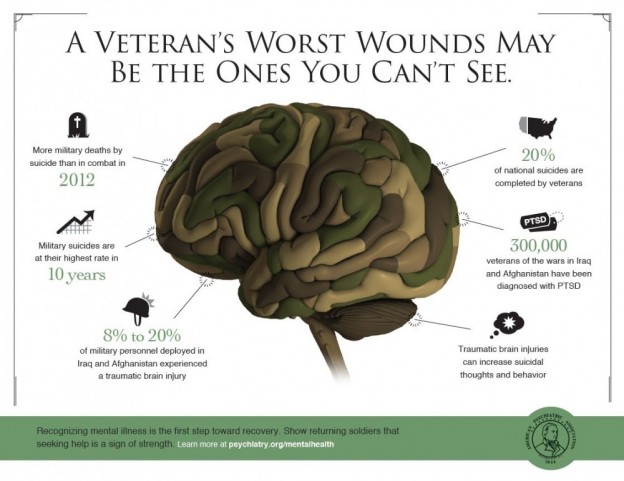
veteran-infographicSuicide rates among soldiers, for the first time ever, outnumbers the deaths occurring in active combat. There is PTSD, and number of additional other issues which, again, because of technology and advancements in mental health awareness & medicine, are now at the forefront of the adverse affects of war. Women who are deployed face a higher risk of Postpartum Depression which in turn, affects an entire generation. War truly leaves a mark on every one of us, both on and off the battlefield.

So today, when you thank a veteran, particularly a younger veteran, take the time to embrace that they may be filled with emotions they may not be ready for today as a result of the onslaught of gratitude. Take the time to realize that these brave men and women have lost loved ones, brothers in arms, and they are replaying this in their heads as you thank them for their service. Respect their journey but also take the time to check in with them and ask them how they are doing.

For they are soldiers, they are brave men and women, but beneath it all, they have a heart, a soul, and they have bled for us, some more than others. They deserve nothing less than our greatest compassion and understanding for the hell they witnessed on the battlefield as they fought for freedom from tyranny in our great country’s name.
ppdchat-11-4-13

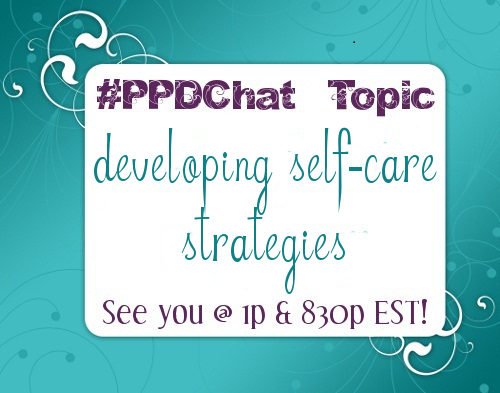
#PPDChat Topic 11.4.13: Developing Self-Care Strategies

ppdchat-11-4-13

With the holidays rapidly approaching, it is time to revisit the topic of self-care. As women, we so very often forget to mother the most important person in our lives – ourselves. If we do not take the time to refill our souls and our bodies, we are useless to those around us. Self-care is not selfish, it is selfless for it allows us to give others more when we are giving from full capacity. Just as it is impossible to pour a glass of water from an empty pitcher it is difficult to pour ourselves into others if we are empty.

Go check out this worksheet and rate your level of self-care. What areas are lacking? Where are you thriving? Then I want to challenge you to doing what the worksheet says at the top – commit to improving at least ONE thing from each section every week. Baby steps matter and with the busy holiday season right around the corner, it is important we all remember to give the gift of ourselves to ourselves. While the small things are not at all a FIX for your issues, they matter and they add up over time.

It is also important to remember to care for ourselves during the winter months, particularly if we struggle with Seasonal Affective Disorder. Having moved back north where there is less sunshine during the winter, I am finding this a challenge. Feel free to jump in and share any strategies you may have to combat this common issue as well as discuss the challenge struggling with SAD in addition to PPD may bring.

Looking forward to chatting about the importance of self-care during the fall & winter months at 1pm ET & 830pm ET. See you on Twitter!

The Challenge of Moderating A Mental Health Peer Support Community

The world of advocating and supporting those fighting the hard fight against Perinatal Mood & Anxiety Disorders holds within it a myriad of challenges. Moderating a community requires a lot – patience, compassion, understanding, and knowing when to properly apply tough love. The last one gets me every time -it is definitely a challenge and very heart-breaking to apply tough love to a struggling mama- but it is sometimes the only option left.

Within the #PPDChat community, some moms may end up being friends, others may just need me for a short period of time on their journey. I have to be okay with either, learning to let go as the moms who contact me move in a very fluid way in and out of my world.

My primary goal, however, is to keep everyone within the community safe above all else. To ensure that they feel respected, empowered, validated, and treated with all the dignity each of us deserves as humans and as adults, something all of us deserve. When someone within the community fails to meet this goal or feels these goals are not being met, I take action.

When there is a threat/disrespect for the community, a member requires more help than I or other members can provide, or threatens the safety of those close to them, I reach out for additional support. Dealing with threats to themselves or to the safety of the group is not a pleasant situation but it is something which is bound to crop up every so often. I must be prepared to provide solace for all involved – the community at large and the struggling member, without divulging too much information regarding either. Even though I am not legally bound by the classic “client/therapist” privilege rule, I hold myself to it unless threats are made. Even then, I only release information to the necessary parties.

Moderating #PPDChat has taught me a few lessons about dealing with people in general:

1) Be kind, for everyone you meet is fighting a hard battle. This one is tough because sometimes, when I would like to be angry at someone, I see their pain. I see the suffering which is causing their anger. I have learned when to dive in and hold a conversation but at the same time I have also learned when to walk away and let them fight their own battles with their dark storms. Sometimes, and this is perhaps the toughest lesson of all, people need to fight the storm on their own and we have to walk away because they are simply not prepared to let others put on their battle armor with them. I have found that if I need to do this, the best way to do so is to leave the door open as I walk out, in case they are ready to have an army by their side.

2) Be kind to yourself, for the battles you face may be harder than you think they are and it’s okay to not be okay. We all do it, tell ourselves that what we’re going through isn’t as hellacious as it should be – a lie. It’s okay to fight, it’s okay to hurt, and it’s okay to be kind to yourself. I say this often: Self-care is not selfish, it’s selfless. There is a fine line between self-care and selfish, however – it’s importance to balance taking care of your responsibilities with taking care of yourself. In the same vein, it’s okay to say no to extras. Things which are responsibilities take priority over things which are “supplemental” to life. To figure out the difference, make a list and ask yourself if life will go on if you skip something. Meal prep is a responsibility. Gotta eat. Making a ton of cookies for the church social? Yeah, saying yes might put you in the good graces but if it’s at the sacrifice of your sanity, it might not be worth it. Instead, choose to spend that time with your family or with yourself.

3) Everyone won’t be happy with the rules…or with what other people in the group have to say about certain topics. We all come to motherhood with different expectations and beliefs about how things should go. We all walk different paths and need to find the right path for us – in the process, remember that the right path for US may not be the right path for those around us. Judging the choices of others is something I DO NOT tolerate in the #PPDChat community because we are already judging ourselves as women, as mothers, and as mothers fighting a mental health battle. The LAST thing we need to add to that full plate is our support community judging us too. When personal attacks happen, tough love knocks down the door dressed up as a Mama Bear.

4) Treating others with dignity goes a long way. We’re dealing with other adults here, not with children. I don’t even see Teen Moms as children. They are mothers now, with very real adult responsibilities. To treat them, or any new mother, as anything less than an adult with responsibilities, is to disrespect them. You’re not helping if you’re constantly holding someone’s hand and telling them what they can or cannot do. It’s not empowering to talk down to them. Mental health struggles do NOT equal incapable. I was an adult prior to my postpartum issues and I was still an adult when I was fighting the beast. I treat others with the same respect and dignity with which I would want to be treated in the midst of my own storm. I believe it lends to confirming to the woman/family seeking help that they ARE still human, they DO matter, and it provides a sense of normalcy, if you will. It’s possible to acknowledge struggles without demeaning or patronizing the person experiencing them.

5) Authenticity is important. Sharing parts of yourself as a peer moderator builds trust. It shows your community that you are indeed human and understand their pain. Particularly online, it is important to not just be a robot spouting self-care-isms, if you will. Mean what you say and say what you mean. My community is perfectly aware of my rather unhealthy obsessions with bacon, football, F1, Star Wars, and a myriad of other things. Why? It humanizes me and therefore humanizes the community as we are able to bond with each other over a myriad of topics. It allows us to talk about things beyond our “labels.”

6) Know when to be light-hearted and when to be serious. There is a fine line between these two approaches, particularly when dealing with mental health issues. Cross the light-hearted line a bit too much and you may end up in the stigma/discrimination zone. That’s never a good thing. We joke a bit more about it in closed group but I am always, always careful about how I phrase things because I absolutely do not put up with any form of discrimination within the community. I see everyone one equal footing – as people fighting like hell to just be themselves, whatever that may be now. We need laughter but we also need respect and tough love. Toeing the line requires finesse, something I work diligently at achieving.

I’m sure there are more lessons I have learned whilst moderating the #PPDChat Community but the six above are perhaps the most important ones.

It is my utmost desire that everyone who reaches out to #PPDChat for support find a community which respects them as a whole person, respects their individual choices regarding child-bearing and child-rearing, and empowers them as they fight with all their might on their journey toward being well once again.

I know people feel that way because I hear it every so often from those who have participated. In fact, just the other day @jenrenpody shared this with me:

“I turned to ppdchat because I felt safe, validated and heard. I needed that validation and support. I found so much more – community and friendships.”

#PPDChat works to do exactly what Jen states and it always will. If for some reason, you have a different experience, let me know and I will do my best to address the issue. You are absolutely not alone, you will be heard, and you are safe. Always.

What would be most important to you in a peer-based community support group and why? Has #PPDChat helped you feel empowered to fight your battle against Perinatal Mood & Anxiety Disorders? Join in the discussion by sharing below!

#PPDChat Topic: Like A Butterfly: Transformational Power of a Perinatal Mood Disorder

ppdchat 09-30-13

Today, we’re focusing on the ways Perinatal Mood & Anxiety Disorders change us. Many of us know all too well the amount of energy it takes to fight through to ourselves during a Perinatal Mood & Anxiety Disorder. As someone who is now able to look back at my experiences instead of being caught in the midst of it, I see how that fight changed my outlook on life as well as changed almost everything inside me. While I have been remodeled, some of the old me remains. Isn’t this the way with all trauma and substantial life experiences? We are constantly growing and changing as life ebbs and flows through us, are we not?

The 1:00pm ET chat will be a prelude to tonight’s chat with @WalkerKarraa regarding the amazing transformational power Perinatal Mood & Anxiety Disorders have in the lives of the women who experience them. I hope you’ll join us as we casually explore and discuss the ways PMAD’s have changed our lives during the afternoon chat.

Then at 8:30pm ET, Dr. Walker Karraa will join us. I am excited about her joining #PPDChat as a guest, particularly on this topic as she has been talking to several women about this very thing, allowing her amazing insight into the overall transformational power of PMAD’s in our lives.

To say I am excited about today’s topic would be a huge understatement. I cannot wait to discuss this with y’all!!! For more information about Walker and today’s topic, go here.

See you at 1:00pm ET and hope you will join us at 8:30pm ET as well!

Celebrating Through Giving Back – Today’s spotlight: @postpartumprog

HI!

Today’s the day, my birthday.

I’m highlighting Postpartum Progress today. But I thought that was just a blog, you’re thinking. Nope. The awesome Katherine Stone has turned her work into a non-profit which is making a lot of waves right now. It’s been inspiring to see how much they’ve managed to do so far with the base Katherine developed through her blog. I know they’re gonna go places and make a helluva difference in the world.

I LOVE the description of who they are:

We are catalysts. We are champions. We are instigators. We want change as soon as possible and we’re going to make it happen.”

Go over to the non-profit site here. Check out what they’ve been up to and possibly donate or even volunteer. She’s building an army of Warrior Moms. Go be one.

Keep up the fabulous work, Katherine. Proud to know you, and blessed to be one of those in the trenches with you as we fight against the stigma and misunderstanding of Perinatal Mood & Anxiety Disorders. Keep rocking, lady.