Tag Archives: postpartum depression

How the @BostonGlobe got Postpartum Depression Wrong

With more news stories mentioning Postpartum Depression these days, it is becoming painfully obvious that reporters are scrambling to get their facts straight. Bless them for trying but sometimes, even with the best of intentions, they fall short. Like Karen Weintraub’s article “When the ‘baby blues’ are something more” at the Boston Globe on October 21, 2013.

Karen defends herself in the comments (all two of them at time of writing) about the term “baby blues” by saying that in her researching for this piece, she discovered there is such a thing as baby blues:

Boston Globe Comments

Kudos to Ms. Weintraub for doing enough research to realize that baby blues ARE distinct from depression.

BUT.

There are a multitude of omissions and errors within the article as it stands right now. Let’s go through them:

Ms. Weintraub breaks the Perinatal Mood & Anxiety Disorder experience into only three groups:

  • Baby Blues
  • Postpartum Depression
  • Postpartum Psychosis

Immediately, sirens sound. Particularly because the case study, a Nicole Caligiuri, a first time mother, states she felt “angry and anxious” all the time. While anger/irritability is a sign of depression, anxiety combined with anger is typically (in my non-professional opinion) more closely related to an anxiety disorder. Ms. Caligiuri, however, was diagnosed with Postpartum Depression.

By ignoring the additional facets of the PMAD spectrum, Ms. Weintraub does a severe disservice to those mothers who may be suffering from Postpartum Anxiety, Postpartum Post-traumatic Stress Disorder, or Postpartum OCD.

Weintraub states that 50-85% of new mothers experience baby blues, 14% experience postpartum depression, and a “fraction of 1 percent of new moms” experience Postpartum Psychosis. If you go by those numbers (at the higher levels), nearly 100% of all new mothers experience one of these three phenomena and none experience Postpartum Anxiety, Postpartum Post-traumatic Stress Disorder, or Postpartum OCD.

According to Postpartum Support International’s Get the Facts page:

  • Approximately 6% of pregnant women and 10% of postpartum women develop anxiety. Sometimes they experience anxiety alone, and sometimes they experience it in addition to depression. 
  • Postpartum Obsessive-Compulsive Disorder (OCD) is the most misunderstood and misdiagnosed of the perinatal disorders. It is estimated that as many as 3-5% of new mothers will experience these symptoms.
  • Approximately 1-6% of women experience postpartum post-traumatic stress disorder (PTSD) following childbirth.

But in Weintraub’s scenario, there isn’t room for the nearly 20-27% of women who develop these particular Perinatal Mood & Anxiety Disorders. As a survivor of Postpartum OCD, I find this troubling. Particularly because OCD can scare a new mother into thinking she is experiencing a form of Psychosis due to the horrific intrusive thoughts.

As I have mentioned multiple times, it is beyond important to differentiate the varying aspects of a Perinatal Mood & Anxiety Disorder. Why? Because when you lump Postpartum Psychosis sensationalism in with Postpartum Depression, things get murky. You scare new mothers who may be a bit depressed into thinking if they go get help, they will be thought of as potential criminals and have their babes ripped from their arms the instant they admit to feeling anything less than happy.

An additional issue with this article is the strong focus on early motherhood. The logic of this focus is evidenced by the study on which it is centered but a quick mention that PMAD can persist beyond early motherhood would have been a quick fix for this bias.

Why is it important to emphasize that PMAD onset can extend beyond early motherhood?

Often, many mothers do not realize they have issues until they are well into the 6th month or more. I have had mothers contact me at almost a year postpartum to share that they think something has been deeply wrong since the birth of their child but they did not recognize it until now. Many Perinatal Mood & Anxiety Disorders crop up within the first 2-3 months, often immediately after the period of baby blues, but some mothers do not recognize them or even get hit with them until much later. PMAD’s can crop up  within the first 12 months after birth and even then, may not be recognized until much later. But this information is not mentioned anywhere in the article nor are we ever told at what point Ms. Caligiuri sought help.

I deeply appreciate Ms. Weintraub’s effort to reach out to Dr. Katherine Wisner and Dr. Michael O’Hara, respected experts in the research field of Perinatal Mood & Anxiety Disorders, however, I wish she (or her editor) had taken the time to allow this article to be a bit more clear regarding the wide scope of Perinatal Mood & Anxiety Disorders. I also wish a side bar had been included to resources for women and families who are struggling with these issues, particularly given that Ms. Weintraub included this quote from Dr. O’Hara:

Social support is probably the most important thing to provide a new mother, who is at a particularly fragile point in life, said Michael O’Hara, a professor of psychology at the University of Iowa, who has been researching and treating postpartum depression for three decades.


Postpartum Support International will connect new mothers with social support. Also, specifically in Hadley, Massachusetts, there is Mother Woman, a fabulous organization who is making fantastic strides toward improving access to support and care for struggling women & families. Advocates in the trenches, such as the volunteers with PSI and Mother Woman, recognize how important it is to have peers support each other so they do not feel all alone in the dark. It is an oversight that neither of these organizations are mentioned anywhere in Ms. Weintraub’s piece.

Overall, Ms. Weintraub, despite making a few blunders, seems to handle the issue at hand with a respectable grace. The study at the heart of the article focuses on the development of depression in children born to mothers who struggled with depression but Ms. Weintraub is fabulous in her handling of this issue, particularly with this paragraph:

But parents shouldn’t feel like they’ve ruined their child’s life if they go through a period of depression, Pearson said. The increased risk of depression in their children is small. Overall, 7 percent of teens are depressed, compared with 11 percent of teens whose mothers were depressed early in their children’s lives.

She side-steps the potential onslaught of guilt and gracefully allows parents to breathe a sigh of relief by including this information from the study’s co-author.

As I stated in the opening, coverage of Perinatal Mood & Anxiety Disorders is greatly improving. But we still have a long way to go to get to fully informed reporting. For the most part, Ms. Weintraub’s article is generally free of sensationalism, includes quotes from respected experts, and manages to allay any potential guilt a new mother with a PMAD may feel in reading it. However, it is still just a few small adjustments away from being truly spectacular and informative.
Dear Sting, Postpartum Depression is No Joking Matter

Sting played a small venue in Chicago last night to promote ‘Last Ship’, according to this article written by Scott C. Morgan.

The article discusses the process Sting went through to bring ‘Last Ship’, a Broadway musical, to life.

Then at the end, is the kicker.

Though Sting is writing the score for “The Last Ship,” he won’t be appearing in the show. So Seller asked the singer how it will be for him to see other people performing his songs onstage.


“I imagine I’m going to have postpartum depression,” Sting joked.


Oh, Sting.

I have been a fan since I was a pre-teen and had to sneak off at my grandmother’s house to watch videos on MTV. Yanno, back when MTV actually showed videos.

You’ve been a source of solace for me in my dark times. I used one of your songs in a playlist of mine as I healed from my own bout of severe Postpartum OCD. The rhythm was just right and I liked the emotion it evoked within me.

But now?

I can’t do that.

Because you’ve said this.

In eight words, you have managed to completely undermine the seriousness of what I experienced. What millions of women experience every year. In eight words.

Do you see how easy it is to marginalize someone else’s experience? How easy it is to compare the hell that is a Perinatal Mood Disorder by saying you’ll go through the same thing as you watch other people perform your songs? While it may not be easy to see other people perform your art, I guarantee you that it is a hell of a lot easier than the depths of hell I and millions of other women witness as survivors and warriors in the trenches against PMADs.

We fight, Sting, for our fields of gold, fragile as we are. We fight because maybe, just maybe, tomorrow we’ll see a brand new day filled with hope. We don’t want to be the shadows in the rain, never coming home.

Please, think about what you are saying before you say it. Because when you do not think before you speak, you end up hurting people, minimizing their experiences, and comparing their hell to something which is not even close to their experience.

For now, I am gonna have to do the opposite of Rick Astley and give you up because you let me down.

Open Letter to Savannah Guthrie

Dear Savannah Guthrie:

Sit down.

I would like to talk with you for a few seconds.

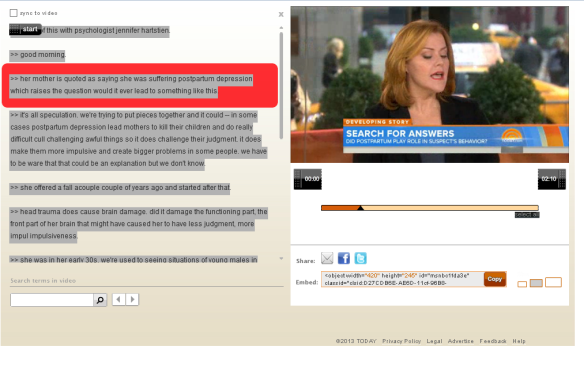
Savannah Guthrie Transcript“Would postpartum depression, if it existed, ever lead to something like this?” you asked psychologist Jennifer Hartstein this morning on the Today Show as you kicked off a discussion about mental health and the tragic situation which concluded in Miriam’s death yesterday. (You’ll note that the “if it existed” part is strangely omitted from the screenshot)

“…if it existed…”

*sucks teeth*

So, Savannah, darling, about that “…if it existed…” comment… I am guessing you would like to tell me that when I was in the hell that was immediately after giving birth to both of my daughters, I imagined it. Didn’t happen.

I did not have compulsions, I did not delve into the darkness and fight to get through every day even though I was triggered by even the tiniest cry. Never existed. My hospitalization – unnecessary because it was for something that never existed.

My blog? A bunch of hot air because I waste my time discussing some inane make believe condition that doesn’t exist.

Women fight and struggle with Perinatal Mood & Anxiety Disorders every damn day. Reporting about it as you did this morning helps no one. I get that it is easier to say Postpartum Depression because it’s a term the general public understands. BUT it’s a term they understand because people like YOU refuse to educate the public at large about the other conditions along with Postpartum Depression such as Postpartum Anxiety, Postpartum Post Traumatic Syndrome, Postpartum OCD, and Postpartum Psychosis.

There was no discussion of these other conditions on your show this morning. NONE.

You sat there and grinned through the entire segment, nodding and smiling but educating no one.

What about the mom in Iowa who is three months postpartum and watches you faithfully and is struggling but heard you associate postpartum depression with a desire to harm oneself? Oh, now she can’t seek help because people will think she wants to kill herself and her child. YOU did that to hundreds of mothers across the country today, Savannah. You added to the stigma instead of taking a few extra minutes to educate yourself about the entire situation.

But “It’s a developing story…” so? Gather the facts on what you have and educate yourself along the way. Don’t be ignorant along the way, be educated. You, more so than any of the rest of us, are in a position to remove stigma in a powerful way because you have the audience and the platform on which to do so.

You failed us this morning.

You broke our hearts and made us wonder when or even if, stories like these will EVER be reported properly. Your colleague over at ABC, Dr. Richard Besser, got close when he made a point to mention Postpartum Psychosis.

Instead, you discussed Postpartum Depression and a potential brain injury as a result of a fall.

Sighs.

Way to fail, Savannah. Way.to.fail.

The Challenge of Moderating A Mental Health Peer Support Community

The world of advocating and supporting those fighting the hard fight against Perinatal Mood & Anxiety Disorders holds within it a myriad of challenges. Moderating a community requires a lot – patience, compassion, understanding, and knowing when to properly apply tough love. The last one gets me every time -it is definitely a challenge and very heart-breaking to apply tough love to a struggling mama- but it is sometimes the only option left.

Within the #PPDChat community, some moms may end up being friends, others may just need me for a short period of time on their journey. I have to be okay with either, learning to let go as the moms who contact me move in a very fluid way in and out of my world.

My primary goal, however, is to keep everyone within the community safe above all else. To ensure that they feel respected, empowered, validated, and treated with all the dignity each of us deserves as humans and as adults, something all of us deserve. When someone within the community fails to meet this goal or feels these goals are not being met, I take action.

When there is a threat/disrespect for the community, a member requires more help than I or other members can provide, or threatens the safety of those close to them, I reach out for additional support. Dealing with threats to themselves or to the safety of the group is not a pleasant situation but it is something which is bound to crop up every so often. I must be prepared to provide solace for all involved – the community at large and the struggling member, without divulging too much information regarding either. Even though I am not legally bound by the classic “client/therapist” privilege rule, I hold myself to it unless threats are made. Even then, I only release information to the necessary parties.

Moderating #PPDChat has taught me a few lessons about dealing with people in general:

1) Be kind, for everyone you meet is fighting a hard battle. This one is tough because sometimes, when I would like to be angry at someone, I see their pain. I see the suffering which is causing their anger. I have learned when to dive in and hold a conversation but at the same time I have also learned when to walk away and let them fight their own battles with their dark storms. Sometimes, and this is perhaps the toughest lesson of all, people need to fight the storm on their own and we have to walk away because they are simply not prepared to let others put on their battle armor with them. I have found that if I need to do this, the best way to do so is to leave the door open as I walk out, in case they are ready to have an army by their side.

2) Be kind to yourself, for the battles you face may be harder than you think they are and it’s okay to not be okay. We all do it, tell ourselves that what we’re going through isn’t as hellacious as it should be – a lie. It’s okay to fight, it’s okay to hurt, and it’s okay to be kind to yourself. I say this often: Self-care is not selfish, it’s selfless. There is a fine line between self-care and selfish, however – it’s importance to balance taking care of your responsibilities with taking care of yourself. In the same vein, it’s okay to say no to extras. Things which are responsibilities take priority over things which are “supplemental” to life. To figure out the difference, make a list and ask yourself if life will go on if you skip something. Meal prep is a responsibility. Gotta eat. Making a ton of cookies for the church social? Yeah, saying yes might put you in the good graces but if it’s at the sacrifice of your sanity, it might not be worth it. Instead, choose to spend that time with your family or with yourself.

3) Everyone won’t be happy with the rules…or with what other people in the group have to say about certain topics. We all come to motherhood with different expectations and beliefs about how things should go. We all walk different paths and need to find the right path for us – in the process, remember that the right path for US may not be the right path for those around us. Judging the choices of others is something I DO NOT tolerate in the #PPDChat community because we are already judging ourselves as women, as mothers, and as mothers fighting a mental health battle. The LAST thing we need to add to that full plate is our support community judging us too. When personal attacks happen, tough love knocks down the door dressed up as a Mama Bear.

4) Treating others with dignity goes a long way. We’re dealing with other adults here, not with children. I don’t even see Teen Moms as children. They are mothers now, with very real adult responsibilities. To treat them, or any new mother, as anything less than an adult with responsibilities, is to disrespect them. You’re not helping if you’re constantly holding someone’s hand and telling them what they can or cannot do. It’s not empowering to talk down to them. Mental health struggles do NOT equal incapable. I was an adult prior to my postpartum issues and I was still an adult when I was fighting the beast. I treat others with the same respect and dignity with which I would want to be treated in the midst of my own storm. I believe it lends to confirming to the woman/family seeking help that they ARE still human, they DO matter, and it provides a sense of normalcy, if you will. It’s possible to acknowledge struggles without demeaning or patronizing the person experiencing them.

5) Authenticity is important. Sharing parts of yourself as a peer moderator builds trust. It shows your community that you are indeed human and understand their pain. Particularly online, it is important to not just be a robot spouting self-care-isms, if you will. Mean what you say and say what you mean. My community is perfectly aware of my rather unhealthy obsessions with bacon, football, F1, Star Wars, and a myriad of other things. Why? It humanizes me and therefore humanizes the community as we are able to bond with each other over a myriad of topics. It allows us to talk about things beyond our “labels.”

6) Know when to be light-hearted and when to be serious. There is a fine line between these two approaches, particularly when dealing with mental health issues. Cross the light-hearted line a bit too much and you may end up in the stigma/discrimination zone. That’s never a good thing. We joke a bit more about it in closed group but I am always, always careful about how I phrase things because I absolutely do not put up with any form of discrimination within the community. I see everyone one equal footing – as people fighting like hell to just be themselves, whatever that may be now. We need laughter but we also need respect and tough love. Toeing the line requires finesse, something I work diligently at achieving.

I’m sure there are more lessons I have learned whilst moderating the #PPDChat Community but the six above are perhaps the most important ones.

It is my utmost desire that everyone who reaches out to #PPDChat for support find a community which respects them as a whole person, respects their individual choices regarding child-bearing and child-rearing, and empowers them as they fight with all their might on their journey toward being well once again.

I know people feel that way because I hear it every so often from those who have participated. In fact, just the other day @jenrenpody shared this with me:

“I turned to ppdchat because I felt safe, validated and heard. I needed that validation and support. I found so much more – community and friendships.”

#PPDChat works to do exactly what Jen states and it always will. If for some reason, you have a different experience, let me know and I will do my best to address the issue. You are absolutely not alone, you will be heard, and you are safe. Always.

What would be most important to you in a peer-based community support group and why? Has #PPDChat helped you feel empowered to fight your battle against Perinatal Mood & Anxiety Disorders? Join in the discussion by sharing below!