I met Helen at Facebook. (Yes, I spend entirely TOO much time there) She’s a wonderfully brave soul who is opening up about her recent experience with Postpartum Depression and Thyroiditis. Did I mention her daughter also had kidney reflux? Helen is one tough chick and I can’t wait to share her journey with you. In fact, let’s get started now!
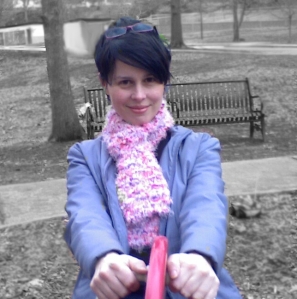
Tell us a bit about yourself. Who is Helen Crawford when she’s just HELEN?
Hey Lauren! I am a happy, confident, empathic soul.
Every day I am a being that is – a mother, wife, architect, artist, advocate, gardener, speaker, and big city lover. Our children, Joe (age 5 1/2) and Nora (age 19 months) are hilarious, engaging little people.
Did your pregnancy and birth go as you expected or were there some unexpected experiences thrown in for good measure?
Both pregnancies were good! You know normal stuff – morning sickness, back aches. I was busy doing things that I love to do both times.
My due date for both my children was the same day, October 16th. Ironically, it is also the day my husband asked me to marry him. Now, were they born on that day? Of course not!
With just about every pregnancy and post-natal period there are unexpected experiences large and small. With my son Joe, it was a c-section, and a lousy bout of mastitis afterward. I did not have PPD following his birth. However, after the birth of my second child, Nora in Oct 2007, everything was great until the fourth month post-partum. I started feeling tired, overwhelmed, and my hair was falling out. I was always cold, and my skin was rashy. I was anxious and sluggish. Thus began a very confusing, insidious spiral downward, a complete descent into more than one post-partum related illness.
You too have tread down the bumpy cobblestone avenue of Postpartum Depression. Just how bumpy was that road for you? How did your journey start out?
Severe bumps. I have seen clinical depression up close many times, as a witness. Depression runs in these genes, and having it myself was one of my biggest fears.
In March 2008, my OBGYN tested my thyroid. The numbers were off and I was sent to an endocrinologist. I was diagnosed with (temporary) Post-Partum Thyroiditis. Post-Partum Thyroiditis mimics symptoms of depression and anxiety. Since I had wacky blood work – that must have been it right? The source of the anxiety attacks and lost feeling? That proved to be wrong. It took 6 months for my thyroid to return to normal, and when it did the panic attacks increased. In late August 2008 when my daughter was 10 1/2 months old, I stopped sleeping and eating entirely. And then I knew, PPD was here. Full, clinical post-partum depression/anxiety had been here the whole time, hiding behind abnormal blood work, an thyroid in overdrive, increasing anxiety about my daughter’s kidney reflux, and my role as a mother and practicing architect.
What were some of the things you did to get through your darkest days? How were you received when you sought help?
I pulled myself together as best as anyone in the scariest place they have ever been could. Used every inch of energy I had to find a psychiatrist that would see me immediately. I found a great one and also called my therapist, whom I had not seen since Nora’s kidney diagnosis in June. She met me after hours immediately. I saw the psychiatrist 36 hours later and started medication. Medication was and still is necessary for me. On that day I went the the psychiatrist, I called my office and was honest. My office was accepting. And then crawled back into bed to begin recovery, whatever it would become, and is becoming.
Oh – Practiced breathing. Meditation. I accepted what was now – this depression and that I was doing everything in my being to crawl out of it. Once the medication started working and my appetite nourished my strength, I started painting and writing again. I wrote about what it felt like to have this monster. I drew strength from these words and images. Here is a diary entry that I read and reread often:
Dear Post Partum Depression,
After the birth of my daughter, you silently slipped in, and settled down. I recovered from birth, hugged my family, and watched autumn change to winter, while you slowly grew. You hid behind other temporary, post partum illnesses, undetected. You fed on stress. You fed on fear, until I found myself in a black hole so deep, dark and terrifying. The sides were wet, damp and crumbly dirt; the width of my arms. Up far above, the sky was barely visible. Sometimes I could feel the sun for seconds. There in that place, I accepted that you were here. With intense fear, I stood up and gathered my army – friends, family, therapist and psychiatrist. But even at night, when I lay on the cool floor of my porch, listening for anything – birds, trains, wind – waiting for the anxiety attacks to stop, waiting weeks for the medication to work, waiting for sunlight, sleep and appetite to return, I knew you were not me. Depression, you are something that happened along the way – a situation. I accept this. You do not define me. I laugh, sleep, play with my children, talk with my husband, draw, paint, smile, pray, cry, spend days with friends and live. I climb, inch by inch, fingers dug in the sides, pulling myself up. Each inch I climb is a triumph. I am on this path that is life. My light shines from within.”
Support from a spouse/partner or family and friends is invaluable during recovery from a Postpartum Mood Disorder. What was your experience with family and spousal support as you recovered?
Everyone needs an army. My parents came for 3 months to take care of us. My in-laws supported us in many ways. My husband went to therapy with me and took care of the children every night for 4 months, as I was getting stronger. I am truly blessed. It’s been 8 months since I sought treatment, and I am heading towards remission. I’ll still be on medication for a while and that’s OK.
Name three things that made you laugh today.
I overheard the 19 month old say to her big brother, “stop whining Joe Joe.”
A Jon Stewart clip.
My son break/karate dancing like a pro.
What do you find the most challenging about parenting? The least?
The dynamics are always changing – this is the hardest. The least challenging of course is loving the pure joy these two bring us. Beats all the hard work!
Self-care is so important. Often we forget to Mother the most important person in our lives – OURSELVES. Share with us what you do when taking time for yourself.
Every mother knows that this is one of the hardest things to do, find time. I realized with the help of my husband and therapist that I always sabotaged my own free time. I didn’t let free time for me happen, because I did not know how. Now I paint and practice yoga – by myself. I see my friends more.
At Facebook, you host a group encouraging the support of the MOTHER’S Act. Tell us about your support of this legislation.
I am still amazed that there is not much understanding of this illness including in the medical profession. Research and public awareness are necessary! This is REAL. It’s not momentary sadness, weakness or weepy, female emotions. The women whom get through this are the bravest, strongest women in the world. Listen to their voices.
The Facebook group is starting to take off. Its called “Sign This- Post Partum Depression Mothers Act.” All the names are sent to the national petition list that Susan Dowd Stone is compiling. Names are sent per state, so remember to let us know where you live!
On the group page there is an opportunity to contact your individual senators.
And last but not least, let’s say you have an opportunity to share some advice with an expectant (new or experienced) mom about Postpartum Mood Disorders. What would you tell her?
There is no shame in having this illness or possibly having this illness. Sometimes it just happens along the way. It is awful, but treatable, and temporary with help. I would hug her and remind her she did nothing wrong, EVER. She just had a beautiful baby and the body is having bumpy time trying to recover. Speak up, seek help and find peace within, even if it means medication and an army of support. My daughter is the happiest girl I have ever met. As I recover, I laugh out loud about how I gave her all my happiness to go forth in the world. So now I’m in the process of re-growing mine!