Tag Archives: postpartum depression

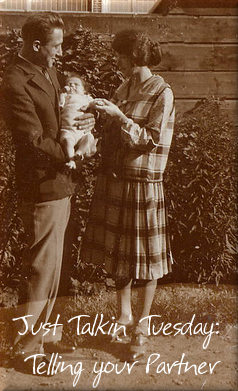
Just Talkin’ Tuesday 08.18.09: Telling Your Partner

Original photo by Pingu1963 @ flickr

Original photo by Pingu1963 @ flickr

We’ve touched briefly on seeking support and how you overcame the stigma of admitting something was wrong.

Today I want to take that topic to a more personal level.

How did your partner take the news?

My husband was so confused right after we had our first daughter. One minute I’d be fine, the next – yelling at him for simple things – like criticizing how he blew his nose or something equally inane. Or one of my favorites – the laughing hyena fits. Oh how I hated those! They hit at the most inopportune time! Him: “My day sucked.” My response: laugh so hard milk I had drank that morning would come spewing out my nose. Yeah, peachy, huh?

Once I kind of figured out what might be happening it really helped us both immensely. I stopped believing he had been born with super powers which would magically allow him to know precisely what (and when) I needed him to do with the baby and he started asking what he could do to help out. Before you knew it, we were navigating the perilous yellow brick road of communication quite successfully! (Did I mention he even talked to his parents about PPD for me? How sweet!)

By the time my second episode occurred, he knew more than enough to recognize old habits and encouraged me to seek help. We did have a bump when I was hospitalized but I think anyone with a loved one with a need for mental health hospitalization would be understandably stressed.

Third time around he was just as big an advocate as I was, knew a ton, and fortunately, sailed right through the experience with me. We were both very blessed to be able to fully enjoy the newborn stage with at least one of our children. That experience is something neither one of us takes for granted.

So – what I’d like to talk about today is how you told your significant other that everything was not alright in New Momville. How’d that conversation go? Did you initiate it? Did they? What was the reaction? What did they do to support you as you recovered?

I do want to take a moment to mention that if you have an unsupportive partner, talk with your caregiver about this. See if you can arrange to have your partner attend an appointment with you so that the doc can explain to them how important it is for you to have support at home. Good support at home is essential to a solid recovery and as your partner, they are on the front lines. In fact, it’s always a good idea to take your partner with you to your appointment because they may be witness to behavior you are not aware of in yourself.

Let’s get to Just Talkin’ Tuesday!

Just Talkin’ Tuesday 08.11.09: Breastfeeding & PPD

Original Photo "the breastfeeding lady 2" by Raphael Goetter @ flickr

Original Photo "the breastfeeding lady 2" by Raphael Goetter @ flickr

When I gave birth to my second daughter I saw my dreams of a normal postpartum smashed upon the rocks just 30 minutes after delivery. A delivery after 42 hours of labor, 36 weeks of pregnancy spent un-medicated but largely depressed and unaware of any potential issue facing us. We fully expected (as any parent) a healthy child, normal delivery. A large part of my smashed dreams tied into the hard reality that I would absolutely not be able to nurse her because she was born with a cleft palate so wide and large that it would be physically impossible for us to do so.

Later that day I was faced with a crucial decision. What kind of formula would I prefer for my daughter? I cried. She wasn’t SUPPOSED to get formula! That evening found me hooked up to a hospital grade pump praying for anything to happen. I barely squeezed out a drop. But I persisted and pumped for her faithfully until she was seven months old. I even researched everything I could in order to try to get her to nurse – books, cleft organizations, the La Leche League, the local Lactation consultants and even going to a training to become a trained Certified Lactation Counselor (which I completed one month AFTER we stopped nursing!) I left no stone unturned! Charlotte and I used SNS, nursing shields, and sheer determination. She eventually nursed for almost five minutes! Those five minutes were so amazing words cannot even begin to describe. In fact, it was tears falling from my face which interrupted the glorious event.(You can read more about our journey here: Breastfeeding Charlotte)

But at seven months, I faced a decision. My desire to continue to give breastmilk to my daughter or my mental health which had deteriorated so much it was adversely affecting my relationship with my husband and other daughter. With a heavy heart, I drove to Wal-mart to purchase formula. I cried the whole way home. Eventually I made peace with the decision. “Hanging up the Horns” or HUTH as it’s called in the world of exclusive pumpers, was a difficult decision. But one I was glad to make as it allowed me to bond with my entire family. I had come to resent Charlotte for all the extra work she required. But now, all I had to do was pour, heat, and I was done. I made strides towards better mental health and so did the rest of the family.

For me, the decision centered around the stress providing breastmilk created. I was also on medication which can be another tremendous issue for new moms. Many mothers don’t want anything crossing over to their infant through their breastmilk. Dr. Thomas Hale, author of Medications & Mother’s Milk, is a wonderful authority on the topic as are the researchers at Motherisk in Canada. When nursing while on any medication, it is important for the infant’s pediatrician to be aware of the medication and dosage amount so baby can be monitored for any adverse reaction. The decision to take medication is a personal one and should be made carefully with the help of professionals. Ask questions. Make sure the prescribing physician KNOWS you are nursing. And do not let them force you into quitting nursing if it is the one thing in which you find comfort. If you are currently struggling with this decision, please read this wonderful essay by Karen Kleiman: Is Breast Really Best?

So let’s get to Just Talkin’ Tuesday already!

Did your Postpartum Mood & Anxiety Disorder affect your nursing decision? Did you decide to formula feed to help improve your mental health? Do you regret your decision? Made peace with it? Did stopping help? Did your desire to nurse increase your desire to seek natural treatment? Speak up! Share!

(Absolutely no bashing for deciding to formula feed will be tolerated here. We respect the decision of all mothers to choose the course of treatment/feeding they feel is right for their families. Any posts discrediting or attacking a mother for her decision to formula feed will not be approved.)

Heartbreaking News out of Houston, TX

I debated about whether or not I should blog about this topic. It’s graphic, it’s disturbing, and it’s deeply saddened me. I finally made the decision to blog about it to clear up a certain point I’ve found in most of the news stories.

Unless you’ve been on a news blackout or under a rock, you’ve undoubtedly heard about the tragedy which occurred in TX this past weekend. I will not be delving into the details here. They are quite graphic and disturbing. I had a hard time reading the news story. I do not wish to trigger any suffering women who regularly read or subscribe to this blog. If you have a stronger stomach and do not feel you would be triggered by the details, you can read the story here.

The news story states the mother was mentally ill, having been previously diagnosed with schizophrenia.(Dad also had been diagnosed with schizophrenia)

Once again though, Postpartum Depression is mentioned in the story. Postpartum Depression is being bandied about as a possible cause of her behaviour.

I’d really like to make something perfectly clear.

Women with Postpartum DEPRESSION do NOT murder their children.

Let me say that again.

WOMEN WITH POSTPARTUM DEPRESSION DO NOT MURDER THEIR CHILDREN!!!!!!!

However, women with Postpartum PSYCHOSIS are much more likely to follow through with these horrific thoughts.

Postpartum Psychosis is a medical emergency. The onset is fast and furious and this particular Postpartum Disorder carries the highest risk of suicide, infanticide, and filicide of ALL the Disorders on the spectrum.Women with Postpartum Psychotic symptoms should absolutely not be left alone with their infants.

According to MedEd PPD, Symptoms of Postpartum Psychosis are:

  • Risk of harm to self (suicidality)
  • Risk of harm to others (homicidality)
  • Inability to provide basic care for self (usually due to psychosis). Psychosis is associated with both suicidality and homicidal ideation toward the infant or others.

Mothers with Psychosis may also show signs of delusional thinking, hear voices, or experience hallucinations.

And what should family members do if they suspect a new mother may be exhibiting signs of Psychosis?

Most importantly, the mother should NOT be left alone with her infant. She should be immediately transported to the ER for professional assessment and treatment. In the above article, it is stated that the mother’s family noticed her decline in mental status just a week prior to her crime. She was hospitalized but signed herself out.

Risk Factors for developing Psychosis include (but are not limited to) family or personal history of bipolar disorder or schizophrenia. In this particular case, the mother had been previously diagnosed and hospitalized for Schizophrenia.

How often does Postpartum Psychosis occur? One per 1000 mothers may experience Psychosis.

If you want to truly understand Postpartum Psychosis, go read my interview with Teresa Twomey, author of Understanding Postpartum Psychosis. Both she and her daughter fortunately survived Postpartum Psychosis. With the publication of her book, she hoped to help remove stigma from this condition which is so very often sensationalized in mainstream media and made to seem more common than it really is.

How many more of these cases do we need to read about? How many more times do we have to confuse Postpartum Depression with Postpartum Psychosis in mainstream media? How many more times do we have to mourn the loss of another infant because a mother was left behind by an uneducated system which failed her? How many more times are we to read about a family destroyed by something which could have been prevented if swift action had been taken?

Why weren’t preventative measures already in place given the mom’s mental health history? Why was this tragedy allowed to occur? And why are moms in TX murdering their infants at such a high rate?

Why?

When will we wake up and realize that we need to reduce stigma, increase awareness, educate, research, and inform medical professionals in ALL fields about the dangers of Postpartum Psychosis? Educate them about the differences between Postpartum Depression, Anxiety, Obsessive Compulsive Disorder, Post-Traumatic Disorder – WHEN?!?!

THE MOTHER’S ACT needs to be passed NOW! Families cannot wait any longer for relief!

Just Talking Tuesday 07.07.09: Anti-depressants or Not?

original photo by thegirlsmoma @ flicker

original photo by thegirlsmoma @ flicker

Today’s topic was inspired by a post over at Postpartum Progress: You don’t NEED Anti-depressants, Do You?

In this post, Katherine discusses the lack of stigmatization regarding pharmeceutical treatment for medical conditions in response to a ScienceBlogs post you can find here.

Anti-depressants are stigmatized. Period. Nitro-glycerin or insulin? Not so much. Why? Just as Anti-depressants may work for me, they may not work for you. And if you have the wrong heart condition and take nitro-glycerin, things may not go your way either. But you don’t hear people judging others for being on nitro-glycerin, now do you? And insulin? Many Diabetics require this life-saving medication. Even pain medication after an injury – do you question that prescription? Most don’t and certainly aren’t stigmatized for taking it because let’s face it – a broken leg hurts – something we all understand.

Mental illness hurts too. It hurts the person suffering. It hurts the people around them. And if the right medication is paired with the right therapy, it can make a world of difference. Why then, are we stigmatized or accused of not understanding informed consent for deciding (of our own free will) to take medication as we heal? What makes the scaffolding of Anti-depressants any different than pain medication as a broken leg heals?

So I’m posing a pretty big question today. And I expect there will be a bit of debate about it – which is good…our different opinions are what keep us interesting! Just keep things polite. No hateful, judgemental or fear-centered comments will be approved.

Do/did you or don’t/didn’t you take Anti-depressants? Why? Why not?

And more importantly – IS it your place to tell someone else they absolutely SHOULD not take them if you don’t believe in them or have had a bad experience? Or should you calmly refer them to research that explains the risks vs. benefits and let them make the decision on their own WITH a professional on board?

Let’s get to Just Talkin’!

PPD may aggravate already impaired sleep quality

Hang on folks – put your seatbelts on and make sure you keep all arms and legs inside the vehicle at all times.There’s another shocking study involving sleep and Perinatal Mood Disorders.

It IS important to be aware of your sleep patterns during the postpartum period as sleep deprivation can certainly make you grumpy. It can also cause a number of other issues if not corrected quickly.

That said, a new study published in the July 1st issue of the Journal SLEEP, states that Postpartum Depression may aggravate already impaired sleep quality.

Huh. Really?

What does that mean exactly?

It means that if you’re already not sleeping well, your visits with dear Mr. Sandman may become even more insignificant if you develop a Perinatel Mood Disorder.

Interestingly enough, 21% of the moms involved reported depression during pregnancy while 46% had experienced a previous bout of depression prior to conceiving.

The risk factors discovered by the researchers involved “Depression, previous sleep problems, being a first time mother, not exclusively breastfeeding or having a younger or male infant were factors associated with poor postpartum sleep quality.”

They also discovered that “Better maternal sleep was associated with the baby sleeping in a different room.”

I find it interesting that not exclusively breastfeeding was a factor in poor postpartum sleep quality. Many times mothers feel that if they could just stop nursing and give a bottle so others in the family could help with the feedings, they would be able to sleep better. I know I finally got rest when I stopped pumping and/or nursing. I do concur with the baby sleeping in a different room – all three of my children slept in their own room in a crib from the day we brought them home from the hospital. We did not want to wean the child from our room at a later date. Those who choose to co-sleep should seriously consider this particular risk, especially if depression is an issue.

The lesson here?

Moms – if you’re not sleeping well, tell your care provider. EMPHASIZE that this is not normal for you.

Caregivers – If a new mom tells you she’s tired, LISTEN. Don’t brush it off as just a new mom thing. Dig beneath the surface. She may be trying to tell you she’s depressed and doesn’t know how else to put it.

You can click here to read the entire article about this study.