Category Archives: women

To Write Love on Her Arms Suicide message

In which I thank a friend for saving my life

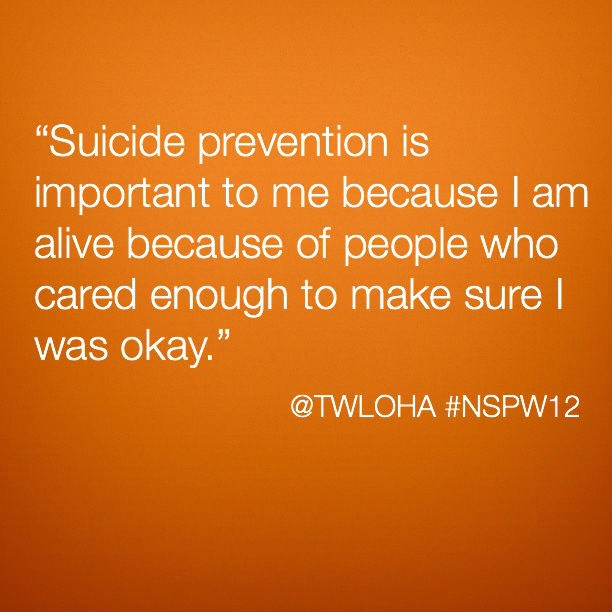
I shared the above graphic on my personal FB page tonight. You see, today is National Suicide Prevention Day, kicking off a full week of awareness. I’ve seen blog posts, links, graphics, etc, pop up all over the place. Hell, even Wil Wheaton shared about depression.

A year ago this time, I was dancing with Suicide. Tango, actually. Cheek-to-cheek. There was no rose, no romantic embrace, just chills, thoughts, wondering, wanting, yearning. It was a dirty affair with no promise of a happy ending.

But I had this friend. An online friend who recognized my fall from grace despite my best efforts to convince everyone around me (and myself) that everything was hunky dory. My divorce had just been finalized. I was still unemployed. Not with my children. My heart broken into a zillion pieces, scattered and yet still throbbing on the cold hard floor. Yet somehow, I fell asleep every night and awoke every morning.

Did I want to? No.

Every time I was in my car, I wanted to swerve in front of every 18 wheeler I saw, every sturdy oak, down every steep hill. But I didn’t.

Then there was THE day.

The day when I stood upstairs, in my bedroom at my parents’ house, staring out the window, calculating at what angle I’d have to throw myself out of it in order to hit the cement retaining wall which separated the house from the lower driveway. As my hand reached out and touched the screen on my window, I recoiled. Ran downstairs, phone in hand, and sat in the living room with my mother, silent.

I texted my friend.

“I am not okay.”

He responded. Wanted me to call him. I did. He talked me through it. Searched online for an agency which offered income sensitive help. I called them the next day. I was in therapy until this past May with an amazing therapist who constantly pushed the envelope and forced me to face life head-on, something I hadn’t done for years.

That friend?

SAVED.MY.LIFE.

Do you hear me?

HE SAVED MY LIFE.

For so long, and even now, I am *that* person for others. To be on the other side of the equation is impossible for me to fathom. It was then and it is now. But even those of us who *KNOW* about mental health and the toll it has on lives struggle from time to time. We are not perfect. We are human. We too need support when it gets dark. In fact, I’d even postulate that it’s sometimes more dangerous for those of us who *KNOW* about mental health because we tend to talk ourselves out of it without reaching out for help because dammit, we’re supposed to know our stuff.

Reach out.

If you’re suffering, reach out.

If you’re not suffering, reach out to those around you and ask how they’re doing.

Then LISTEN. Don’t listen and think about what you’ll say in response, just listen. Let them pour themselves out and wait for them to need a response. Sometimes? We don’t need a response.

Sometimes?

We just need a comforting and safe place into which we can pour our fear, our darkness, and let go of our terrors. We need a warm hand willing to lift us out of our miry clay into the light. We need to be rescued before it’s too late.

To the friend who saved my life, thank you. Thank you more than the number of stars in the sky, atoms in the universe, and more than all the bacon I will ever eat in a lifetime. Because of you, I am still here. I am still breathing. I.BREATHE.BECAUSE OF YOU.

Thank you more than I can EVER EVER EVER EVER EVER EVER say.

If you or a loved one are thinking of suicide, there’s a button at the top of my sidebar on my homepage here at the blog – click on it for resources. You are not alone. Suicide is a very permanent answer to a very temporary problem. There IS light, laughter, and love on the other side – I’ve found it and I will never again take it for granted.

Time - Are You Mom Enough

TIME Magazine fails to support mothers

When Jamie Grumet was tapped for an interview and photo-shoot for the most recent issue of TIME magazine, her goal was not to raise our hackles. Her goal, according to a Q&A at Time was: “There seems to be a war going on between conventional parenting and attachment parenting, and that’s what I want to avoid. I want everyone to be encouraging. We’re not on opposing teams. We all need to be encouraging to each other, and I don’t think we’re doing a very good job at that.” Read more: http://healthland.time.com/2012/05/10/q-a-with-jamie-lynne-grumet/#ixzz1uUnnAmrE

I have to say —I kind of agree with Jamie— but I disagree with about where the judgment is originating. For instance, this weekend is Mother’s Day weekend. Instead of celebrating motherhood for the amazing and difficult job it is –regardless of your approach– TIME magazine instead chooses to share an incredibly divisive article with an even more divisive headline, “Are you MOM Enough.” The real title, as accessed at their website is: “The Man Who Remade Motherhood.”

As for the photographer, Martin Schoeller, who took the photo, in an article focusing on “Behind the Cover,” he stated: “I liked the idea of having the kids standing up to underline the point that this was an uncommon situation.” He also further stated, “It was important to show that there’s no stereotypical look for a mom who practices this kind of parenting.” Oh Martin. There’s no stereotypical Mom either – aside from, you know, a woman who has a child. Beyond that though, everything is up for grabs.

It’s time to stop judging each other for our choices. To stop allowing the media to get us all riled up. To stop thinking “Am I Mom Enough?” You are. No “as long as…” attached. There are, of course, mothers who don’t even try, mothers who have truly given up and are absent. But we’re not discussing mothers who are absent. We’re talking about mothers who give enough of a damn to raise their hackles in response to an article like this.

I don’t want to play the game anymore. But, as a mom who blogs and actively supports mothers who struggle with Postpartum Mood & Anxiety disorders, I feel I would be remiss in not addressing this topic.

Mothers, all of us, are different. We are unique in our approach to how we mother our children. These philosophies are rooted in how we are raised, how we relate to our partner, how our children relate to us, and the needs of our children. We adjust our lives in order to provide the best for our children with the resources we have and the beliefs which live deep within our hearts. If your children are secure, happy, and loved, there really isn’t any issue as to what your parenting philosophy is or if it’s any better than the mom next door.

All that matters is that what you’re doing WORKS FOR YOU.

This weekend, don’t wonder if you’re Mom enough.

KNOW you are. And know I love you for it.

Give up giving yourself up

Parenting is a ritualistic exercise in extreme sacrifice. We awake earlier than we want, watch television programs we don’t want to, make play-dates we could care less about, plan parties, go to parties, make nice with another parent because our kid likes their kid, etc, etc, etc, etc. It goes on forever.

But that’s what parenting is, right? Sacrifice?

Yes.

And yet a resounding no.

Last night, I asked on Twitter if Motherhood should trump Womanhood once it entered the mix. What ensued was an extremely interesting conversation. Answers varied from “If that’s what the woman wants” to “No, it shouldn’t” to “I don’t understand, isn’t Motherhood a facet of Womanhood?” It is, once it enters the mix. But what fascinates me is the way we, as women, and as society, measure a woman’s worth based on her desire to conceive or parent. Someone even pointed out a pet peeve with articles which identify someone as a Grandmother, Mother, etc., even when it’s not relevant.

In the infancy years when our children depend fully upon us, Mother is our defining role. However, we should still make time for ourselves as women as well. We are still us, we have merely added another facet to our skill set. Some of us are woman first, mother second. Some may be Mother and then Woman. That’s okay. It varies from woman to woman and is based on personal experience as well. Go with what works for you and your family.

For those who are woman first, mother second, we know we need to be valued as a woman. But no one will value us as woman if we fail to treat ourselves as woman first. But what is woman once she is a Mother? She is you, as you were before children, with the added responsibility of child-rearing. Woman is beautiful, exhilarating, compassionate, powerful, strong, complex, amazing, and full of heart. She is life, and yet at the same time, she can get so lost in roles demanded by society, she may be her own death. Swallowed whole by Mother, Wife, Employee, Caregiver, Daughter, Sister, Cousin, etc, she finds herself carried away by the powerful current of Life, not realizing until too late she is in dangerous waters.

Today I tweeted, with the intent of being humorous, “For Lent, I’m giving up giving up things.” I also posted it as my Facebook status. The responses surprised me. One of my friends on Facebook included a link to a post written by a friend of hers last year —On Eating Chocolate for Lent— which got me thinking –should we be giving up anything for Lent at all– especially when we already give up so much of ourselves as Mothers? If we continue to sacrifice ourselves at the rate we’re going, we will have nothing left to give our children or loved ones once we finish –if we finish– before we pass out, an exhausted heap in the kitchen floor.

Want to give up something for Lent? Give up throwing yourself under the bus for everyone around you. Give up saying yes to every responsibility you are asked to take on by friends, family, work, etc. Give up judging yourself for not keeping up with the Joneses. Stick with the bare necessities. Give yourself the gift of time to yourself, the gift of time with your children instead of racing around like crazy to keep family, friends, and society happy and smiling. Give yourself happy. Give yourself joy. Give yourself laughter.

Give up giving yourself up for 40 days. Be kind to you. You are worth it.


Who’s that girl?

“When you see her, say a prayer and kiss your heart goodbye
She’s trouble, in a word get closer to the fire
Run faster, her laughter burns you up inside
You’re spinning round and round
You can’t get up, you try but you can’t”

 -lyrics, Who’s that Girl, Madonna-

Innocent enough lyrics, right? Of course, given that they’re Madonna lyrics that’s an arguable statement. Yet these lyrics are so very applicable to Postpartum Mood Disorders.

As a mother with Postpartum Mood Disorder, we drag ourselves out of bed in the morning after a lengthy internal argument between “have to, able to, and want to.” We stumble into the bathroom where we catch a glimpse of ourselves in the mirror. Raw. Unkempt. Barely awake. Depressed. Anxious. Angry. Petrified. Unrecognizable. So we hide her. We hide the girl in the mirror behind make-up. Behind a forced smile. We tuck her away in the corners of our mind and pretend to be okay for everyone else.

It works for awhile.

But then the mask begins to crack. Chips fall to the floor. We can’t replace them. The cost is too great. Exhaustion sets in, keeping us from fixing the veneer we have worked so very hard to replace. Our hearts and broken minds spill out into public view. We crumble as the pain of exposure overwhelms us. Frozen with fear we become deer trapped on a country road as vehicles race past us.

Until finally someone stops, gets out, and approaches us with compassion. They hold us and walk us back to ourselves, allowing us to lean on them along the way. As we awake each morning thereafter, the girl in the mirror begins to look a bit more like us. Sure, we still have our raw, unkempt, angry, sad, depressed, exhausted days. But in between those days, we cautiously regain our glow. Our eyes once again transform into a beautiful stained glass window to our soul instead of the broken window to the dark soul of the depression or anxiety which has gripped us for so very long.

But the window to depression or anxiety which exists in our eyes, jutting deep into our souls, will never fully close. It stays open, even if just a centimeter. Each time we falter, fail to live up to our own impossible standards, our mind will scurry to that window to measure the opening, to see if it’s widened. We will check and re-check, not believing original measurements equal to the original. Eventually we walk away somewhat satisfied but never fully believing we are recovered.

Depression and mental illness thrive on doubt. They thrive on suppression, stigma, and questioning of our own abilities whether from others or the internal struggle for sense of self. Even without mental illness, we question ourselves our entire life. Grab onto the positive. Grasp tightly onto balloons of hope when they float by. Marvel at the flame of a beautiful candle when it shines light onto your path. Find your light where you can, when it is offered, and let it flood your world. Don’t hide it behind the darkness in the soul of your depression.

Let go. Allow the light flood into your world until you recognize the girl in the mirror again as beautiful. It’s not that she disappeared. It’s that your perception of her was stolen by Depression, a sly thief. Steal her back.

KevinMD guest post misses the mark about Mothers

This evening I happened upon a guest post over at KevinMD by Dr. Srini Pillay, MD, an author and an Assistant Clinical Professor at Harvard Medical School. KevinMD has been a site I read more and more these days. I enjoy the insight offered by his knowledgeable guests. Today’s post, however, has me shaking in anger.

Dr. Sirini Pillay’s post is entitled “What a psychiatrist learned in therapy sessions with mothers.” It’s also posted at Pillay’s other blog, Debunking Myths of the Mind under the title “I love my children but hate my life: Solutions to Dilemmas Mothers Face” with the subtitle of “A balm for all guilty mothers.”

(Please note: All text below in italics and bold is directly from Dr. Pillay’s article)


Dr. Pillay pontificates a few reasons for the psychological issues/stress mothers experience during their lives. With every one of them, his explanation (in my opinion) places even more guilt upon the already exhausted and stressed out mother rather than offer true solutions for her success as a mother. Perhaps most glaring  in his examination of the trials and tribulations of motherhood is the omission of any mention of a Postpartum Mood Disorder as the source for the points upon which he offers his expert insight. I find it impossible to believe, given the statistics of Postpartum Mood Disorders (1 in 8 new mothers), Dr. Pillay has never seen a mother with a Postpartum Mood Disorder or is unaware of the additional issues a Postpartum Mood Disorder brings to the dynamic of Motherhood, especially if said Postpartum Mood Disorder goes untreated. It is both appalling and irresponsible to me for a Psychiatrist to fail to mention such a glaring issue in the face of addressing issues faced by Mothers.

First up, Dr. Pillay mentions Perfectionism. “New mothers often expect to be perfect rather than the best that they can be,” Why does the mother expect to be perfect, Dr. Pillay? Is it because SHE has placed those ideals in her head? No. It is because society has placed these ideals in her head. We are absolutely expected to be pristinely Stepford in our execution in the assigned task of Motherhood while Fathers are expected (also unfairly) to be aloof idiots. What Dr. Pillay fails to mention is that those of us who are obsessive perfectionists are at a higher risk for developing a Postpartum Mood & Anxiety Disorder. What he fails to mention is that, in order to overcome this “Peril of Perfection” society must also change their view of Motherhood. Instead, Dr. Pillay perpetuates the stigma and tells Mothers “you can always strive to be better by making small changes. Holding yourself to a standard of perfection can lead to burnout in all areas of life, because you are constantly striving for something that does not exist.” I agree, Dr. Pillay. But the same society fails us when they perpetually hold us to a standard of perfection, for which when not reached, we are then automatically judged and crucified.

Next up, burnout. Burnout is a direct result of perfectionism. It’s also the direct relation of attempting to care for an infant while struggling with the depths of a Mood Disorder. Study after study has proven the adverse effect of Postpartum Mood Disorders on sleep. Have a Postpartum Mood Disorder? You won’t sleep as well when you do sleep. Sleeping less and lower quality of sleep are both symptoms of a Postpartum Mood Disorder. Yes, everyone knows new mothers don’t sleep much. But moms with a Postpartum Mood Disorder sleep even less and achieve a lower quality of sleep when we DO sleep. Another kicker? Our children sleep less and at a lower quality as well. So now you have an exhausted dyad attempting to live up to an impossibly high societal standard which is now even further out of our grasp. Need more ammunition here? We’re also told to snap out of it if we seek help. Stigmatized. Made to feel guilty. Not allowed to have the “time” to be depressed because by God we have an infant to raise which is what we were bred to do. Failure is not an option. So we stay silent, we suffer, we weep, we wail, we dry our eyes in the face of the public realm because we’re not allowed to have emotions other than those seen in Johnson & Johnson or Pamper’s commercials. Everything is to be picture perfect. If it’s not, we’ve failed. Dr. Pillay’s suggestion here? “So rather than force themselves to think and feel differently, addressing the burnout can help many problems all at once.” I would have loved to have addressed the issue of burnout. I attempted to address the issue of burnout with each one of my children. I asked for help. I begged for a night nurse from the pediatrician once our second daughter came home after nearly a month in the NICU after being born with a cleft palate. His response? “Why do you need a night nurse?” I had a toddler. Two dogs. A husband who worked 70+ hours a week. I was exclusively pumping every three hours and running a Kangaroo pump on the same schedule. I had to clean my daughter’s PEG site and jaw distraction sites a total of 4-6 times a day on TOP of everything else. Sleeping would have been a gift from the Gods. Yet I was denied and landed in a Psych Ward less than two months after my daughter’s birth through no fault of my own. No amount of forcing myself to think and feel differently would have helped. But I tried to address the burnout. That too, failed.

Now we move into “The best balance.” This paragraph’s opening sentence really captures judgment of mothers across the world: “When women feel overwhelmed, they essentially need to ask themselves why they expect something impossible from themselves.” Again, he’s absolutely right. Yet again, it’s society which has trained us to expect the impossible from ourselves. Dr. Pillay goes on to suggest “The reality is that if a woman has a need to work and have a baby, she needs to find a best balance that is right for her and her family.” Again, I agree. But if a woman has a Postpartum Mood & Anxiety disorder, she is already wracked with guilt. Attempting to find balance in her life is not achievable until she has begun to heal from her fragile mental state. A woman with a Postpartum Mood & Anxiety disorder can barely survive her day let alone find balance in her life until her mental health issues are addressed. Any health professional or anyone I knew mentioning to me all I needed to do to improve was to “find a best balance” in my life when I was in my darkest days would have heard an earful. We’re barely able to keep our own heads above the fray – how are we expected to balance too?

“There is no one-size-fits-all type of mother, and different types of mothering produce different positive and negative outcomes.” Amen. And yet, society expects Sally to parent like Suzie and Suzie to parent like Bethany and Bethany to parent like Rebecca and Rebecca to parent like Jody and Jody to parent like.. well.. you get my drift. It’s the whole Stepford thing. Again, society does not allow for this sort of flexibility. Mothers with Postpartum Mood Disorders parent far differently than any other mother on the planet. We realize the value of self-care because it’s necessary for our survival. For some of us, it’s necessary for our children’s survival. We are judged for how we parent. How we HAVE to parent. We are judged for expressing our frustrations, for choosing to formula feed, for choosing not to go the attachment parenting route, for letting our little ones watch TV because we’ve had a tough day. Yes, we heal from a Postpartum Mood Disorder but when you’re in the thick of it and family members or random people in public are judging us, we have a harder time letting it go and then BAM. Hello guilt. Hello Xanax. I love the idea, I love the theory of “no one -size-fits-all type of mother,” I do. But it doesn’t work in the real world and certainly doesn’t work when the public thinks of mothers with Postpartum Mood Disorders. A mother with a Postpartum Mood Disorder is a horrible mother to most – we’re stigmatized and in addition to overcoming the every day normal judgmental issues which accompany motherhood – we must also overcome the additional perception of our “bad mother” rep.

The final paragraph recognizes that “It’s not all you.” It’s not. It’s genes. It’s how our child is wired to react. But guess what? Kids of depressed parents are more at risk for issues like ADHD. They sleep less. Their quality of sleep is less. Dr. Pillay says, “Parents who take on all the responsibility of this often distort this, feeling as though they are fully responsible for how a child turns out.” Wait a second. Aren’t we? What about Parents who are arrested for the behavior of their children? Parents who are judged because their child isn’t yet sleeping through the night or wets the bed or isn’t getting good grades in school? Or Parents who have infants who are not yet eating solid foods even though they keep trying? Yet, Dr. Pillay’s solution is for PARENTS not to blame themselves when their child doesn’t “lean on their own sense of responsibility.” He also goes on to add this gem: “Also, mothers who are alarmed by their own mistakes set a challenging standard for their children who may grow up to learn that mistakes are “bad” rather than inevitable but not a reason to give up.” Let’s say a mother has a doctor for her Postpartum Mood Disorder who keeps telling her she’ll get better with every therapy they try. Instead, she continues to worsen. Eventually she’s convinced the fault lies within her. That SHE is the problem. Some of these mothers may even give up and just live out the rest of their lives without trying any more therapy because they are the issue, not the therapy. So of course she will raise a child to believe mistakes are bad as opposed to inevitable. Of course she will raise her child to believe once a mistake is made more than once that giving up is the proper course of action. Or even worse yet, let’s say mom doesn’t get treatment at all (which is the case with most mothers struggling with a Postpartum Mood Disorder, by the way), this issue will spill over into how she raises her child and no amount of pulling herself up by the boot straps will change her thinking. She’s leaned on her own distorted sense of responsibility and it didn’t work for her. Why should she then expect it to work for her child? Why would she not consider herself fully responsible for her child’s behavior when society does just that on a daily basis?

My absolute favorite part of Dr. Pillay’s piece is the closing paragraph:

“Thus, when mothers find their relationships thrown into disarray, they may want to re-examine their own standards and relax their judgments toward themselves as they allow themselves to be more human and the very best that they can be without needing to be perfect.”

Sighs.

If only society would let us, Dr. Pillay. If only society would let us.

I’d like to add though should a mother finds her relationships thrown into disarray, she should not immediately blame herself for the fault of the disarray. Yes, she may truly be at fault but the other party may be at fault. She may be struggling with a Perinatal Mood Disorder or another type of mental illness. There are many additional reasons for the fault of relationships to be at fault other than the internal (yet societal driven) standards imposed on Mothers today. Perfectionism is imposed, not perceived. Failure to achieve perfection is perceived yes, but the standards we fail to reach were, at some point, imposed upon us by society. If we truly want to help mothers overcome the perception of succeeding by not being perfect, we need to first change society’s view of mothers, not mother’s view of themselves. The standards we try to reach our not our own… they are the fences between which we are forced to live. Until these barriers are removed, we will never succeed.