Category Archives: postpartum depression

What Is Recovery?

In glancing through search terms which people have searched to find my blog, questions about Postpartum OCD are the most common.

The biggest question, and the one I dread the most asks, “Do intrusive thoughts go away?”

My heart breaks when I am asked if the thoughts go away because I know where they are – how they’re feeling. How FRUSTRATING it is to want to be with your child and not have any intrusive thoughts flit through your head as they snuggle close to you and  drink in that sweet angelic baby smell in the dusk of the evening.

I know it goes away.

I know it fades.

What stays, and what is difficult for those of us who have OCD to differentiate, are typical parental fears – the nagging fear that something might happen to your child when you’re not watching. THAT stays forever. It’s not intrusive, it’s a normal heightened awareness which comes with parenting. When you have survived OCD, however, it is extremely difficult to keep these normal heightened awareness type thoughts from spiraling into intrusive thoughts. We constantly battle to keep them from growing into giant monsters.

Recovery, at least for me, is not a cut-off date. It’s a constant involvement in awareness of my feelings, reactions, and coping methods in regard to the ever changing world around me. It’s ensuring that in addition to my daily requirements, I’m taking care of myself as well. Recovery is not a discharge notice from a hospital, nor is it the last pill swallowed at the end of a prescription. It’s not the final therapist visit nor is it uttering the words, “I’m okay.”

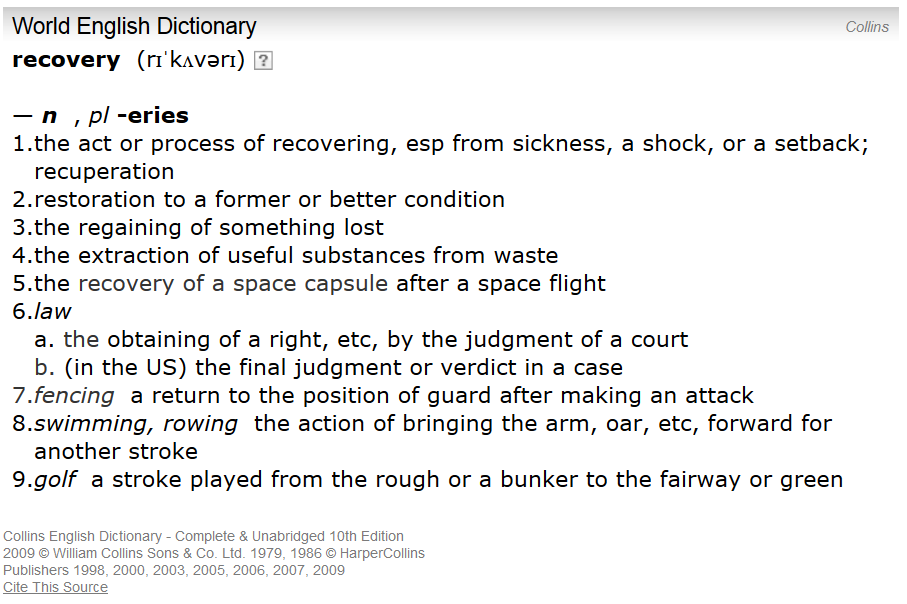
This is how the dictionary defines recovery:

Recovery Definition

What is recovery in the living world?

Recovery is life.

It’s living and moving forward with a tenacity learned in the depths of hell, a grip on enjoying all the little things and a determination to not go back. It’s knowing that even if I do go back, I have a road map to lead me back out again.

Recovery is self-care, self-compassion, and self-respect.

It is knowing that it is okay to not be okay sometimes. Recovery is celebrating both the ups and the downs. It’s getting to know yourself SO well that you recognize the difference between yourself and depression/mental illness. Recovery is knowing exactly what to do when the ugly beast stirs to keep it from waking completely. It is about arming yourself with a cadre of weapons guaranteed to slay the succubus.

Recovery is acceptance.

It’s being okay with the tough days and providing a soft place to land when they happen. It’s having a support system in place for the bleak days, one that will also be there for the good days. It’s understanding that sometimes, you’re gonna feel angry about your mental health and that’s okay. It’s learning the range of healthy and unhealthy emotions and knowing when to reach out for help.

Recovery is being imperfectly perfectly you.

According to Alexander Pope, “To err is human.” Perfection is a fallacy (so is control). It is an impossibility we set up in our minds, a standard most of us will not reach. Do the best you can with what you have. There’s a special kind of joy (and peace) to be found when you let go of any expectations you, life, or anyone else may have forced upon you. When you are truly yourself, you shine.

Recovery is personal.

We cannot compare our journey to that of others. There are similarities, sure, but we each carry our own luggage and travel our own road. Our stories are as different as we are from each other. Knowing someone else has traveled a similar road helps. But it is absolutely important to remember that just because someone was at point X by a certain point on their Y timeline does not mean you will also be at point X at the same time. There are SO many variables to every story. It is impossible to compare so stop doing just that.

Recovery is…..

Your turn. What is recovery to you? Share below.

On Loving Motherhood

One of the phrases I hear a lot from parents who struggle with mental health issues after the birth of a child is that they didn’t feel an instant bond with their child. Or that they did but it was to the nth degree and they obsessed over every little thing that happened to their child, to the point of it interfering with day to day living. Instead of being the parent society leads us to believe every parent should be, they were either detached or over-attached. It’s the Goldilocks syndrome with none of us feeling that “just-right” level of attachment.

One of the most difficult aspects of experiencing a mental health issue after the birth of a child is that in addition to healing ourselves, we must develop a bond with a new person we hardly know and cannot communicate with in the normal manner because they are not yet capable of deep thought and expressive language.

Imagine that you’ve just met an amazing person. You want to get to know them, to give them all you have inside you, but you can’t. You don’t have the energy. So you worry about the effect this will have on the relationship -if they’ll end up hating you because you can’t quite reach out the way they need you too. You wonder how much emphasis they’ll put on the lack of affection from your end. Somehow, though, you manage to muddle through and they miraculously stay. They love you simply because you’re you, something you struggle to comprehend. Then you feel guilty because you haven’t put as much into it as they have (or perceive that you haven’t) and so you overcompensate, which fills you with intense guilt as the days go by. So you read books about what you should be doing. After awhile, it becomes habit but somewhere, deep inside, you always wonder if you’ve done enough. Or if they’ll bring it back up some day when you falter the least bit.

Or you remain detached, thinking that it’s just not worth the work, the stress, the anxiety. Things are the way they are for a reason, right? Why bother? They’ll either stay or go. The choice is theirs in the end.

Parenting can be hell.

It’s the toughest job on the planet, and no matter how much preparation we put into it while expecting a new little one, we’re all thrust into it, suddenly. It’s on-the-job training. When you add a mental health issue, it’s like on-the-job training at the Hoover Dam on a day when it’s sprung a leak. SO much is flung at you.

Every little thing means more than it should.

Bed seems really lovely.

Giving up seems like a fantastic idea.

Walking away – sheer brilliance.

In the past, I envied parents who seem to know exactly what they’re doing or really enjoy their kids. As a survivor of multiple PMAD episodes and issues and a relative introvert, it’s extremely difficult for me to relate to others who want to spend every waking minute with their children. It’s not that I don’t love my kids, I absolutely do. But for me, parenting is traumatic. My start was more of a train wreck with a hurricane thrown in for good measure. I fight for every second of what appears to be “normal” parenting.

What I forget in my battle to be “normal” is that no one is normal. We are all fighting our own battles, they are just a bit different from the battles of those around us. As I have moved toward healing, parenting has become more like breathing for me. Sometimes I still have to fight for breath but most of the time due to the necessity of mindfulness in my own survival, parenting has become easier as the years have gone by. The wounds have healed enough to not feel as if they are torn off with every single negative instance.

To those who are still in the trenches and still fighting for breath as they fight to parent their children and remain sane, (with or without a PMAD), my hat tips to you. To those fighting through a PMAD specifically as you parent your new one (and possibly even older children), I know how it feels to be where you are and I want to tell you that it won’t always be this way.

One day, things will just work. There will always be potholes and bumps as you navigate the road, but if you take the time to just breathe, ask yourself if what you’re about to explode over is really worth it, and then address the issue at hand (or not, depending on the answer to the second step), things will improve. Take time for yourself. See your child as just that – a child – take the time to see the world through their eyes, marvel at the little things right along with them, and let the world hold you close instead of crawling away into a cave. Baby steps.

You may remember all your faults but your baby will not. All your baby needs is you. They are not mini-adults, judging you for not knowing what to do. They aren’t the ones behind the myriad of research which blames parents for all that is wrong with adults. Let it go. We are our own worst critics. If we take the time to just be as humans instead of critiquing every single choice life flows so much better.

Stop judging.

Stop worrying.

Just be. Drink in life, drink in your child. Drink in the sunshine and the joy when you can. Store it up for the days short on both.

You can do this. Even Goldilocks found the right one eventually, didn’t she?

Your just right is out there, I promise. It’s just a bitch to find in the fog.

You are not alone, you will be okay, and your baby will be okay too.

In the interest of all honesty, recovery is not as easy as sitting out in the sunshine and drinking in life. For many, it takes a multitude of visits to a therapist, maybe a few medication changes, and a hell of an effort to reach the point where you CAN sit in the sun and drink in life. It certainly took all of that for me, and more. But the fight is worth it in the end and that fight will make the sunshine even brighter once you’ve evicted the fog.

If you find yourself struggling with a Perinatal Mood & Anxiety Disorder, you can find hope and help through Postpartum Support International or over at Postpartum Progress. If you are feeling down and struggling with suicidal thoughts, reach out to Lifeline, the National Suicide Hotline here in the United States.

The Challenge of Moderating A Mental Health Peer Support Community

The world of advocating and supporting those fighting the hard fight against Perinatal Mood & Anxiety Disorders holds within it a myriad of challenges. Moderating a community requires a lot – patience, compassion, understanding, and knowing when to properly apply tough love. The last one gets me every time -it is definitely a challenge and very heart-breaking to apply tough love to a struggling mama- but it is sometimes the only option left.

Within the #PPDChat community, some moms may end up being friends, others may just need me for a short period of time on their journey. I have to be okay with either, learning to let go as the moms who contact me move in a very fluid way in and out of my world.

My primary goal, however, is to keep everyone within the community safe above all else. To ensure that they feel respected, empowered, validated, and treated with all the dignity each of us deserves as humans and as adults, something all of us deserve. When someone within the community fails to meet this goal or feels these goals are not being met, I take action.

When there is a threat/disrespect for the community, a member requires more help than I or other members can provide, or threatens the safety of those close to them, I reach out for additional support. Dealing with threats to themselves or to the safety of the group is not a pleasant situation but it is something which is bound to crop up every so often. I must be prepared to provide solace for all involved – the community at large and the struggling member, without divulging too much information regarding either. Even though I am not legally bound by the classic “client/therapist” privilege rule, I hold myself to it unless threats are made. Even then, I only release information to the necessary parties.

Moderating #PPDChat has taught me a few lessons about dealing with people in general:

1) Be kind, for everyone you meet is fighting a hard battle. This one is tough because sometimes, when I would like to be angry at someone, I see their pain. I see the suffering which is causing their anger. I have learned when to dive in and hold a conversation but at the same time I have also learned when to walk away and let them fight their own battles with their dark storms. Sometimes, and this is perhaps the toughest lesson of all, people need to fight the storm on their own and we have to walk away because they are simply not prepared to let others put on their battle armor with them. I have found that if I need to do this, the best way to do so is to leave the door open as I walk out, in case they are ready to have an army by their side.

2) Be kind to yourself, for the battles you face may be harder than you think they are and it’s okay to not be okay. We all do it, tell ourselves that what we’re going through isn’t as hellacious as it should be – a lie. It’s okay to fight, it’s okay to hurt, and it’s okay to be kind to yourself. I say this often: Self-care is not selfish, it’s selfless. There is a fine line between self-care and selfish, however – it’s importance to balance taking care of your responsibilities with taking care of yourself. In the same vein, it’s okay to say no to extras. Things which are responsibilities take priority over things which are “supplemental” to life. To figure out the difference, make a list and ask yourself if life will go on if you skip something. Meal prep is a responsibility. Gotta eat. Making a ton of cookies for the church social? Yeah, saying yes might put you in the good graces but if it’s at the sacrifice of your sanity, it might not be worth it. Instead, choose to spend that time with your family or with yourself.

3) Everyone won’t be happy with the rules…or with what other people in the group have to say about certain topics. We all come to motherhood with different expectations and beliefs about how things should go. We all walk different paths and need to find the right path for us – in the process, remember that the right path for US may not be the right path for those around us. Judging the choices of others is something I DO NOT tolerate in the #PPDChat community because we are already judging ourselves as women, as mothers, and as mothers fighting a mental health battle. The LAST thing we need to add to that full plate is our support community judging us too. When personal attacks happen, tough love knocks down the door dressed up as a Mama Bear.

4) Treating others with dignity goes a long way. We’re dealing with other adults here, not with children. I don’t even see Teen Moms as children. They are mothers now, with very real adult responsibilities. To treat them, or any new mother, as anything less than an adult with responsibilities, is to disrespect them. You’re not helping if you’re constantly holding someone’s hand and telling them what they can or cannot do. It’s not empowering to talk down to them. Mental health struggles do NOT equal incapable. I was an adult prior to my postpartum issues and I was still an adult when I was fighting the beast. I treat others with the same respect and dignity with which I would want to be treated in the midst of my own storm. I believe it lends to confirming to the woman/family seeking help that they ARE still human, they DO matter, and it provides a sense of normalcy, if you will. It’s possible to acknowledge struggles without demeaning or patronizing the person experiencing them.

5) Authenticity is important. Sharing parts of yourself as a peer moderator builds trust. It shows your community that you are indeed human and understand their pain. Particularly online, it is important to not just be a robot spouting self-care-isms, if you will. Mean what you say and say what you mean. My community is perfectly aware of my rather unhealthy obsessions with bacon, football, F1, Star Wars, and a myriad of other things. Why? It humanizes me and therefore humanizes the community as we are able to bond with each other over a myriad of topics. It allows us to talk about things beyond our “labels.”

6) Know when to be light-hearted and when to be serious. There is a fine line between these two approaches, particularly when dealing with mental health issues. Cross the light-hearted line a bit too much and you may end up in the stigma/discrimination zone. That’s never a good thing. We joke a bit more about it in closed group but I am always, always careful about how I phrase things because I absolutely do not put up with any form of discrimination within the community. I see everyone one equal footing – as people fighting like hell to just be themselves, whatever that may be now. We need laughter but we also need respect and tough love. Toeing the line requires finesse, something I work diligently at achieving.

I’m sure there are more lessons I have learned whilst moderating the #PPDChat Community but the six above are perhaps the most important ones.

It is my utmost desire that everyone who reaches out to #PPDChat for support find a community which respects them as a whole person, respects their individual choices regarding child-bearing and child-rearing, and empowers them as they fight with all their might on their journey toward being well once again.

I know people feel that way because I hear it every so often from those who have participated. In fact, just the other day @jenrenpody shared this with me:

“I turned to ppdchat because I felt safe, validated and heard. I needed that validation and support. I found so much more – community and friendships.”

#PPDChat works to do exactly what Jen states and it always will. If for some reason, you have a different experience, let me know and I will do my best to address the issue. You are absolutely not alone, you will be heard, and you are safe. Always.

What would be most important to you in a peer-based community support group and why? Has #PPDChat helped you feel empowered to fight your battle against Perinatal Mood & Anxiety Disorders? Join in the discussion by sharing below!

#PPDChat Topic: Like A Butterfly: Transformational Power of a Perinatal Mood Disorder

ppdchat 09-30-13

Today, we’re focusing on the ways Perinatal Mood & Anxiety Disorders change us. Many of us know all too well the amount of energy it takes to fight through to ourselves during a Perinatal Mood & Anxiety Disorder. As someone who is now able to look back at my experiences instead of being caught in the midst of it, I see how that fight changed my outlook on life as well as changed almost everything inside me. While I have been remodeled, some of the old me remains. Isn’t this the way with all trauma and substantial life experiences? We are constantly growing and changing as life ebbs and flows through us, are we not?

The 1:00pm ET chat will be a prelude to tonight’s chat with @WalkerKarraa regarding the amazing transformational power Perinatal Mood & Anxiety Disorders have in the lives of the women who experience them. I hope you’ll join us as we casually explore and discuss the ways PMAD’s have changed our lives during the afternoon chat.

Then at 8:30pm ET, Dr. Walker Karraa will join us. I am excited about her joining #PPDChat as a guest, particularly on this topic as she has been talking to several women about this very thing, allowing her amazing insight into the overall transformational power of PMAD’s in our lives.

To say I am excited about today’s topic would be a huge understatement. I cannot wait to discuss this with y’all!!! For more information about Walker and today’s topic, go here.

See you at 1:00pm ET and hope you will join us at 8:30pm ET as well!

Celebrating Through Giving Back – Today’s Spotlight – @PostpartumHelp (PSI)

Shortly after I decided that I needed to reach out to other mothers as an advocate, I found Postpartum Support International. I ordered the manual Jane Honikman had available through the site about how to organize. She was an angel and shipped it to me before receiving the check for it from my mother (we were struggling at the time and it was a gift my mother decided to provide to me – bless her).

Shortly thereafter, while forming my own in person support group, I also became a Co-Coordinator for the state of Georgia. One of my first calls landed me on the phone with Jane because it was such a doozy and I had no idea what I needed to do – I handled it wonderfully with her support. Jane is warm, caring, and makes you feel at ease instantly. When I had the chance to meet her in 2010, it was all I could do not to cry – you PSI Coordinators know what I’m talking about. Because of this fabulous woman who has walked in our shoes, has hurt, and has decided that NO ONE ELSE SHOULD HURT ALONE, is why PSI exists today.

Without early support from PSI, from Jane, Wendy Davis, and other coordinators who at this point are far too numerous to name (waves at Heidi Koss and Diane Ashton, two very early allies), I would never have started down the road to advocacy. They nurtured an early advocate and provided sage advice along the way.

PSI operates a very large net of volunteer Coordinators, all of who go above and beyond to help the families reaching out to them. The world is a phenomenally better place because of these men & women manning the front lines.

I always refer to PSI for information and support. Go check out their website for information, to locate a volunteer near you, to volunteer, or even to donate to support what they’re doing to help families.

Thank you, Jane, Wendy, and all the past and future Presidents of PSI. Because of you, lives are saved and will continue to be saved. Don’t stop fighting the good fight. We are not alone because you have lit the path for so many and it will never stop shining.