Category Archives: postpartum depression

Pregnant? Better avoid stress too!

Professor Vivette Glover, a prenatal studies expert at Imperial College in London, has just released new research showing that stress during pregnancy may affect children for years to come.

According to a recent article appearing in The Irish Times, Prof Glover’s study discovered 15% of the most anxious women in her study had double the rate of offspring with ADHD. Another study also revealed that if mom is stressed during pregnancy her child may perform poorly on infant IQ tests or be more fearful.

The most important relationship in this factor was the one the expectant mother had with her partner with emotional abuse seemed to be one of the red flags for behavioral issues later in the child’s life.

Based on Prof Glover’s research, it seems cortisol (that stress hormone) is at the basis of this issue. The Placenta is actually designed to block up to 90% of cortisol from the developing fetus. However, in mothers with additional stress, more cortisol seems to “leak” through and may be at the root of early delivery as well as affecting the development of the brain. Animal research has shown that cortisol “can kill nerve cells in the hippocampus area of the brain which is important for learning and memory.” (Irish Times, August 4, “Don’t Mix Stress with Pregnancy”) Glover hopes to translate these findings in animals to people.

The most noted statement by Glover in this article for me was the following:

“Physical care of pregnant women has improved enormously in the past 100 years but emotional care has not.”

I’d have to agree. Through all three of my pregnancies, the only time anyone really seemed to care about how I was feeling emotionally was when I advocated for attention to that particular area. The myth that all pregnant women are automatically happy is just that – a myth. (And FYI, not all of us like it when you complete strangers approach us to pat our belly and offer your sage advice either!)

So if you’re stressed and pregnant, what can you do? You can talk about anything causing you stress. Back off from making large decisions about life such as moving, going back to school, or finding a new job unless these things are absolutely necessary. Recruit family members to help keep things as even and calm for you as possible. Have that one pessimist in your life? Minimize contact with him/her while you’re pregnant. Don’t watch the news or read the paper if negativity stresses you out. I still filter the news I read and hardly ever watch CNN or the 6 o’clock news. In fact, I can’t even tell you who the anchors are anymore which I think is a great thing. While you can’t control everything around you, you CAN control what reaches you. My husband knows not to tell me about certain news items and I only receive certain topics on my phone – Politics, Entertainment, Health & Wellness, Science, Strange News (hey, I like to laugh), and Technology (yeah, I’m a closet geek).

Also remember that life will happen. It is literally impossible to protect yourself from ALL stress. But when you can minimize, make a concerted effort to do so. Your body (and your child) will thank you.

(You can read the complete article “Don’t Mix Stress with Pregnancy” @ The Irish Times by clicking here.)

TIME Magazine misfires debate on MOTHER’S Act

Awhile back, I was contacted by Catherine Elton regarding an article which was to examine Postpartum Depression and the Mother’s Act. The email somehow got buried and I did not get a chance to participate in the discussion.

It seems that it would not have mattered if I had been able to discuss my story with her.

Time published the story this week. While the online version has been modified to correct an error with Ms. Amy Philo’s story, you can still see the original version in the hard copy. (Which by the way, I am personally asking you to boycott – even asking if you can take the copy of TIME home from the doctor’s office in order to keep other moms from reading it! And make sure you ASK – because just taking it would be stealing and that’s illegal.)

The original version, entitled “The Melancholy of Motherhood” includes one quote from Carole Blocker, the mother of Melanie Blocker Stokes, a mother who tragically committed suicide after unsuccessful treatment for severe postpartum depression after the birth of her daughter. The quote reflects Ms. Blocker’s confusion as to how someone could oppose the MOTHER’S Act, a bill which is designed to increase public and professional education regarding Postpartum Mood & Anxiety Disorders. Frankly, I’m confused right along with Ms. Blocker.

The only survivor story featured in this article is that of Amy Philo, one of five recipients of an Outstanding Achievement for Mothers’ and Children’s Rights awards from the Citizens Commision on Human Rights or CCHR. CCHR was founded in 1969 by none other than the Church of Scientology, well-known to oppose the entire psychiatric field.

Amy has tirelessly worked against this bill for quite some time now but continues to be tragically misled. Few discussions with her have led to quite the round robin with Amy unable to come up with legitimate research to back up her claims. When asked for said research, Amy refers to her own websites instead of to specific research articles supporting her claims.

I happen to know that Ms. Elton did indeed interview fellow survivors who support the bill. One has to wonder then, why did their stories not make it into the article? Was it length? Was it editing? Or was it intentional? Regardless, the finished piece as published presents a very frightening and deceiptful picture of what new mothers face is this bill is passed. To begin with, the MOTHER’S Act no longer mandates screening. It requires a study to be completed by the Secretary of Health and Human Services (Kathleen Sebelius) as well as funds for an educational campaign for both caregivers and the general public.

I agree that just because a new mother shows emotion she should not immediately be diagnosed as having a PMAD. I also believe that a woman should have free choice when it comes to her treatment decisions and should NOT be judged for those choices. I chose to take Anti-depressants. My first prescription did not work out. But my second one did. Just as with any other medication, sometimes they don’t work so well with your system. So you try another one. You don’t suddenly take your own care into your hands – that’s ridiculous. Would you try to heal a broken leg or diabetes on your own? No? I didn’t think so. So why would you rely solely on self-care when it comes to mental illness? Self-care should be part of the picture but it shouldn’t be the ONLY part of the picture.

I am so tired of being judged and accused of not having informed consent. You know what? When I made my decision to go on Anti-Depressants, I had carried around an informational packet about AD’s & Breastfeeding given to me by the NICU Lactation Consultant with me for a week. I read that thing through and through. I was exclusively pumping for my daughter at the time and did not want to jeopardize her receiving my milk if I ended up having to take something. But I couldn’t function. I couldn’t take care of my family, I couldn’t take care of myself, and a lot of the same thoughts were coming back. Negative, scary thoughts about knives and hurting myself and my family. Yet I wasn’t on anti-depressants. I needed to be able to function. So I made a very informed decision to do so, one I do not regret to this day.

TIME – I am very disappointed in your lack of sharing both sides of this debate. Very very disappointed.

iPhone App Sad Scales includes Edinburgh Postnatal Depression Scale

(Note: This is post does not imply an endorsement or recommendation of this particular application. As with any evaluation, please be sure to see a professional for final diagnosis)

This morning I discovered an iPhone app which includes the Edinburgh Postpartum Depression Scale along with three other depression scales.

While I have not used it myself, it seems like a really neat concept considering how prevalant iPhones are in our society today. Chances are many new moms either have an iPhone or know someone who does. What’s really cool about this app is that it stores the last 30 entries so you can take the results straight to your doctor.

Speaking of doctors – if you’re a professional, you too can get this app for your iPhone as well so if you’re faced with a new mom who doesn’t seem to be doing very well, you can screen on the spot without having to hunt down a screening tool in your office.

Pretty cool, huh?

You can read more about the app here and no, I’m not getting a cut by referring you to the store – it’s just the best description I found of the application.

Just Talkin’ Tuesday 06.30.09

With last week’s debut so full of seriousness, I thought it’d be best to balance things out a bit with a lighter topic.

Sleep!

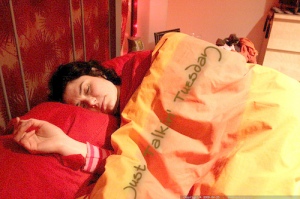
sleeping mamaAs parents, we all know how meaningful sleep can be – it’s precious lifeblood which lets us function – and when we don’t get it, World watch out! Unfortunately, those of us who struggle with a Postpartum Mood Disorder on top of the common parental experience of dazed consciousness are really in trouble. You see, it’s been proven over and over in research that sleep has something to do with our psyche. And guess what – lack of sleep can exacerbate symptoms of Postpartum Mood or Anxiety Disorders! Great, you say? Yeah, well, that was my reaction too when I first read the research. I mean, really, why did they even bother researching this topic? Isn’t it common knowledge? BUT… they did research it… and now we have something concrete to point to when our beloved partners are befuddled at our new-found obsession with sleep.

So here’s today’s topic:

Share with us what effect (if any) sleepless nights had on your Postpartum Experience. Did you sleep? Did you not sleep? When you woke up, were you rested or did you wish you could go back to sleep? What strategies did you use to help regulate your sleep? Did you read? Watch TV? Play on the Internet?

Here are some basic suggestions for those who are STILL struggling with sleep.

Get into a routine. At a certain point in the evening (if you can – we all know how unpredictable babies can be!), start a certain chain of events that will lead to you crawling er, collapsing into bed.

Once in bed, if you lay there awake, GET back up and go somewhere else. Watch TV or read for 30 minutes. Bathe, shower, drink some hot milk. Then get back in bed. Don’t stay in bed if you’re awake. This will cause you not to associate bed with just sleep. (which completely defeats the purpose!)

Have your partner take a night feeding and let you sleep for at least 5-6 hours at night. (Even if you’re nursing DO this – and have your partner get baby ready for nursing by changing diaper, etc, so you can get a few extra minutes!)

Remember – if you are not sleeping and/or have difficulty sleeping for more than a week, call your doctor. This is not the time to hold off on getting relief!

You can read more at this website about sleep disorders and difficulties.