I had the pleasure of meeting Amber during an initial meeting for the formation of Georgia Postpartum Support Network. Amber is a mom, a working professional,
a blogger and a dedicated Postpartum Peer support volunteer who facilitates two groups in Atlanta. She also serves as GPSN’s Secretary. Thank you Amber, for being a brave and courageous woman in adding your voice to the ever-growing group of advocates for PPD Support!
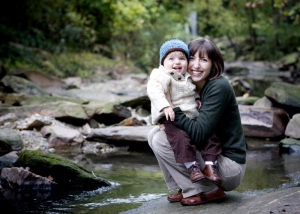 Tell us about yourself. Who is Amber when she’s not being a mom?
 I am a friend, a wife, a sister, a daughter, and also a career-oriented woman. I enjoy my work in service as Director of Intergenerational Ministries at my church. I also provide one-on-one and group volunteer peer support to women with Postpartum mood disorders. I do this through email, meeting moms in person, the telephone, and also a support group in Midtown Atlanta that I facilitate twice a month. I also host a playgroup and mom’s discussion group at the church, each once a month. I serve as Secretary of GPSN and I hope that this role will allow me to help bring awareness and education to Georgians and all Americans someday.
Share with us how your Postpartum Experience unfolded. Did you feel prepared for childbirth and the postpartum period prior to giving birth?
I was commited to a natural birth, but after 36 hours of labor I had to get an epidural and then after ten more hours I had an emergency c-section. My birth was completely different than I had planned or hoped for, and I was devastated. I began my postpartum experience filled with regret, shame, and completely sleep-deprived in addition to being physically unwell. I utilized the Hynobirthing method in preparation for and during labor. I did feel completely prepared for a natural, vaginal birth. Unfortunately, in my desire to be commited to natural methods I didn’t even consider the possibility of it not unfolding the way I wanted. This left me disappointed and shocked.
What prompted you to seek help – what wasn’t going well and what helped you get on the road to recovery?
After 5 weeks of exclusively pumping breastmilk because my son would not latch on and not getting more than 2 hours sleep at night I felt completely a wreck. I was scared, unhappy, exhausted, and I had so many unsettled feelings leftover from the birth. On top of that, I was still recovering from major surgery. My head was filled with obsessions and anxiety. I knew that I needed help. I was thankful that I had the business card of a psychiatrist my OB-GYN had given me early in my pregnancy (it was a surprise and I was not sure how I felt about it when I first learned I was pregnant). What helped most was the medication. After two weeks on anti-depressants I knew I was still very unwell and we added a couple of other meds to my regimen. This helped SO much. I really needed something to help me sleep and quell my anxiety. Talking with my doctor who is an expert in this field made me feel normal and less alone. The biggest thing I did to help myself was to admit to everyone how sick I was. I told my parents and husband the truth about my obsessions, my depression, my lack of sleep, and how helpless and hopeless I felt. Because of my truthfulness, they were able to be fully aware of my situation and to act appropriately to care for me and my son. During the 4th week postpartum we had begun utilizing the nanny who had planned to be with my son once I returned to work. After I was diagnosed and through my early weeks of treatment she continued helping several days a week. Knowing my baby was well cared for was reassuring. During the most difficult time (weeks 6-12 postpartum) my husband was my rock. I am not sure how he was able to keep a positive outlook while living with someone who was so depressed, but he did. Returning to work at 13 weeks postpartum was healing for me. I found the me that had something to offer other than diaper changing and rocking. Lastly, I have a best friend that was there for me in every way on an almost daily basis. That support rounded out my treatment and allowed me to recover much faster.
I know that you’ve had some Postpartum Thyroid issues. Share with us some of your experience and how your physicians uncovered the Thyroid factor.
It is still unclear as to the severity of the thyroid issue or whether it has had any role in my postpartum struggles. I have had fairly moderate gastic pain and also sleep difficulties and fatigue since I first gave birth. In my efforts to explore what was wrong physically and emotionally in the 2nd month postpartum we learned that my thyroid was functioning in the hyper spectrum, if only slightly. One year later, the results are the same. I will be having a thyroid scan on Monday to determine how my thyroid is functioning on the whole. I do know for sure that thyroid issues can have an extreme impact postpartum, though, and recommend that thyroid tests be done on anyone experiencing a PPMD.
At what point in your recovery did you feel the desire to turn your journey into support for other mothers? How empowering has the experience been for you?
I knew from the moment that I began coming out of the darkness (around 11 or 12 weeks postpartum, after 6 or so weeks on medication and with therapy) that I felt called to serve other women and to educate all people about PPMDs. In my darkest hours I never felt alone and always knew that God would make good out of a truly horrific experience. He has opened so many doors for me. I am still amazed at how women find me…it feels very spiritual at times. Being able to help others makes me feel purpose in my pain. It allows me to relate to others and provide true empathy. It is a precious gift. As I often share; it took me 31 years to find my calling and spiritual gift. I never was good at sports or music, and though I did well academically, I believe that this work is my true passion and area of giftedness.
Share three things that made you laugh or smile today.
My son trying to “swiffer” my hardwood floors at 16 months old.
Realizing that I endured 36 hours of labor naturally…and that really, I shouldn’t feel guilty or embarrassed…that’s not a bad track record! (It only took me 16 months to get to this point!)
The thought of sitting on the beach reading a book in complete peace and quiet.
What has been the most challenging aspect of parenting so far? The least challenging?
For me the loss of identity initially was devastating. I had a very difficult transition into motherhood that I believe they now call Postpartum Adjustment Disorder. I simply could not accept that my life entailed changing diapers and trying to entertain a completely helpless being. Finding a way to find myself again and then balance the “new normal” with fulfilling my own personal needs was a challenge. I believe that it is only in the past 3 months that I have found my way again. I typed the sentence, “the least challenging for me…” three times before I finally erased it and decided to share that I don’t think there are any aspects of being a good parent that are easy. That’s the deal…you reap what you sow. I know that each time I face a choice when it comes to my son that the “harder” option in the short term will be the better one for the long term. That which takes effort is rewarding.
As you recovered from Postpartum, how much of a part did your faith play?
As you can tell from my previous answers, my faith was everything to me. I am not a fundamentalist and I don’t feel like an extremely “religious” person, but I do believe that God can be seen so many times in my day, each day. His hand touches my life with great blessing. I am not rich, powerful, or even close to perfect, but overall I have a good life. There was a time that I didn’t, so I think I appreciate my life now even more. I believe that being in conversation with God through prayer during the difficult childhood I endured and the horrible PPMDs I overcame made the difference in who and how I am on the other side of all that. Faith defines who I am.
Tell us about your blog. What should readers take away from your writing there?
My blog began as a way to talk about what I was doing with the mom’s groups and what I hoped mothers would get out of those groups. I also wanted to document my experiences in an organized way and once I read another blog I realized that was a free and easy way to do so. That was almost a year ago. Since then, I have developed it into a much more comprehensive site. I post news and research, personal stories, support group info and more at www.atlantappdmom.blogspot.com. Had I realized that I would be writing in the long term there and that the readership would grow, I would have chosen a different web address. In order to have a more educational site with a name that will appeal to everyone I created a website, additionally. www.postpartumhealing.com has specific information for those who are just discovering postpartum health topics. I hope that readers of my blog will find honesty and integrity in what I share about being a mother. I try to tell it like it is, even if I am only feeling that way for a short period of time. I know a few things I have shared have made people cringe, but I never was good at hiding the truth. Maybe there are women who LOVE every moment of it. But, I think that most of us dislike a lot of aspects of being a mom. It doesn’t mean we love our children any less, though.
And last but not least, if you had a chance to give one piece of advice about Postpartum Depression to an expectant mother, (new or experienced), what would it be and why would it be important for her to know?
My advice to everyone, postpartum or not, is to have and to offer REALISTIC expectations of motherhood, especially the first 3 months. It is normal not to fall in love with your newborn. It is ok to feel inept and scared. It is not really easy or fun to care for such a little person when they can’t even provide a smile to thank you for your exhaustingly hard work to keep them alive and well. Being a new mother is a journey with challenges that match each joy.
Thank you for inviting me to share my experience with your readers.
