
Congressman Bobby L. Rush makes a statement on the House Floor about the MSB MOTHER’S Act.
You can also read reactions to the passage of the bill at Coping with Life by Tom Davis and Postpartum Progress by Katherine Stone.
ONTO THE SENATE WE GO! (Have you called your Senator yet?)
Congressman Bobby Rush’s Statement on H. R. 20 the Melanie Blocker Stokes Mom’s Opportunity to Access Health, Education, Research and Support for Postpartum Depression Act of 2009
Monday March 30, 2009
Madame Speaker, today I rise in strong support of the Melanie Blocker Stokes Mom’s Opportunity to Access Health, Education, Research, and Support for Postpartum Depression Act of 2009.
I would like to thank Chairman Waxman, Ranking Member Barton, my colleague Congressman Frank Pallone, and the Members of the Energy and Commerce Committee who unanimously supported this legislation’s passage out of the committee.
After eight long years, today marks an important step forward in the journey for Congress to fully recognize postpartum depression as a national women’s health priority.
This bill comes to the floor today with strong, bipartisan support. No longer will postpartum depression be dismissed as mere “baby blues.”
Madame Speaker, today, 60 to 80 percent of new mothers experience symptoms of baby blues while the more serious condition, postpartum depression, affects up to 20 percent of women who have recently given birth. Experts in the field of women’s health like Susan Stone, Chair of the President’s Advisory Council of Postpartum Support International, says that these statistics do not include mothers whose babies are stillborn, who miscarry, or who are vulnerable to these devastating disorders which raises those at risk into the millions. The most extreme form, postpartum psychosis, is exhibited in about one percent of all new mothers.
At what should be the happiest time in a woman’s life these mood disorders result in feelings of despondency, tearfulness, inadequacy, guilt and fatigue. In the worst case scenario, if left untreated or not treated properly, postpartum depression and postpartum psychosis has resulted in suicide and infanticide. The consequences of untreated maternal depression in the mother range from chronic disability to death of the infant as well as learning and behavioral disabilities that can negatively impact a child’s development.
In light of all these sobering facts, sadly, I was finally compelled to author H.R. 20 in December 2007 after watching the news accounts of the missing Melanie Blocker Stokes. This bright, vibrant woman who loved life was a first time mother, a successful business woman and my constituent. Despite her family’s valiant interventions, Melanie’s psychosis was so severe that she slipped away and ended her life in solitary agony.
As news of her death swept throughout Chicago, I reached out to Melanie’s mother, Carol Blocker, who told me her daughter’s diagnosis and suicide was the result of postpartum psychosis.
And, sometime later, Dr. Nada Stotland of the American Psychiatric Association, also a constituent of mine, also reached out to me. Dr. Stotland detailed the value of additional research and discussed the under-reporting and misdiagnosis of postpartum depression and psychosis in our country.
There is no denying the fact that the need for resources to combat postpartum depression grows more and more each and every year. Here are the facts:
H. R. 20 will finally put significant money and attention into research, screening, treatment and education for mothers suffering from this disease. Research indicates that some form of postpartum depression affects approximately 1 in 1,000 new mothers, or up to 800,000 new cases annually. This data does not include the additional cases of women who may be vulnerable to these illnesses even after they’ve miscarried or who deliver stillborn infants.
Of the new postpartum cases this year, less than 15 percent of mothers will receive treatment and even fewer will receive adequate treatment; however, with treatment over 90 percent of these mothers could overcome their depression.
Every 50 seconds a new mother will begin struggling with the effects of mental illness.
Madame Speaker, these facts are profound and, in the words of Carol Blocker, “…hundreds of thousands of women, who have suffered from postpartum depression and psychosis are still waiting for Congress to act eight years after legislation was first introduced.”
Madame Speaker, thank you for this day because, today, Mrs. Blocker and hundreds of thousands of mothers will not have to wait any longer for Congress to act!
By passage of H.R. 20, today, we will put mother’s first.
When this bill becomes law, my legislation will:
– encourage the Secretary of Health and Human Services to continue: (1) activities on postpartum depression; and (2) research to expand the understanding of the causes of, and treatments for, postpartum conditions
– express the sense of Congress that the Director of the National Institute of Mental Health may conduct a nationally representative longitudinal study of the relative mental health consequences for women of resolving a pregnancy in various ways
– amend the Public Health Service Act to authorize the Secretary to make grants for projects for the establishment, operation, and coordination of effective and cost-efficient systems for the delivery of essential services to individuals with a postpartum condition and their families.
– Direct the Secretary to ensure that such projects provide education and services with respect to the diagnosis and management of postpartum conditions.
Moreover, this bill is an affordable approach to research and services.
This is good policy, good politics and a good public health bill!
Before I close, I’d like to take a moment to remember and honor the hundreds of thousands of women-women who have lost either their ability to “mother” or, in far too many cases, their lives to postpartum depression.
Madame Speaker, this bill, this day and this moment would not be a reality had it not been for a beautiful, young Chicago native, the late Melanie Blocker Stokes, and the valiant effort her husband and her family made to save her lift but to no avail.
And, even though Melanie did not survive her battle with postpartum psychosis, Melanie’s battle and her ultimate sacrifice will never be forgotten because of our efforts, here, today.
I would like to thank Carol Blocker, my friend, constituent and fellow activist, who with grace and dignity found a way for her daughter’s memory to live on.
I would also like to thank all the groups who support this legislation. Groups like, Postpartum Support International, the Family Mental Health Foundation, the American Psychological Association, the American Psychiatric Association and the American College of Obstetricians and Gynecologists.
I’d also like to acknowledge the tremendous work of groups like the Children’s Defense Fund, the Melanie Blocker Stokes Foundation, Suicide Prevention Action Network, Planned Parenthood Federation of America, Depression and Bipolar Support Alliance, Mental Health America, NARAL, National Alliance for Mental Illness, Community Behavioral Healthcare, the March of Dimes, The National Association of Social Workers, National Organization for Women and North American Society for Psychosocial Obstetrics and Gynecology.
I thank these groups and various activists for their relentless efforts to address this issue including calling their congressional representatives and mailing or faxing letters in support of H.R. 20. Our work will not be done until this bill is signed by the President. And, the good news is, this time we have a friend and fellow Chicagoan in the White House.
And, finally, let me once again thank the hundreds of thousands of unsung women, and their families, who have battled postpartum depression in silence or isolation, in some form, for far too long. To those women and their families I say, you will never suffer in silence again.
And, with that, I proudly urge my colleagues to vote “yes” on H.R. 20.
Thank you.
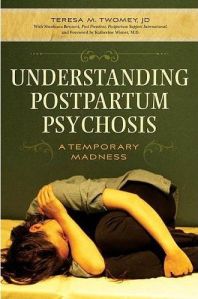 A new book by Teresa Twomey with Shoshana Bennett became available today. This book is not for the faint of heart.