Category Archives: Perinatal Mood Disorders

Kudos to Dr. Oz MD & Dr. Michael Roizen MD

Last night as I was traversing Publix during our weekly grocery trip, all three kids in tow, I managed to flip through a copy of YOU, Having a Baby by Dr. Michael Roizen, M.D., and Dr. Mehmet Oz, M.D. Yes, that’s the same Dr. Oz with the daily TV show.

I picked it up and flipped to the index. Betcha can’t guess what I was checking for…. c’mon. Guess!

I almost didn’t find Postpartum Depression. When I did, it had three page numbers listed. Thankfully, Postpartum Psychosis was listed right below it so I flipped to the page closest to that one. (Pages 272 & 273 if you’re wondering.)

Dr. Roizen and Dr. Mehmet?

THANK YOU.

Thank you for addressing Postpartum Mood Disorders properly.

Thank you for distinguishing between Baby Blues and Postpartum Depression.

Thank you for acknowledging that if a woman even THINKS there’s a problem she should see her provider.

THANK YOU for talking about scary thoughts.

THANK YOU for writing so honestly and informatively about Postpartum Psychosis and not making moms who have PPP seem like hopeless cases. Because they’re not.

I was very impressed indeed.

I can only hope other pregnancy book authors will follow your lead and write so honestly and informatively about Postpartum Mood Disorders. Moms deserve nothing less.

(In the interest of full disclosure, I did not receive anything at all for writing this review. It is an honest gut reaction from randomly picking the book up while my two year old attempted to nap on my chest as we waited for Daddy to bring his sisters back from a bathroom break. It doesn’t get anymore real and honest than that, people. And yes, there is a link to purchase the book @ Amazon BUT it is not a link via my Amazon Associates account. Just a plain ol’ link.)

Just Talkin’ Tuesday: Defining Postpartum Mood Disorders

Welcome to my blog if you’ve traveled here from 5 Minutes for Mom’s Ultimate Blog Party for 2010.

This is my second year of participating.

The following post is meant to spark discussion as well as explain why I blog.

Won’t you come on in, sit down, and have a cup of tea?

I’m so very glad you’re here.

And if you stick around, there’s a meaningful giveaway at the end.


Since my first brush with a Postpartum Mood Disorder, I have come to learn so very much about this world I consider myself fortunate enough to have stumbled into.

Fortunate? To have stumbled into a Postpartum Mood Disorder? What the hell is wrong with you?

Isn’t that a bit like being thrilled to pieces about stumbling into a briar patch?

While I certainly wouldn’t wish a Postpartum Mood Disorder on my worst enemy, I am eternally grateful for the growth it has brought to my life. For the changed relationships, the maturity, the amazingly strong women it has brought into my life. I am eternally grateful that because of my Postpartum Mood Disorders, I have rediscovered my passion for writing. For supporting new mamas as they navigate the very dark and frightening valley of Postpartumville.

For me, as a recovered two time fighter, I define Postpartum Mood Disorders as the source of my strength. As the fertilizer from which the bloom I am constantly reinventing each and every day relies upon. My Postpartum Mood Disorders do not define me anymore. They used to – they used to fill me with a deep sadness, shame, anxiety, fear, hopelessness. I feared sharing my story. The very thought of having to tell one more person what happened to me made me want to crawl into bed, pull up the covers, and never come up for air again. Until I realized I could turn and fight. Turn and kick my PMD’s ass. So I did. And I kicked it hard.

So many women out there deserve to know they are capable of the same strength. They need to know that deep within them lies a spring so full of strength they can’t even see it or sense it until they desperately need it. Then, and only then, will the waters filled with strength begin to flow. Once that flow is turned on, there’s no turning back. Some of us need help turning it on and will need to take medication or talk with a therapist. Some of us will find help and hope in exercise and natural approaches. But just as there is no one size fits all for women, there is no one size fits all for Postpartum Mood Disorder recovery. You have to do what is absolutely right for you, your situation, and your family. And you should NOT be made to feel guilty about that at all by anyone.

This is why I blog, why I wake with the goal of connecting at least one mom with the feeling that she is not alone as she decides to turn and fight her Postpartum Mood Disorder. I have not failed in my daily mission in over three years. That’s over 1000 women and counting! There are no plans to stop this train anytime in the near future either. In fact, there are blueprints on the way to expand this bad boy.

Postpartum Mood Disorders have made me incapable of taking any moment with my family for granted. Incapable of not grasping the deeper meaning of my life and the lives of those around me. My PMD experience has brought a silent clarity to my life. And for me, it’s been absolutely instrumental in bringing my relationship with God back to where it needs to be. And for that, I am certainly eternally grateful.

When you are faced with any illness, you have a choice. You can turn and fight or you can succumb. There are those who have succumbed to their Postpartum Mood Disorders. And for them, for their families, their loved ones, I mourn. But I understand. I know how they reached that point. Because I got dangerously close to it myself. And if you ever wondered what someone who has considered suicide or held suicidal ideations is like, that person is like me, like you, like the barista at Starbucks, the Judge at the courthouse, the Principal at your kid’s school, like the cashier who just smiled at you at the grocery store – the bottom line is that mental illness, just like cancer, can hit any of us at anytime. It’s unpredictable and extremely difficult to prevent even if we do everything right.In order to help prevent suicide, it is important for us to understand the warning signs. It’s important for us to be a friend to those who are struggling. To not judge them when they open up to us. It’s especially important to continue support as they are in the early stages of healing.

I bring up suicide because it ties in with my giveaway. Steve Krupnik over at NoBlu has graciously agreed to give away one of their gorgeous Sunstone Pendants. The design was settled on

“After countless hours of research, collaboration and design we created our organizations symbol, the noblu eclipse. The design is our interpretation of a solar eclipse created to inspire people to support others faced with the challenges of all form of depression and suicide prevention. If you think of the sun as the light within each one of us and the moon as the “visitor” that may block the light of inspiration you can see why we selected this glowing option. The eclipse is a reminder to look for help when we need it, to help others when they need it and inspire everyone to make a difference.”

Those of you who are regular readers know that I’ve never done a giveaway before. But I feel very strongly about the mission of NoBlu and want to share it with you. In order to be entered, leave a comment here. A winner will be chosen on April 19th at 8:00pm EST via Random.org.

So let’s get to just talking – how do YOU define Postpartum Mood Disorders? What has your experience meant to you? How have you grown?

Not had a Postpartum Mood Disorder? Have any questions about them? Want to know how to help a loved one? I’ll answer those too.

Prefer not to comment with either of those topics but want to be entered in the giveaway? Just visit NoBlu and post the first line of their mission statement as your comment.

Breast Cancer, Diabetes screening worth it; Postpartum Depression screening not

Earlier this week, I wrote about UK researchers concluding that Postpartum Depression screening was just not cost effective.

Since then, a couple of other studies regarding screening for other conditions have been released.

It seems that screening for Diabetes in primary care qualifies as cost-effective.

And screening for Breast Cancer saves lives despite the habitual over-diagnosis. For every misdiagnosed case, two lives are saved. In fact, the researchers for this study state that approximately 6 women are misdiagnosed and undergo unnecessary treatment for cancer they may never have developed as a result of a false positive at the screening level. In case you were wondering, these researchers are UK based as well.

Hey. Wait.

The researchers from the UK cited over-diagnosis  as one of the reasons formal screening for Postpartum Depression was not cost effective.

And being misdiagnosed with Postpartum Depression does not lead to expensive radiation treatment or other damaging exposures including surgery. At very worst, you may receive a script for an anti-depressant or a referral to a counselor for some talk therapy.

What the….

So lemme get this straight.

Pumping a woman full of radiation and chemotherapy is hunky dory and cost effective EVEN if she doesn’t need it.

But a quick questionnaire to check on mom’s mental health is NOT?

On what planet does this even BEGIN to make sense??

Let’s also discuss this little nugget. For both the Diabetes and Breast Cancer studies, ACTUAL records were used. The Postpartum Study was compromised of 92 “hypothetical” cases.

When did we stop rating the study of actual records? When did researchers stop including the actual risks and ripples of Postpartum Depression? A woman without Postpartum Depression or who is successfully diagnosed, treated, and recovering is more likely to breastfeed in my opinion. And if she’s nursing, she’s protecting herself and her child from – guess what – Diabetes AND Cancer.

So you really want to practice cost-effective healthcare?

SCREEN women after birth. Ensure their stability, support, and positive outcome with life as a new mom. Encourage them to participate in health practices for themselves and their children. Enabling women to make healthier choices reduces the risk of other issues down the road. Screening saves lives when it comes to Postpartum Mood Disorders. It saves mothers, children, and families. It’s not something you skip over because it’s simply not “cost-effective.” Skip screening and cost will simply shift elsewhere – to diabetes care, cancer care, future mental health care for mom or kids, broken families, etc.

It is simply not acceptable to allow new mothers to continue to suffer. Not acceptable at all.

Two years ago today

I wrecked my Mazda.

Without insurance, I went to the hospital on a backboard.

My fingers and toes were numb. Tingly but mostly numb.

I was scared.

It got worse.

After what seemed like an eternity in the hospital, I was released.

Into the custody of a Police Officer.

For not having auto insurance.

Because my husband was addicted to marijuana and had not been paying our bills because he had been too busy paying his habit.

All of this after surviving two episodes of Postpartum Depression.

Giving birth to a third child and FINALLY experiencing bliss. What it was SUPPOSED to be like. Heart Soaring Heaven.

Two years later from that night  – tonight –

I am in my living room.

My husband is sitting in his chair.

We love each other more than ever. We talk more than ever.

We.are.still.married.

WE are strong.

Still not perfect but hey, who really is?

God had to tear us down first and whooo… did he tear us down.

But it was worth it. Oh so very worth it.

Marriage is for better. For Worse. We’ve been  both places.

Better is well, better. But Worse is survivable.

And I am grateful.

SO grateful He chose me all over again.

Today is his 2 year sober anniversary. And our two year brand new marriage anniversary.

Happy anniversary, honey.

I love you more than I can ever ever tell you with words.

Postpartum Depression formal screening not worth the cost, BMJ study says

According to a recently published study in the British Medical Journal (BMJ), Postpartum Depression Screening is not…. brace yourselves. Worth the cost.

That’s right.

NOT.WORTH.THE.COST.

In their cost effective analysis, the researchers used “A hypothetical population of women assessed for postnatal depression either via routine care only or supplemented by use of formal identification methods six weeks postnatally, as recommended in recent guidelines.”

The conclusion was that overall not using a formal screening method was much more cost effective as it eliminated false positives.

So the mental health of a woman which will then affect her child, her family, her community, the world at large, are just not worth it to the National Health System of the UK. The EPDS scored out at about $67,000 per quality adjusted life years while no screening method scored at a price tag of just $20 – $30,000. No value for the money was found to exist when using the formal identification methods.

Did these researchers not read Murray & Cooper’s Controlled trial of the short- and long-term effect of psychological treatment of post-partum depression which explores the effects of postpartum depression treatments on children?

There is SO much more at stake here than the dollar value to the National Health System.

There’s the potential for broken families. The potential for children growing into their own mental health issues, the potential for continued need for mental health treatment due to an undiagnosed episode of postpartum depression, potential for increased incarcerations due to untreated mental illness, continued sadness, the continued stigma, continued and perpetuated lack of education on the part of physicians in regards to Postpartum Mood Disorders.

The most interesting aspect of this study is that it focused on screening for Postpartum Depression in the Primary Care setting. Primary care physicians are not always comfortable or knowledgeable in screening for mental health issues. If a patient were to screen positive, that physician is then morally responsible for referring them to a specialist. Often times, at least here in the states, a Primary Care physician is unaware of where to refer a patient for help with a Postpartum Depression Disorder. Therefore, they become afraid of screening because they fear what will happen if a positive were to occur. What would they do with the patient? Where would they send them? How would they respond? Are they familiar enough with Postpartum Mood Disorders to recognize a false positive?

I think the key to the results of this study is not so much in blaming the high percentage of false positives but in urging that Primary Care physicians receive more training to enable them to recognize a false positive through more in depth questions after a positive is scored via the Edinburgh Postnatal Depression Scale.

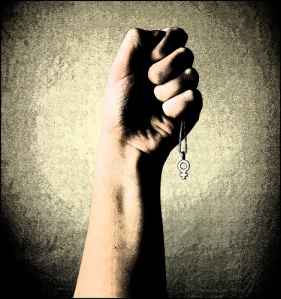
original photo/graphic "Hand holding necklace" by K.Sawyer @flickr

A stronger safety net involving a stronger communication between midwives, Obstetricians, Pediatricians, and General Practitioners is so desperately needed to keep women from falling through the very big cracks which currently exist in the system.

Let’s think about this for a moment, shall we?

A woman gets pregnant. She sees a medical physician to get the pregnancy confirmed. Most mothers seek OB or midwife care for their entire pregnancy. Unless they’re depressed – depressed and mentally ill mothers are less likely to take good care of themselves during a pregnancy, making specialized care even more important even when baby is still in utero. Once mothers give birth, they are then shuttled off to the pediatrician’s office for the bulk of their medical contact. One six week or eight week visit to the midwife or OB to ensure mom is healing properly then an annual PAP visit unless something arises in between. Many Pediatricians focus on babies and not mother. But the tide is changing as more and more Pediatricians are taking into account the family lifestyle and well-being. My own Pediatrician does this and I absolutely adore her for it.

But overall, there is typically no continuity of care, no communication between physicians throughout the birth process. There should be. There needs to be. A woman deserves a team of support. She deserves to thrive. So do her children.

No matter what the cost.

Because once you fail woman and her children, you fail society.

Fail society and we fail to exist.

If we fail to exist….