An article in May’s issue of Vogue entitled “Pregnant Pause” by Alexis Jetter attempts to provide insight into the very confusing world of the pharmacological treatment of depression or mental illness during pregnancy. Ms. Jetter seems to have done her homework. She brings up some very valid points, includes supportive research, referring to specific studies all framed within a heart-tugging story of a boy born with a heart defect as a result of his Mom taking Paxil during her pregnancy. Yet Ms. Jetter forgets to tell both sides of the story. Here’s my take on the article.
In no way am I belittling this Mom’s experience by rebutting some of Ms. Jetter’s claims. As a Mom of a special needs child, I know first-hand how difficult life becomes as you work with and around your child’s needs. I also understand the enveloping guilt which rages inside you every time you see your child suffer or struggle and wonder “Did I do that? Was it my fault?”
You see, I didn’t take my pre-natal vitamins during my second pregnancy. At first it was because of the wretched morning sickness. Then I just didn’t want to take them. I even pondered what would happen if I didn’t take them, thinking it would be a neat little “experiment” to find out.
When my daughter was born with Pierre Robin Sequence which included a complete and bilateral cleft of her hard and soft palate, I felt a guilt that cannot begin to be described by any words known to mankind. It took me nearly two years to admit this to anyone. I lied at the hospital when I was asked if I had taken my prenatal vitamins. Why? Because I knew from my mom’s quick research about PRS that lack of folic acid in the maternal diet increases the risk for this particular condition. The last thing I needed was for the doctors to also blame me for my monumentally bad judgment. Looking back, I’m pretty sure this erratic behavior was directly related to my untreated issues with Postpartum OCD/Depression after the birth of our first daughter.
To this day as my daughter struggles with speech, socialization, and a myriad of other challenges, I still blame myself somewhat. Intellectually I know her problems are not my fault. I have accepted this on that level. But a small part of me will always wonder if she would have these problems if I had just taken my vitamins. So I get it. I get the guilt, I get the hind-sight. I get the anger and outrage. And I definitely get the need for education and informed consent.
What I don’t get is the desire to limit treatment options for other people. Instead of limiting, let’s encourage the development and shared knowledge of non-pharmacological therapies for mild cases of depression during pregnancy such as altering your diet, increasing exercise, natural supplements, psychotherapy, to name a few. Instead of judging, let’s allow women to make their own decisions regarding their mental health treatment. (you can read more on my thoughts regarding the ante-partum medication conundrum here)
Just as with those who are passionate for home-birth and those who are passionate for breastfeeding, there is a caution to be heeded here. We cannot convince a woman who is determined to have a caesarean section to have home-birth just as we cannot convince a woman who is convinced that a pill will solve her problems to try other therapies. All we can do is provide the education, statistics, and support. Then we need to step out of the way and let the woman make the decision with her medical professional team.
We can only fix ourselves, not those around us.
Now, onto the meat of the article, if you will.
After we meet Gina Fromm and hear of her difficult experience as a result of taking Paxil during her pregnancy, we are introduced to Dr. Anick Berard, PhD and Professor of Pharmacy at the University of Montreal. He discusses his study on Paxil, concluding that “..now other people have done the studies, too. And I’m much more comfortable saying that Paxil is a bad drug to take during pregnancy.”
Really, Dr. Berard?
I found a more recent study undertaken by none other than Dr. Anick Berard which concludes that unless the dose of Paxil is above 25mg during the first trimester, Paxil usage is not associated with an increase in congenital cardiac malformations when compared with non-SSRI usage. (Typical therapeutic dosage for Paxil can range anywhere from 10mg to 40mg.) When researching it’s not difficult to find studies to contradict one another but when you find them from the same researcher it’s a bit odd.
Next we meet Carol Louik, Sc.D, author of one of the two studies released in June of 2007 extolling the small risk SSRI’s posed to the human fetus. Turns out Carol’s study was partially funded by GlaxoSmithKline, Sanofi Aventis, and another Pharmaceutical Company. However, at the same time Carol’s study was published in the New England Journal of Medicine, another study was also published. This study was coordinated by the CDC out of Atlanta and did not have any financial disclosures to the Pharmaceutical Companies. Sura Alwan, MSc, and Jennita Reefhuis, RN, were first and senior authors respectively. Their study concluded the absolute risk of exposure vs. non-exposure not to be much different than the standard baseline risk for defects in any healthy pregnancy.
But the Alwan/Reffhuis study results are not present in the Vogue article.
Then we’re tossed this golden nugget – “….SSRI usage dramatically increases the chances that a baby may be miscarried, born prematurely or too small, suffer erratic heartbeats, and have trouble breathing.” The author further states that “Taken together the NEW research caught many experts by surprise.” Yet most of the research articles I located by the researchers quoted were from 2006 or earlier. This is hardly NEW research. In fact, the NEW research contradicts many of the studies referenced in the Vogue Article.
For instance, we’re informed through a quote from Dr. Adam Urato, M.D. That “these antidepressants are portrayed almost like prenatal vitamins that will level out their mood and lead to a healthier baby. But antidepressants have not been shown to decrease rates of miscarriage or birth defects or low birth weight. On the contrary, they’ve been shown to increase those problems.” Then directly after this quote, Ms. Jetters states pregnant women are routinely excluded from clinical tests of new drugs. But she fails to ask a very important question.
Why?
A solid answer can be found in the February 2009 Carlat Psychiatry Report, an unbiased report regarding all things psychiatry related, including medication. According to an article entitled “Psychotropics and Pregnancy: An Update,” the Carlat Psychiatry Report states “the gold standard study will never occur. It will never be ethically permissible to enroll pregnant women into a randomized, placebo controlled trial designed to determine if a drug causes birth defects. For this reason, we are left with less than ideal methods of determining risk.”
To seemingly substantiate Dr. Urato’s quote regarding miscarriage, birth defects, or low birth weight, a study performed by Developmental Pediatrician Tim Oberlander, M.D. At the University of British Columbia is briefly examined. This study concluded after tracking the birth outcomes of 120,000 women that infants exposed to SSRI’s prenatally were born too small and have trouble breathing. Oberlander’s quoted conclusion for the article? “It’s not the mother’s mood,” Oberlander says. “It’s the medication.”
Yet Oberlander’s study is negated by Einarson’s study, “Evaluation of the Risk of Congenital Cardiovascular Defects Associated With Use of Paroxetine During Pregnancy” Einarson also writes a letter to the American Journal of Psychiatry, (located in Vol. 64, No. 7, July 2007) which states the conclusions made by Oberlander and others is not supported by the data presented. Einarson points out that low birth weight was not stated as an investigated outcome and that only average weight of newborns and proportion falling lower than the 10th percentile (ie, small for gestational age but NOT low birth weight. Low birth weight is technically defined as >2500g2.
Einarson’s study combined both prospective and retrospective methodology to examine a large number of women specifically on Paxil. Their conclusion? “Paroxetine does not appear to be associated with an increased risk of cardiovascular defects following use in early pregnancy, as the incidence in more than 3,000 infants was well within the population incidence of approximately 1%.”
Just in case you’re wondering, no, their study was not funded by GlaxoSmithKline. The Carlat Psychiatry Report is quick to point out that seven of the nine authors received no funding from GSK or any other drug company but two have received funding for drug research from other drug companies but not GSK.
The Carlat Report also address what one should do with conflicting information regarding medicating during pregnancy. The best one can do from a “medico-legal perspective is to avoid paroxetine. But the data does suggest that paroxetine – and perhaps by extension, all SSRI’s – may be safer than what has been suggested by other smaller studies.”
Going back to the issue of pre-term delivery as well as low birth weight and their relation to mood or medication, a recent study released by Dr. Katherine Wisner examines this very topic. The study looked at 238 women with no, partial, or continuous exposure to either SSRI treatment or depression and compared infant outcomes. Dr. Wisner’s study found that exposure to SSRI’s did not increase birth defects or affect infant birth weight but the importance of this study lies within the finding that the pre-term delivery rates were the same with depression exclusive of SSRI treatment, leading the researchers to state that it is “possible that underlying depressive disorder is a factor in pre-term birth among women taking SSRI’s.” Dr. Wisner also encourages further research into this topic even though her study was just released this year. You can read more about this study by clicking here.
Rita Suri, M.D. from UCLA also studied this very situation, publishing her research in August 2007 in the American Journal of Psychiatry. Not surprisingly, Suri’s study is quoted in the Vogue article. Her results found that infants born to women taking SSRI’s were three times more likely to be born prematurely (although most were only 1 week early) She also found that the higher the antidepressant dose, the higher the risk of early delivery. However, her results did not show that untreated mild depression had an effect on prematurity. I’d like to add a personal digression here. My second daughter was born at 36 weeks. While not officially diagnosed, I would say that I suffered from untreated depression during that pregnancy. Sure it’s not an official research study but it’s very hard to discount personal experience especially when it agrees with current research.
At this point in the article, we’re introduced to one of the more well-known disorders associated with paroxetine usage, Persistent Pulmonary Hypertension of the newborn. Tina Chambers, Ph.d, a birth-defects researcher from University of California at San Diego is the chosen expert for this topic. She states that this condition normally strikes only one or two infants in 1,000. But Chambers found that rates jumped between six and twelve per 1,000 for mothers who take SSRI’s. In contrast, a recent prospective study by Susan Andrade, ScD, concluded no relationship between SSRI usage and PPHN but did admit that given limitations of the study and small number of confirmed cases, further study in this area may be warranted. In Andrade’s study, 1104 mothers were followed with only 5 confirmed cases of PPHN reported.
Alexis McLaughlin’s story about her daughter’s struggle with PPHN is striking, especially for me, because I’ve seen my daughter struggle for breath immediately after birth. Her quote, “It’s difficult because you need good mental health and a healthy baby,” is very reminiscent. You do indeed need good mental health and a healthy baby. When I was pregnant with Charlotte, we told people we didn’t care about gender, all we cared about was health. But if that doesn’t happen? You do your best to get through it because there is nothing you can do to go back and change what was done in the past. We can only move forward, changing what we can, and if we can’t change it, we change the way we think about it. Even with a normal pregnancy given no SSRI exposure or depressive exposure, a mother faces a 3% risk of giving birth to a child with a birth defect of some kind.
We are then moved into the science behind the affect of an anti-depressant on the human fetus. It’s hypothesized that serotonin is responsible for sending “crucial developmental signals to the fetal heart, lung, and brain….[and that]…SSRI’s, which prevent the body’s natural absorption of serotonin, could be tampering with essential cell growth.” A study by Francine Cote concludes that maternal serotonin is indeed involved in fetal development, precedes the appearance of sertogenic neurons, and is critical for development. The latter hypothesis regarding the interference of SSRI with essential cell growth has been and I’m sure will be studied for quite some time.
Shortly after this, the article winds down by warning of the “small coterie of influential doctors who…underplay the dangers of antidepressants,” again, a quote from Dr. Adam Urato. I do agree whole-heartedly with the latter part of his quote: “We want and need expert opinion that’s free from industry influence and from the appearance of bias,” Urato says. “It’s just outrageous that doctors have to work with that.”
Any of the several women I’ve come across who work with the Perinatal Population will be some of the first to admit that yes, there are risks to taking medications while pregnant or nursing. We even inform women we support to not only weigh the benefits against the risks by researching their options but let the professionals determine if the situation is severe enough to warrant medication.
Dr. Katherine Wisner examined this Risk-Benefit relationship in a study back in 2000. In this study, Dr. Wisner encourages physician and patient communication through the use of informed consent, provided the patient meets the legal definition of competent. She also recommends a family member or friend of the patient be present to help alleviate any anxiety and to ask questions the patient may not think of asking regarding any medication decision.
Many of the recommendations Dr. Wisner sets forth should be commonly used by a competent physician. Unfortunately there are physicians who do not follow informed consent and instead pay attention to the perks offered by Pharmaceutical Companies. However; these perks are slowly disappearing as the medical community awakens to the ethical dangers they pose as a result of increased consumer advocacy for fair and informed treatment when it comes to mental illness. If you should find yourself with a physician who prescribes SSRI’s like m&m’s or refuses to listen to your situation, it is time to find a new doctor for your care. A good doctor will listen, research, and collaborate with you.
I want to close with a quote directly from the Vogue article by Gina Fromm, Mother to Mark Fromm, the little boy with the heart defect as a result of his mother’s usage of Paxil. I couldn’t say it any better than this.
“It is easier to take a pill,” Gina says. “But over the long run, that’s not the best solution. It certainly hasn’t been for my life.”
I agree Gina, I agree whole-heartedly.
In my opinion, society today has gotten in the habit of quick fixes instead of sustaining solutions. I personally think it’s time we change that. But let’s do so in a logical, evidence based, and bias-free manner. Otherwise we’ll all just end up stuck right where we are screaming at each other so loud we can no longer hear ourselves think.

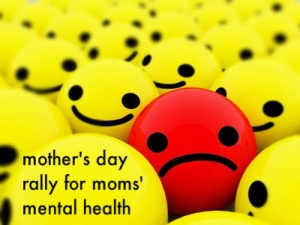 The first annual Mother’s Day Rally for Moms’ Mental Health.
 Tell us a little bit about yourself. Who is Mary Jo Codey when she’s not passionately speaking out about Postpartum Mood Disorders?