Category Archives: family

@karma_D finds her Postpartum Voice

@karma_D, Lisa, found me via the #PPDChat at Twitter. At this week’s Just Talkin’ Tuesday, she expressed a desire to share her story but said she wasn’t ready to do so on her own blog yet. Lisa wanted somewhere to share her story anonymously in order to help other moms. I offered her a place here at My Postpartum Voice. This is truly what I want this site to be about – the power of sharing our stories to help one another find our own Voice as we journey through recovery.

Lisa’s story is powerful. Her NICU start reminds me of my own postpartum after the birth of my second daughter. It’s a rough start for sure and I hope Lisa finds the same strength as I have as she journeys towards recovery. Please don’t hesitate to send @karma_D some love. And if you’re a mom in need, you can follow me by clicking here. You can also visit Postpartum Support International to find a Coordinator near you. You are not alone, you are not to blame, and you will be well.


I have post partum depression.  That might be a shock to friends and family, but no one was more unprepared for it than I was.  My pregnancy was incredible.  I felt amazing, better than I have in years, both physically and emotionally.  I felt strong, hopeful, like a dream a lifetime in the making was finally coming true. Those months were full of planning, anticipation, expectation, all culminating in the beautiful instant my son was born.  It was the best moment of my life, euphoric almost in the sudden absence of pain and joy of meeting him.

Within hours of his birth, he was taken to the NICU for breathing difficulty, and so began the downward spiral, full of broken expectations.  Instead of bonding with a newborn in the hospital room surrounded by adoring guests, we shuffled back and forth to the NICU to stand around a helpless baby attached tubes and wires.

The night we came home from the hospital without our son was horrible. Pulling into our neighborhood late that night I vividly remember looking out the car window and feeling like I was witnessing life from another person’s body.  Reality seemed unrecognizable.  We arrived home to flowers and hospital bags dropped off earlier by our parents, mountains of gifts and food cluttering the house.  In that moment I couldn’t see this wonderful outpouring for the blessing it was, but instead as anxiety inducing clutter.  Exhausted, my husband went to bed but I stayed up and cried.  I felt alone, scared, not myself.  It was not at all the homecoming I had anticipated.

When we finally did bring our son home a week after his birth, things didn’t get better.  Breastfeeding difficulties often left one or both of us in tears.  It was not at all the bonding experience I had hoped for.  I pushed through because I wanted so desperately to do the right thing, to act like a good mother even if I didn’t feel like one.  I was tearful and scared because I didn’t feel like myself, and when I did manage to communicate this to my husband all I could muster was, “It’s so hard.”  He did his best to reassure me and I tried to reassure myself it was just “baby blues” and sleep deprivation.  I minimized my symptoms to the OB and Pediatrician, who screened me for PPD but didn’t pick it up early on.  I tried to will it away and hoped things would get better, and kept acting like everything was fine.

Months went by and it never did get better, and the mood swings actually got worse.  One moment I was okay, the next agitated or enraged, then crying and despondent.  I yelled a lot, mostly at the dogs or my husband.  One afternoon when my son was crying I yelled at him to “SHUT UP!  JUST SHUT UP!”  The guilt of yelling at him was awful.  I believed it was going to be burned in his psyche forever and he’d always think I was crazy.  Still not wanting to think the mood swings could be PPD, I blamed it on my IUD.  Eventually I did tell my OB about my symptoms (though admittedly I glossed over them again), and she said she “wasn’t getting a good read on (me).”  She agreed it could be the IUD but convinced me to give it some more time, and encouraged exercise and DHA supplements.  Finally I demanded the IUD removed as I wasn’t getting better, but even then no one diagnosed me with PPD.

I spent 6 months of maternity leave waiting for things to look up.  I kept hoping to turn the corner but never did.  Instead, the mood swings continued, and intrusive thoughts began.  I pictured horrible things happening to me and my baby and felt helpless to prevent them.  I often lacked motivation – even the simplest tasks seemed too much to manage. Once I went an entire week without leaving the house because it was just so overwhelming.  My mood wasn’t always down.  There were lots of times I felt fine, happy even, and capable, but they never lasted long.  These moments of calm made me think I was okay.  I never wanted to harm myself nor my baby, I got up and dressed every day, and I didn’t really feel like what I believed depression to be, so I never admitted what was happening in my head and never asked for help.

Returning to work was a blessing and a curse.  It gave me a much needed break but the guilt was crushing.  The mood swings got progressively worse until one night (Valentine’s Day), I got so worked up over my son’s difficulty going to sleep that I exploded.  After slamming the door to his nursery I went and hid under the covers, my body buzzing and feeling like I might explode out of my skin.  My thoughts raced and I just wanted to go away.  I didn’t want to die but I didn’t want to exist either, at least not then.  Later that night I had another fit when the baby woke up.  My husband asked, “What is wrong with you?” in a tone I’ve never heard from him, one that suggested disgust. That was my rock bottom.  I couldn’t hide it anymore.  The next day I finally told my husband I thought I had PPD and made an appointment.  I saw a different doctor and started treatment.

The improvement has been rapid.  I feel hopeful again, motivated, more clear headed.  I can reason rather than shutting down.  The anger is better, the crying is better.  The anxiety still creeps in and I do have setbacks.  On those days I just try to survive until tomorrow.  I’m learning to recognize triggers and figuring out coping mechanisms – Blair’s STOP has been helpful, as has reading and chatting with other moms who’ve experienced PPD.  (At the same time, I feel the need to control what I’m exposed to so I’m careful about following blogs and such and limiting potentially upsetting material.) I’m trying to let go of expectations and enjoy the moment more. My bond with my son is growing and I am starting to appreciate those wonderful Mommy emotions I had hoped to experience immediately. I wear a locket every day and inscribed on the back is “Before I understood your words, I understood your love.”  I have an amazing son and I know he understands the bond, too.

I think a lot about what it will be like next time – the “do over” as I call it.  In the darkest moments of PPD I swore we would be “one and done” – I couldn’t fathom ever going through this again.  Now, I am hopeful.  Things will be different.  Per my doctor, I’ll likely start meds immediately.  I’ll make a strategy for how I’m going to get support, something like a birth plan but for postpartum, and share it with my “team.”  I am almost certain I won’t breastfeed.  The stress of nursing was a huge trigger, even after all the initial issues as I worried about pumping and supply. I’ll also know I’m not alone.  I wish I had believed that months ago.
Postpartum Depression formal screening not worth the cost, BMJ study says

According to a recently published study in the British Medical Journal (BMJ), Postpartum Depression Screening is not…. brace yourselves. Worth the cost.

That’s right.

NOT.WORTH.THE.COST.

In their cost effective analysis, the researchers used “A hypothetical population of women assessed for postnatal depression either via routine care only or supplemented by use of formal identification methods six weeks postnatally, as recommended in recent guidelines.”

The conclusion was that overall not using a formal screening method was much more cost effective as it eliminated false positives.

So the mental health of a woman which will then affect her child, her family, her community, the world at large, are just not worth it to the National Health System of the UK. The EPDS scored out at about $67,000 per quality adjusted life years while no screening method scored at a price tag of just $20 – $30,000. No value for the money was found to exist when using the formal identification methods.

Did these researchers not read Murray & Cooper’s Controlled trial of the short- and long-term effect of psychological treatment of post-partum depression which explores the effects of postpartum depression treatments on children?

There is SO much more at stake here than the dollar value to the National Health System.

There’s the potential for broken families. The potential for children growing into their own mental health issues, the potential for continued need for mental health treatment due to an undiagnosed episode of postpartum depression, potential for increased incarcerations due to untreated mental illness, continued sadness, the continued stigma, continued and perpetuated lack of education on the part of physicians in regards to Postpartum Mood Disorders.

The most interesting aspect of this study is that it focused on screening for Postpartum Depression in the Primary Care setting. Primary care physicians are not always comfortable or knowledgeable in screening for mental health issues. If a patient were to screen positive, that physician is then morally responsible for referring them to a specialist. Often times, at least here in the states, a Primary Care physician is unaware of where to refer a patient for help with a Postpartum Depression Disorder. Therefore, they become afraid of screening because they fear what will happen if a positive were to occur. What would they do with the patient? Where would they send them? How would they respond? Are they familiar enough with Postpartum Mood Disorders to recognize a false positive?

I think the key to the results of this study is not so much in blaming the high percentage of false positives but in urging that Primary Care physicians receive more training to enable them to recognize a false positive through more in depth questions after a positive is scored via the Edinburgh Postnatal Depression Scale.

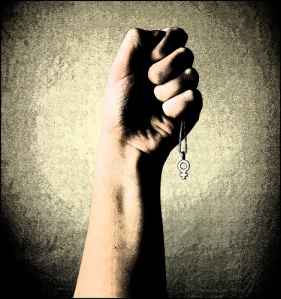
original photo/graphic "Hand holding necklace" by K.Sawyer @flickr

A stronger safety net involving a stronger communication between midwives, Obstetricians, Pediatricians, and General Practitioners is so desperately needed to keep women from falling through the very big cracks which currently exist in the system.

Let’s think about this for a moment, shall we?

A woman gets pregnant. She sees a medical physician to get the pregnancy confirmed. Most mothers seek OB or midwife care for their entire pregnancy. Unless they’re depressed – depressed and mentally ill mothers are less likely to take good care of themselves during a pregnancy, making specialized care even more important even when baby is still in utero. Once mothers give birth, they are then shuttled off to the pediatrician’s office for the bulk of their medical contact. One six week or eight week visit to the midwife or OB to ensure mom is healing properly then an annual PAP visit unless something arises in between. Many Pediatricians focus on babies and not mother. But the tide is changing as more and more Pediatricians are taking into account the family lifestyle and well-being. My own Pediatrician does this and I absolutely adore her for it.

But overall, there is typically no continuity of care, no communication between physicians throughout the birth process. There should be. There needs to be. A woman deserves a team of support. She deserves to thrive. So do her children.

No matter what the cost.

Because once you fail woman and her children, you fail society.

Fail society and we fail to exist.

If we fail to exist….

The havoc of sleep deprivation

Let’s face it – if Alice were a new mother, it wouldn’t have been a rabbit after which she tumbled down a dark hole. No, it would have been the spiraling mental anguish of a sheer lack of sleep due to the sudden presence of a very small creature unable to communicate in any other way but with a loud piercing shriek. The way I see it, Alice is walking through the daisy covered field, singing happily or humming a light-hearted tune and then WHAM! A loud shriek fills the air and down she tumbles, clawing at the sides of the dirt encased tunnel to keep from falling any further.

Sleep deprivation is a serious issue for anyone. But toss in a new mother with hormones bouncing in every direction topped off with a new little being to care for, and a zillion people babbling advice at her all at once, it’s enough to tip the scales in the wrong direction. To add to this negative balance, turns out Postpartum Depression can aggravate already impaired sleep quality.

According to the APA, a person who does not get enough sleep can experience issues with the following: apathy, slowed speech and flattened emotional responses, impaired memory and an inability to be novel or multitask. Hmmmm. Flattened emotional response? Impaired memory? (When DID I feed the baby last?) Multitask? (Ever tried to care for more than 1 kid at a time on next to no sleep? It’s not pretty people, not pretty at all!)

There are a few reasons you may not be getting decent sleep as a new mom. Depression is one of them. Two other conditions that can wreak havoc with your sleep are Thyroiditis and Anemia. Both of these conditions can leave you exhausted even if you are sleeping the required 6-8 hours a night. Be sure to ask your doctor to screen for both. It’s a simple blood test. The results will make a world of difference if  positive. Anti-depressants will not treat thyroiditis or Anemia. You’ll need a different approach altogether. Treatment for thyroiditis or anemia may include hormonal or iron therapy to get things moving in the right direction.

It’s been almost two years since I have been  a brand new mom but recently I received a stark reminder of what sleep deprivation will do to someone.

Our oldest daughter has been sick repeatedly since January. The most recent bout really took it out of me. One evening, I gathered fresh sheets to make up one of the kid’s beds. I carried them straight into the living room and almost made up the space heater instead. Thankfully I realized what I was about to do and turned myself around before placing sheets on the heater.  I was shocked I had let myself get to that point. I remember when the kids were still nursing. I’d finish up nursing them, crawl into bed, only to be woken up by my husband in what seemed just five minutes later to nurse again. With just one kid, it was easy to recover during the day. Recovering from the same scenario with two toddlers and a newborn who just doesn’t want to quit is even harder. Lack of sleep is a debt which adds up quickly. According to recent research, sleep loss is not something we can ever make up. That’s right – sleeping in on the weekends doesn’t really help.

As mothers, we often forget to mother the most important person in our lives – OURSELVES. If we are not healthy, we are then not able to take care of those around us. If we cannot take care of those around us, they become grumpy, unhappy, and unhealthy, giving birth to a very vicious circle which is difficult to escape. However, if we take care of ourselves by making sure we eat right, sleep right, exercise, and feed our souls, those around us will be happier and our kids will have a positive role model on which to base their own behavior.

I know telling a new mother to simply get some rest is so much easier said than done. Talk with your support people prior to delivery. Make sure that sleep is high on the list. First, actually. Before the dishes, before laundry, before anything. In fact, British researchers recently concluded that women need 20 more minutes of sleep than their male counterparts. Why? Because we do more “jobs” with our minds. For instance, right now? I’m blogging, researching, listening to the movie my kids are watching, keeping up with where my kids are in the room (on the couch relaxing right now, thank goodness!), praying the trash truck doesn’t set off too much of a barking event with the dogs, and thinking about what I’m going to make for dinner. I’m also reminding myself about several tasks I need to complete today. Women, by nature, are multi-taskers. Our minds race ahead of themselves at a very fast pace all day long. The extra 20 minutes of sleep allows our minds to rest just enough to be able to get up and do it all over again the next day.

A new mom is struggling to figure out how she’ll get the chores done, feed the baby, soothe the baby, get a shower, breathe, cook, and fit everything else she used to do into her now controlled by a tiny creature life. It’s not easy. Eventually routine happens. One little thing at a time.

Start small. In the morning, make yourself a cup of tea. Sure, it’s not the dishes, but it’s for YOU. If you’re nursing, the more relaxed you are, the easier it will be for your child to get your breast milk flowing. Then, when you are done, take a few seconds to clean your tea cup/mug/glass. See? One dish done. My great-great grandmother once shared a piece of advice with my mother she never forgot and then thankfully passed down to me. If you’re in a room doing something, take a few seconds to clean. In the bathroom? Clean the sink. Heading to the kitchen? Take any dirty dishes with you and rinse them out if needed. If you get in the habit of cleaning up after yourself bit by bit, there is no large task looming ahead of you. Just tiny little ones here and there. And this is how developing a routine begins. It may not happen overnight, but it will happen. And once it does, I bet some of the anxiety about housework fades and your sleep starts to improve.

Going back to the topic of sleep, it’s important to develop a routine there. In the first few weeks after giving birth it will be hard to have a dedicated routine and frankly, you’ll probably be asleep before your head even hits the pillow when you have a chance to clamber (ok, race) to bed. But once you’re through the first few weeks and baby starts to sleep better, start with just one activity to initiate your bedtime. Some common things to do are: read a book, take a shower or hot bath, drink soothing tea (not caffeinated is important here!), warm milk, a favorite TV show, pray or meditate. As time moves on you can combine these things – take a shower, read a book and have some soothing tea. Or watch a TV show and drink some warm milk.

Napping has also been shown to help with mental acuity. Albert Einstein and Thomas Edison allegedly never slept for long periods of time. They napped here and there. A fifteen to twenty minute power nap can do amazing things. Recent research showed that people who took a 90 minute power nap after lunch scored up to 10 percent higher on a cognitive test than those who did not. Stages of sleep affect our body and minds differently. To understand the different stages a bit better, check out this piece by Diana L. Walcutt, Ph.D at Psych Central.

You must sleep sometime between lunch and dinner, and no halfway measures. Take off your clothes and get into bed. That’s what I always do. Don’t think you will be doing less work because you sleep during the day. That’s a foolish notion held by people who have no imaginations. You will be able to accomplish more. You get two days in one — well, at least one and a half.”

~Winston Churchill~

The keys to recovering a good night’s sleep after giving birth to a baby is to slowly incorporate routine back into your life, asking for help and support, and remembering to Mother the most important person in the house. YOURSELF.

Did you watch Postpartum Nightmares?

What were your thoughts?

Did you think Discovery Health did a good job? Or was it just more sensationalism that hurt the public perception of Postpartum Mood Disorders?

What did you like?

What did you not like?

Let me (and Discovery) know what you thought of this documentary!

One reader’s reaction to Crystal’s Video

A close friend of mine, Marcie Ramirez,  a Co-Coordinator with Postpartum Support International in Tennessee, sent me the following piece last night. She wrote it to process her feelings after watching Joseph’s very poignant video about his daughter, Crystal. Marcie used to live in San Diego and was newly recovered from her own journey through postpartum when Crystal’s tragedy occurred. I immediately asked if I could post it as it was beyond fabulous. Sheer power and emotion are captured so magnificently here – I couldn’t let it just sit in my inbox. With no further fuss, here is the piece I received:

Today I was watching a montage that my friend had posted on her blog.  I had read the article which had the basic nuts and bolts…a story of yet another mom who didn’t survive the first year of her child’s life.  A mom, who just like me felt like her family would be better off without her and for whatever reason didn’t feel like she could ask for help.

As I watched the video I not only read the words but I noticed familiarities in the pictures.  It was a landscape common to San Diego, my home until not quite two years ago, where I gave birth to both my children and where I went through the most terrifying experience of my life.  I watched and my suspicions of this woman being from my home town grew when I saw the name of the cemetery.  My heart sank.  I clicked on a link in the blog that took me to the man’s original story and it turned out that he owns a restaurant my husband and I have been to on many occasions.  It was also the restaurant my family and I would go to every Christmas when we would look at the lights on Candy Cane Lane and Christmas Circle.  La Bella’s was one of the few perfect memories of my childhood.

As suspicion turned into reality I realized that I went through my Postpartum hell at the same time she was pregnant and when I was really starting to see a light at the end of my tunnel she saw nothing but darkness.  What if our paths had crossed?  What if I had been able to say something to her that would have allowed her the freedom to ask for help?  I never asked for help.  To this day I am still confident that if I hadn’t have been screened that I would be dead.

San Diego is on the forefront of Postpartum Mood Disorders.  I say this because I know first hand how incredible my access to maternal mental health services was.  I was screened through my pregnancy, before leaving the hospital and again at my six week postpartum checkup.  When I didn’t pass my screening there was a therapist onsite who saw me before I went home.  I saw posters, I had access to a psychiatrist who specialized in maternal mental health.  I wanted to kill myself many times but somehow was able to hold on because I knew if I could just make it to my next appointment that I would have a soft place to fall.  I spent close to two months in a mental hospital when I just couldn’t handle it anymore…but I survived and am thriving.  I am not only a better mom but a better and more empathetic person than I ever thought possible.

Still, when I read the words of this courageous father I was left wondering why she didn’t get the same help?  Was it because she wasn’t screened?  Was it because she developed the PPD after her last screening?  I don’t know and will never know.  What I do know, though is that just as we call our medical professionals to screen new moms we have a responsibility to do our own screening.  We don’t necessarily have to whip out the Edinburgh every week but we can sincerely ask a new mom how she is REALLY doing.  We can learn the signs of PPD and ways that we can help minimize the stress on new moms.   We can offer to bring lunch over and then have a real heart to heart conversation.  We can talk about our own experiences so that the one in seven who are suffering realize that they are not alone.  We can offer to take them to their appointment or watch the baby so they can take an uninterrupted nap.  There are so many things we who have been there can do to make a difference.

Ironically maybe an hour after I read the articles and watched the heart wrenching video, I was at a restaurant with my two boys who are now seven and three.  For some reason my oldest son asked if we could sit at a particular table in a section we had never sat in before.  At the same time a family sat down at the next table.  Mom, dad and a beautiful little girl who was maybe a year old.  The little girl, however screamed over and over and over…and every time she screamed I saw the life draining from her mother’s face.  The mom would bury her head in her hands as if trying to escape.

I was instantly back into my first year postpartum.  I could see, smell, taste and hear the very things that were going on when I was in that place.  My heart sank and I just wanted to walk over, hug her and tell her that she would be able to get through this.  Normally when it’s just a mom and baby I can easily strike up a conversation and casually mention that I had PPD.  This was different, though because dad was there.  He seemed like a wonderful and supportive father from what I could tell from my few minutes watching the family.  He was trying to take over with the daughter so mom could eat in peace.  Eventually he got up to get a drink and I was able to speak briefly with the mom.  I gave her my card which had my contact info for the work I do with Postpartum Support International.

Hopefully this mom was just having a bad day.  But what if she wasn’t?  What if she felt completely hopeless and was ready to escape by any means necessary?  We don’t know.  That is why it is so important for each and every one of us to love new moms and be there for them.  Sometimes a kind word can be the beginning of changing someone’s forever.